Modern bridge construction increasingly requires equipment that can combine structural strength, precise movement, efficient assembly, and dependable safety. These requirements become especially demanding when engineers construct long-span prestressed concrete box girders, high-pier viaducts, urban overpasses, and bridges with irregular cross-sections or complex load conditions. A form traveler is therefore more than a temporary support frame. It is a coordinated structural and construction system that directly influences casting accuracy, construction speed, worker safety, and the final quality of the bridge.
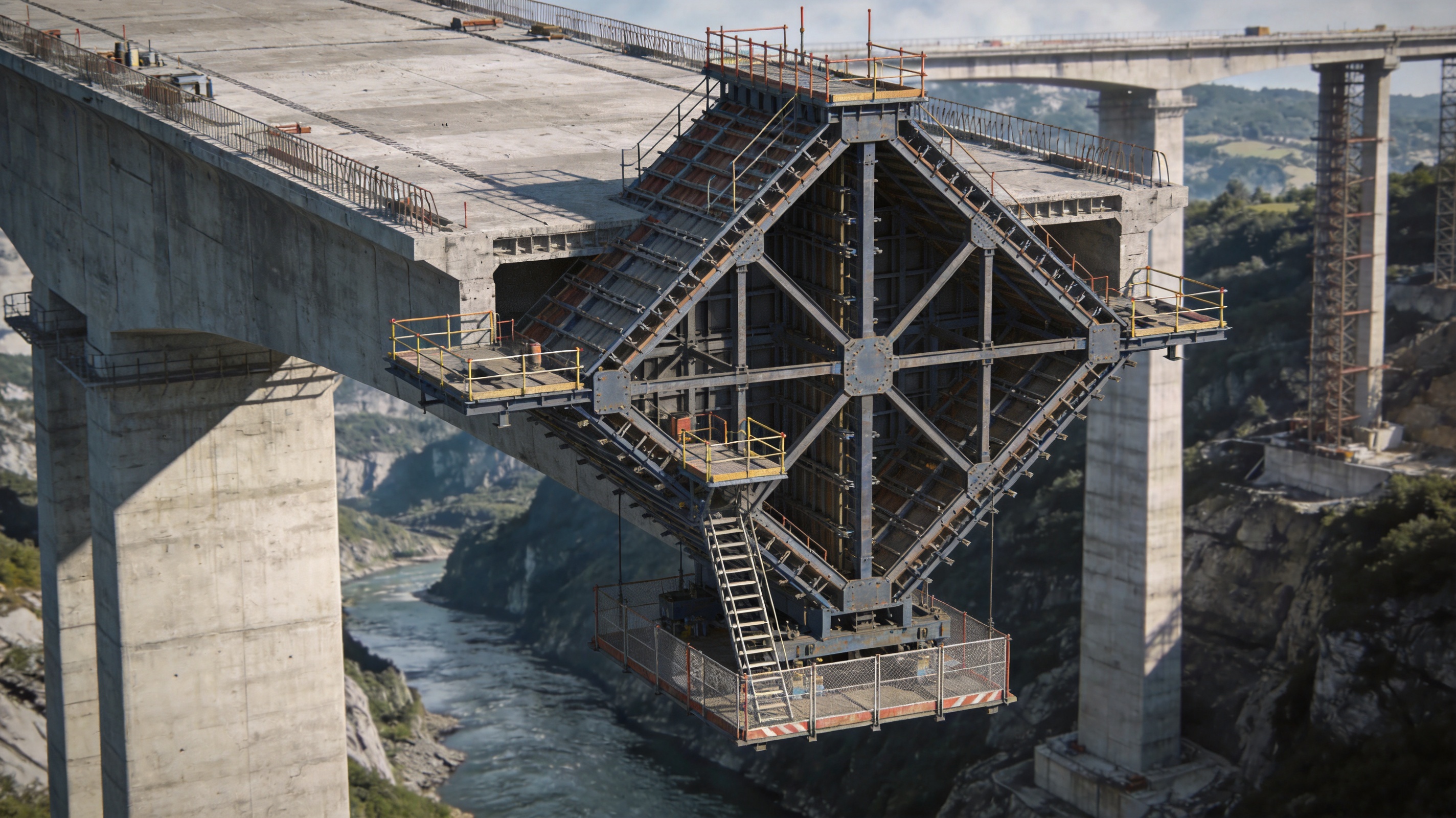
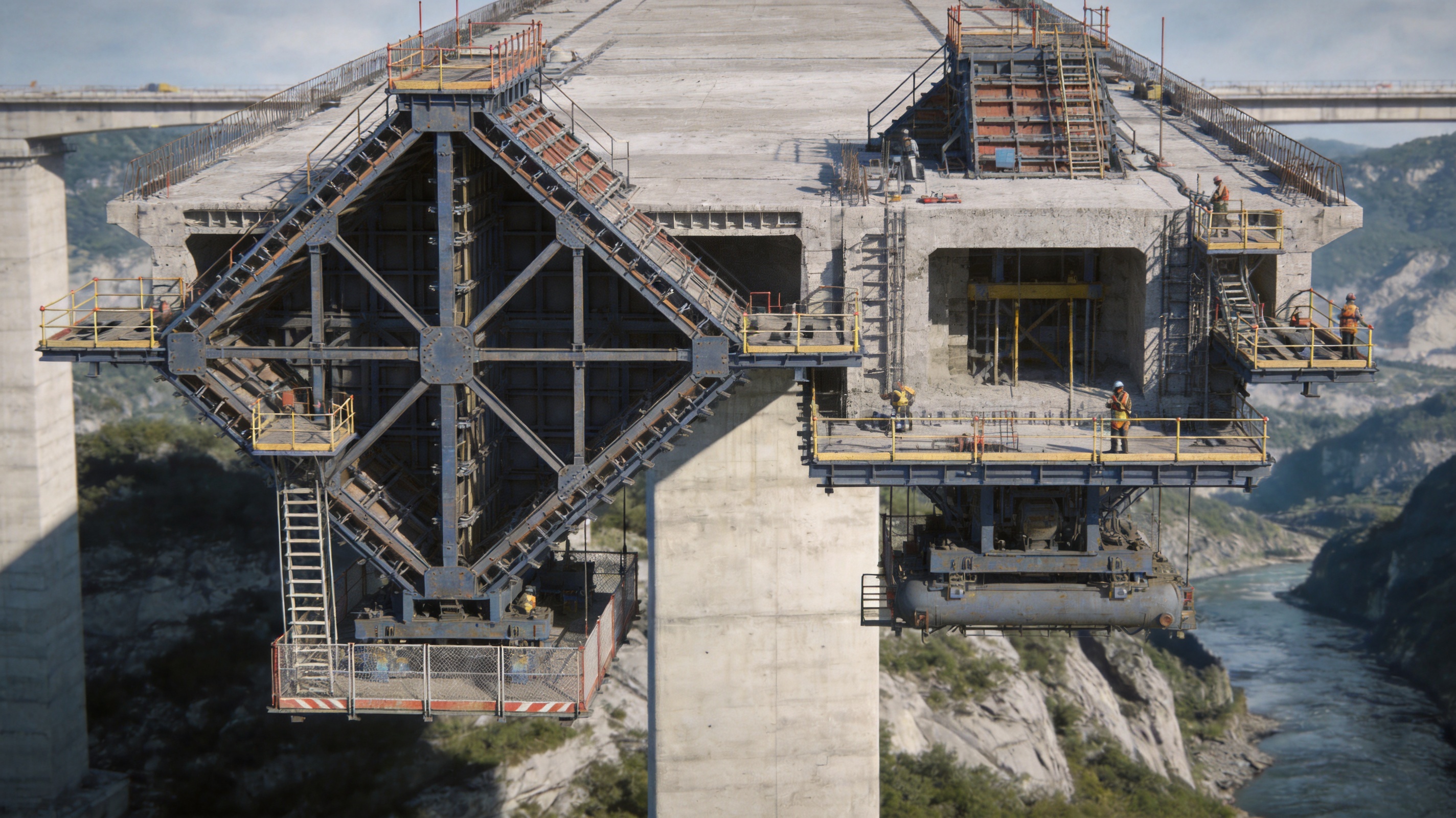
The Diamond Form Traveler is designed for these demanding conditions. Its core load-bearing structure has a rhombus-shaped configuration, giving the system a strong and efficient geometric arrangement. This design provides high rigidity while keeping the equipment relatively lightweight. As a result, the traveler can support substantial construction loads without imposing unnecessary additional stress on the bridge’s main beam or previously completed segments.
The system is intended for balanced cantilever construction, a widely used method for building bridge decks over rivers, railways, roads, deep valleys, and other areas where ground-based falsework is difficult or impossible. By supporting the formwork and fresh concrete at the end of a completed segment, the form traveler allows engineers to cast successive sections while maintaining a controlled construction sequence. Once the concrete reaches the required strength, the traveler can be released and moved forward to the next position.
Compared with conventional traveler arrangements, the diamond-shaped structure offers a favorable balance between stiffness, weight, working space, and adaptability. Its geometry can distribute forces through an organized load-bearing path, reduce excessive deformation, and maintain formwork stability during concrete placement. The result is a construction system suited to large-span, high-load, and complex-stress box girder projects.
What Is a Diamond Form Traveler?
A form traveler is a movable steel framework used to support formwork during the segmental construction of a bridge deck. In balanced cantilever construction, bridge segments are cast progressively from a pier toward the center of a span. The traveler carries the external formwork, working platforms, access systems, adjustment mechanisms, and other temporary components required to produce one segment at a time.
The Diamond Form Traveler receives its name from the rhombus-shaped main load-bearing structure. This configuration is not merely an aesthetic variation. The geometry is intended to create a compact and rigid structural system with efficient force transfer. A rhombus or diamond arrangement can connect upper and lower structural members through inclined components, forming a stable frame that resists vertical loads, horizontal forces, torsional effects, and construction-stage disturbances.
During operation, the traveler is anchored or supported on the completed bridge segment. It carries the formwork for the next segment and maintains the required geometry while concrete is placed and cured. After the segment has gained sufficient strength, the system is released from its working position, advanced by a controlled movement system, and repositioned for the next pour.
The equipment must work in coordination with reinforcement installation, prestressing ducts, embedded components, concrete delivery, inspection, curing, stressing, and formwork adjustment. For this reason, a successful traveler is not judged only by its steel frame. Its performance also depends on fabrication accuracy, connection quality, movement control, safety protection, and the supplier’s ability to provide engineering support.
Why the Rhombus-Shaped Structure Matters
The main advantage of a diamond configuration is its ability to achieve high structural stiffness without relying on excessive quantities of steel. A well-designed rhombus-shaped frame creates triangular and inclined load paths that help resist deformation. This is important because even small deflections in the formwork can affect the elevation, alignment, dimensions, and surface quality of a newly cast bridge segment.
When concrete is poured, the traveler is exposed to significant temporary loads. These include the weight of fresh concrete, reinforcement, form panels, workers, tools, equipment, construction materials, vibration effects, wind, and possible unbalanced loading. The main frame must remain stable while these loads change during the casting process. A rigid configuration helps limit displacement and maintains a more predictable relationship between the traveler and the permanent bridge structure.
The diamond structure also helps create an efficient balance between the upper and lower parts of the traveler. Depending on the bridge design and project requirements, the system can be arranged to provide sufficient clearance for reinforcement work, inspection, concrete placement, and access. This makes the equipment suitable for a wide range of box girder dimensions and construction sequences.
Another benefit is the potential reduction in self-weight. A traveler that is unnecessarily heavy increases the temporary load transferred to the bridge. Excessive self-weight may require larger anchorage systems, stronger temporary supports, additional reinforcement checks, and more complicated forward movement. By using an efficient structural form, the Diamond Form Traveler seeks to provide the required capacity while minimizing avoidable weight.
Core Performance Advantages
High Overall Rigidity
Overall rigidity is one of the most important performance characteristics of a form traveler. The traveler must maintain its shape under changing construction loads and must not experience excessive sagging, twisting, or lateral movement. The diamond-shaped load-bearing frame is designed to provide a stiff structural arrangement that supports stable formwork positioning.
High rigidity helps control the geometry of each segment. It can reduce unwanted changes in formwork elevation and improve the consistency of the deck profile. This is particularly valuable in long-span construction, where small errors repeated over many segments can accumulate into significant alignment problems.
A rigid traveler also supports more controlled adjustment. When the formwork is positioned before casting, engineers can apply measured corrections for permanent deformation, construction tolerances, and expected structural behavior. If the frame is too flexible, adjustment becomes less predictable because the system may continue to deform significantly when reinforcement, concrete, or equipment loads are added.
Low Self-Weight
Low self-weight is a major advantage in balanced cantilever construction. Every additional kilogram placed at the end of a cantilever creates an effect that must be considered in the bridge’s temporary and permanent design. A lightweight traveler reduces the additional moment applied to the main beam and may simplify the anchorage and support arrangement.
Reduced weight can also make installation, dismantling, transportation, and forward movement more efficient. Smaller lifting equipment may be sufficient for certain assembly operations, while fewer workers and less time may be required for handling individual components. The exact lifting plan always depends on the project, but an efficiently designed traveler generally provides greater logistical flexibility.
Low self-weight does not mean reduced safety or insufficient capacity. The objective is to optimize the relationship between weight, stiffness, load capacity, stability, and serviceability. A properly engineered system uses structural geometry, carefully selected steel sections, accurate connections, and appropriate reinforcement at critical points to achieve this balance.
Adaptability to Irregular Beam Cross-Sections
Bridge geometry is not always uniform. Some projects include variable-depth box girders, tapered sections, curved alignments, nonstandard web arrangements, changing deck widths, or special pier zones. A traveler designed only for one regular cross-section may require extensive modification or become unsuitable when the bridge geometry changes.
The Diamond Form Traveler is intended to adapt to various irregular beam cross-sections through coordinated adjustment and project-specific configuration. The formwork and support arrangements can be planned around the actual structural drawings, allowing the traveler to accommodate differences in width, depth, slope, and local detailing.
This adaptability is especially useful near piers, expansion zones, span transitions, closure segments, and sections where the box girder changes shape. It can reduce the need to replace the entire traveler when the project includes several related but nonidentical cross-sections.
Precise Synchronous Forward Movement
The forward movement of a form traveler must be controlled carefully. If the traveler advances unevenly, the frame may become skewed, connections may experience unintended forces, and the formwork may no longer align with the bridge centerline. Uneven movement can also increase the risk of contact with concrete edges, reinforcement, anchorage components, or temporary structures.
Precise synchronous movement allows the traveler’s main support points to advance in a coordinated manner. The movement process can be managed according to the project’s method statement, with checks for level, transverse position, longitudinal position, and anchorage condition. Controlled movement is particularly important for wide decks, long travelers, and construction environments with limited access.
Synchronization also contributes to operational efficiency. A predictable movement sequence makes it easier to plan labor, crane use, inspection, formwork adjustment, and the next casting operation. When the traveler can be advanced smoothly and repositioned accurately, the construction cycle becomes more consistent.
Comprehensive Safety Protection
Bridge construction often takes place at significant heights and above active roads, railways, waterways, or occupied areas. A form traveler must therefore include appropriate safety provisions for workers, equipment, and the bridge structure. These provisions may include working platforms, guardrails, toe boards, ladders, access passages, protective screens, anti-fall measures, anchorage checks, and controlled movement procedures.
A comprehensive safety protection system helps separate work areas from exposed edges and reduces the risk of falls during reinforcement, formwork, inspection, concrete placement, and dismantling. The exact protection arrangement should be adapted to the project environment, local regulations, wind conditions, access requirements, and lifting plan.
Safety is also related to structural monitoring and operating discipline. The traveler should be inspected before each movement and casting cycle. Connection bolts, pins, hydraulic components, support shoes, anchorages, welding areas, working platforms, and form panels should be checked according to an approved inspection plan. A robust design provides the foundation, but safe operation depends on proper procedures and trained personnel.
Application in Balanced Cantilever Construction
Balanced cantilever construction is commonly selected when conventional ground support is impractical. It can reduce disruption to traffic, waterways, railway operations, environmentally sensitive areas, and steep terrain. Instead of building a continuous falsework system from the ground, contractors construct the bridge from piers, extending the deck segment by segment.
In a typical sequence, a pier table or initial segment is completed first. The traveler is then assembled and installed on the completed structure. Formwork is adjusted to the required geometry, reinforcement and ducts are installed, and the next segment is cast. After curing and the completion of required stressing or related operations, the traveler is released and moved forward. The process is repeated until the cantilever reaches the closure zone or the next construction stage.
Balanced construction means that segments are generally built in pairs on opposite sides of a pier. This arrangement helps balance the moments and reactions applied to the pier and foundation. The traveler must therefore perform reliably on both sides of the pier, often under demanding restrictions on unbalanced loads and movement timing.
The Diamond Form Traveler supports this method by providing a movable, rigid, and adjustable platform for the formwork. Its low self-weight helps reduce temporary effects on the bridge, while its structural stiffness supports accurate casting. The equipment can also be configured for the specific dimensions and construction sequence of the project.
Comparison with Conventional Traveler Systems
Different types of form travelers are available for bridge construction, including overhead systems, underslung systems, self-launching arrangements, and customized frames. The most suitable choice depends on bridge geometry, access conditions, segment weight, pier arrangement, construction speed, and available lifting equipment.
Compared with heavier conventional frames, the diamond configuration can offer a more favorable strength-to-weight relationship. A bulky frame may provide adequate capacity but can increase the load on the bridge and make movement more difficult. The Diamond Form Traveler focuses on efficient load-bearing geometry, helping limit unnecessary material while maintaining high rigidity.
Compared with systems designed only for standardized cross-sections, the diamond traveler is better suited to projects where the box girder shape changes. Adjustable formwork and a project-oriented configuration can provide greater flexibility for irregular sections, variable dimensions, and special structural zones.
Compared with systems that depend heavily on manual repositioning, a traveler with precise synchronous forward movement can improve control and repeatability. Coordinated movement reduces the likelihood of skewing and helps maintain alignment during relocation.
Compared with equipment that treats safety as an add-on, a traveler developed with integrated working platforms and protection systems can provide a more complete construction solution. Safe access, edge protection, anti-fall arrangements, and movement control should be considered from the beginning of the design process rather than added after fabrication.
| Evaluation Factor | Diamond Form Traveler | Potential Limitation of Basic Conventional Systems | Project Benefit |
|---|
| Structural configuration | Rhombus-shaped main load-bearing frame | May use heavier or less efficient frame arrangements | Efficient force transfer and high rigidity |
| Self-weight | Designed to minimize unnecessary temporary load | Heavy frames increase cantilever effects | Reduced additional stress on the main beam |
| Cross-section adaptability | Can be configured for irregular beam profiles | Limited systems may require extensive modification | Greater suitability for complex bridge geometry |
| Forward movement | Precise synchronous advancement | Uneven manual movement may cause misalignment | Improved positioning and construction-cycle control |
| Safety integration | Comprehensive protection can be incorporated | Protection may be incomplete or added later | Safer access and working conditions |
| Engineering support | Can be developed around project drawings and methods | Standard equipment may offer limited customization | Better alignment with project-specific requirements |
Engineering Design Considerations
Load Assessment
Before fabrication, the traveler should be evaluated for all relevant construction-stage loads. These may include the weight of the traveler, formwork, fresh concrete, reinforcement, embedded items, workers, equipment, stored materials, wind, impact, vibration, and possible temporary imbalance. Load combinations must be established according to the project’s design criteria and applicable standards.
The analysis should consider both vertical and horizontal effects. Torsion can become important when the traveler is exposed to uneven loading or when the deck has a curved alignment. Local stresses around support shoes, anchorages, lifting points, connection plates, and hydraulic attachments also require attention.
Deflection and Geometry Control
The traveler must be sufficiently stiff to limit deflection to acceptable values. However, bridge construction does not depend on zero deflection. Engineers normally establish controlled adjustments to account for predicted deformation, concrete weight, prestressing effects, temperature, and the behavior of previously cast segments.
Survey control is essential. Before each pour, the formwork position should be checked in three dimensions. Important measurements may include deck elevation, transverse slope, centerline, web position, segment length, edge alignment, and local dimensions. After concrete placement, the measured results can be compared with the design model to improve subsequent adjustments.
Connection and Anchorage Design
Connections transfer forces between the traveler’s structural members and allow assembly, adjustment, inspection, and dismantling. Bolted, pinned, welded, or combined connection arrangements may be used according to the design. Each connection must be compatible with the intended load path and operating sequence.
Anchorage is equally important. The traveler must remain securely connected to the completed bridge segment while the next segment is being cast. Anchor rods, support beams, hanging systems, brackets, shoes, and temporary reinforcement must be checked for strength, stability, fatigue-related effects, and installation accuracy.
Connection areas should be accessible for inspection and protected against damage during repeated movement. Clear identification of components can help reduce assembly errors, particularly when several similar members are installed on both sides of a pier.
Advanced Manufacturing Processes
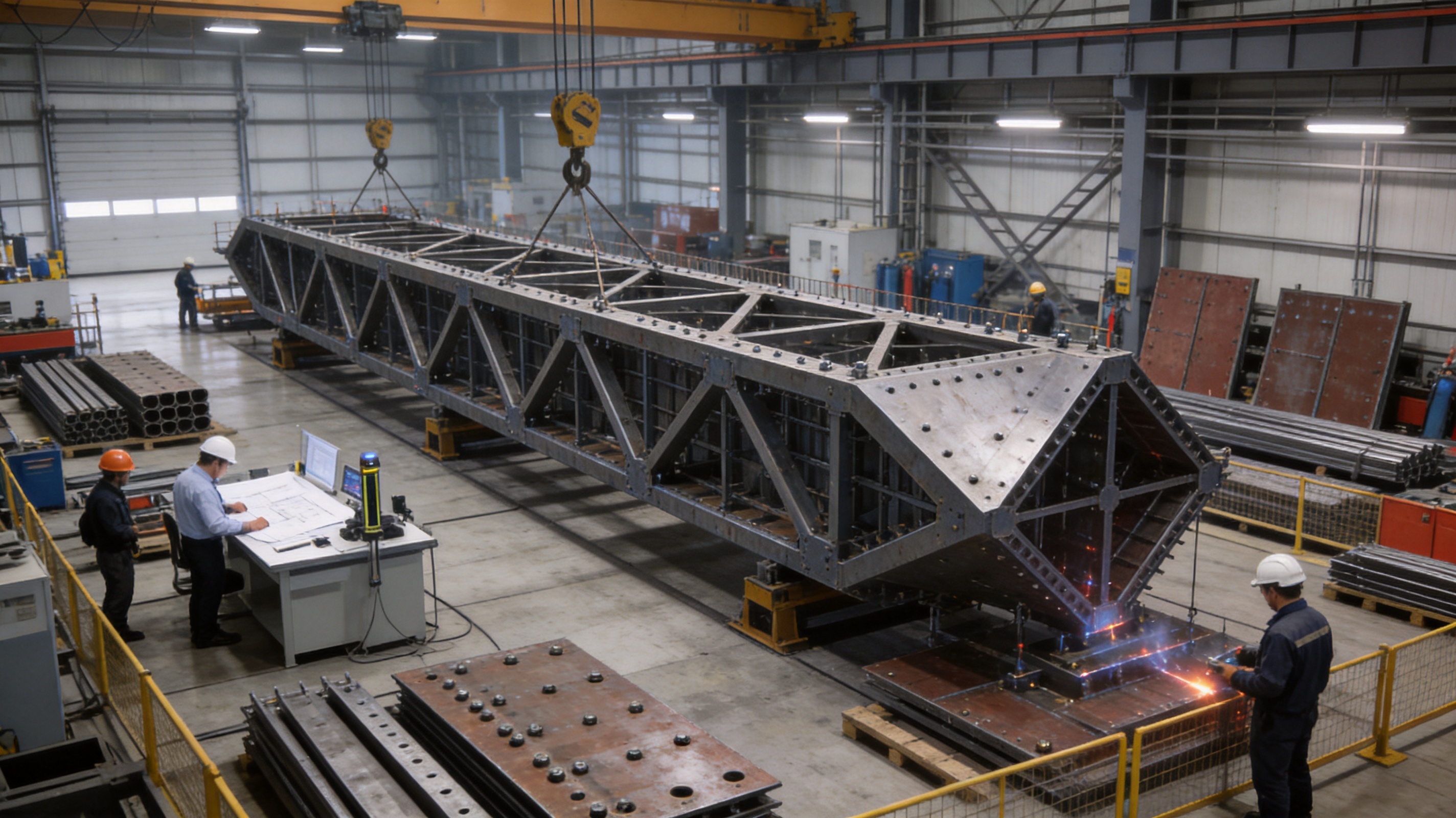
The performance of a form traveler depends heavily on manufacturing quality. A structurally sound concept can fail to deliver its intended advantages if the steel members are inaccurately cut, poorly welded, inadequately protected, or assembled without dimensional control. For this reason, advanced manufacturing processes are an essential part of the product’s value.
Engineering Development from Project Data
Manufacturing begins with the collection and review of project information. Relevant data may include bridge drawings, segment dimensions, design loads, pier spacing, construction sequence, working elevation, access limitations, environmental conditions, required casting cycle, and local safety rules.
Engineers can use this information to determine the traveler’s structural arrangement, support locations, formwork configuration, movement method, adjustment range, access systems, and protection measures. A project-specific design reduces the risk of treating complex bridge construction as a one-size-fits-all application.
Digital modeling and detailed fabrication drawings help coordinate the main frame, secondary members, form panels, hydraulic equipment, platforms, ladders, guardrails, and anchorage components. Interference checks can identify potential conflicts before steel cutting begins.
Material Selection and Traceability
Appropriate structural steel must be selected according to the design requirements, fabrication method, operating environment, and applicable standards. Material certificates, heat numbers, inspection records, and delivery documents should be organized to support traceability.
Traceability is useful throughout the product life cycle. It helps link each major component to its material source, fabrication records, inspection results, and final assembly position. This is particularly important for equipment that may be leased, reused, modified, or transferred between projects.
Precision Cutting and Preparation
Accurate cutting and edge preparation contribute directly to assembly quality. CNC cutting, controlled drilling, and calibrated measurement equipment can improve dimensional consistency for plates, beams, connection components, stiffeners, and brackets.
Accurate holes are especially important for bolted and pinned connections. Poor alignment may create installation difficulties, force workers to enlarge holes on site, or introduce unintended stresses. Controlled fabrication reduces these risks and helps ensure that the traveler can be assembled according to the approved drawings.
Controlled Welding
Welding quality affects the strength, stiffness, durability, and fatigue resistance of the traveler. Welding procedures should be established for the relevant steel grades, plate thicknesses, joint types, and workshop conditions. Qualified personnel and appropriate inspection methods are required to ensure that welds meet the specified criteria.
Important controls may include pre-welding preparation, fit-up inspection, welding sequence, heat input management, distortion control, visual examination, and nondestructive testing where required. Welded assemblies should also be checked for straightness, squareness, and dimensional accuracy after cooling.
Controlling distortion is particularly important for long frame members and large support assemblies. Excessive distortion can affect the traveler’s geometry, connection alignment, formwork position, and movement performance.
Trial Assembly and Dimensional Verification
Before delivery, major traveler components can be assembled in the workshop or checked through controlled fit-up procedures. Trial assembly helps verify that structural members, connection plates, pins, platforms, hydraulic components, and formwork interfaces fit together as intended.
Dimensional verification may include checking overall length, width, height, diagonal dimensions, support spacing, connection positions, and movement clearances. These checks help identify problems before the equipment reaches the construction site, where corrections are usually more expensive and time-consuming.
Surface Treatment and Corrosion Protection
Steel construction equipment is exposed to rain, humidity, concrete slurry, dust, temperature changes, and repeated handling. Proper surface preparation and protective coating can help improve durability and reduce maintenance requirements.
Surface treatment may include cleaning, removal of rust and contaminants, primer application, intermediate coating, and finish coating. Coating selection should consider the project environment, expected service period, transport conditions, and whether the equipment will be repeatedly assembled and dismantled.
Areas subject to abrasion, impact, or contact with supports may require special attention. Damaged coating should be repaired promptly, especially after transportation or site assembly.
Manufacturing and Quality Management Strengths
A capable supplier must combine engineering knowledge, metal fabrication experience, inspection discipline, and field support. The manufacturer of the Diamond Form Traveler operates within a broader business focused on the design, manufacture, erection, and leasing of Bailey bridges, launching gantry systems, hanging baskets, pier formwork, and other steel formwork products.
This product range is valuable because many bridge projects use several types of temporary steel equipment at different stages. Experience with Bailey bridge components, launching systems, hanging baskets, and pier formwork provides a broader understanding of temporary works, structural connections, erection logistics, and site conditions.
The company was established in 2017 and is located in Shangdang Town Industrial Park, Dantu District, Zhenjiang City, Jiangsu Province, China. Its location near major transport infrastructure supports the movement of steel components, finished systems, and project equipment. Access to road, canal, and high-speed rail networks can assist with domestic and international logistics planning.
Integrated Design and Fabrication Capability
Integrated design and fabrication can shorten communication paths between engineering and production teams. When the same organization is responsible for interpreting drawings, preparing fabrication documents, manufacturing components, and supporting erection, design details can be reviewed with practical assembly considerations in mind.
This approach can help identify issues such as limited access for bolt tightening, insufficient clearance for formwork adjustment, difficult lifting points, or conflicts between platforms and reinforcement. Early coordination reduces the likelihood of costly site modifications.
Customized Engineering
Bridge contractors frequently require equipment adapted to a specific project rather than a generic catalog product. Customization may involve traveler dimensions, casting length, segment weight, box girder depth, deck width, cross-sectional transitions, working platforms, access arrangements, movement systems, or local safety requirements.
The company provides customized fabrication, design and system planning, technical support, and quality management. These services allow the traveler to be developed around the actual bridge construction method. Customization should be supported by engineering calculations, drawings, inspection procedures, and a clear division of responsibilities between the equipment supplier and the project contractor.
Experience with Related Steel Structures
Bailey steel bridges and bridge erection systems require reliable connections, standardized components, interchangeability, load awareness, and efficient site assembly. These principles are also relevant to form travelers. Knowledge of modular steel structures can support the development of equipment that is practical to transport, assemble, inspect, modify, and reuse.
The company’s product portfolio includes Type 321 Bailey truss sections, HD200 or Type 200 Bailey truss sections, triangular and diamond hanging baskets, bridge steel formwork, and related engineered steel structures. Such experience strengthens its ability to understand the complete temporary works environment rather than viewing the traveler as an isolated product.
Operational Workflow on a Bridge Project
1. Project Review
The process begins with a review of bridge drawings, construction organization, geotechnical and environmental conditions, segment dimensions, load requirements, and the planned casting cycle. The supplier and contractor should confirm whether the traveler will be used on straight or curved alignment, uniform or variable cross-section, and regular or special pier zones.
2. System Planning
System planning determines the traveler’s main frame, formwork arrangement, anchorage points, support shoes, movement equipment, access platforms, safety protection, lifting points, and transportation breakdown. The movement sequence should be coordinated with concrete strength development, prestressing operations, and site access.
3. Fabrication and Inspection
After design approval, steel components are cut, drilled, welded, assembled, inspected, coated, and identified. Quality records should be maintained for materials, welds, dimensions, coating, and final checks.
4. Delivery and Site Assembly
The traveler is transported in manageable modules according to the approved lifting plan. Site assembly should be carried out on a stable and prepared working area where possible. Components should be checked against packing lists and assembly drawings before installation.
5. Installation and Commissioning
Once assembled, the traveler is installed on the completed bridge segment and connected to its anchorage system. The formwork is then adjusted to the design geometry. Before the first concrete pour, the contractor should complete a commissioning inspection covering connections, support conditions, hydraulic equipment, access systems, safety protection, and survey alignment.
6. Repeated Casting Cycle
The normal cycle includes reinforcement installation, duct and embedded-item placement, formwork inspection, concrete placement, curing, stressing or related operations, form release, traveler movement, repositioning, and final survey. Clear checklists help ensure that no critical step is omitted.
7. Dismantling or Relocation
After the cantilever construction stage is complete, the traveler may be dismantled, moved to another pier, stored for later use, or returned to the supplier. A modular design can simplify this process and support repeated use on future projects.
Safety and Maintenance Requirements
Safe operation requires more than a strong frame. The project team should establish a written operating procedure that defines responsibilities, inspection intervals, permitted weather conditions, movement controls, communication methods, emergency actions, and authorization requirements.
Before each movement, workers should confirm that the traveler is released from all temporary obstructions and that no personnel, tools, reinforcement, cables, or formwork components remain in unsafe positions. The support and anchorage system must be ready to receive the traveler during and after advancement.
Before each concrete pour, the formwork should be checked for geometry, tightness, cleanliness, stability, and connection condition. Working platforms should be free of unnecessary materials, and guardrails and toe boards should be complete. Hydraulic systems should be inspected for leakage, hose damage, pressure abnormalities, and secure attachment.
Routine maintenance should include cleaning concrete residue, lubricating moving parts, checking pins and bolts, inspecting welds and high-stress areas, repairing damaged coatings, and confirming the condition of access systems. Components showing deformation, cracking, excessive wear, or corrosion should be evaluated before continued use.
Weather conditions should also be considered. Strong wind, heavy rain, lightning, flooding, extreme temperatures, or poor visibility may affect movement and working-at-height operations. The project’s safety manager and engineering team should define conditions under which operations must be paused.
Benefits for Contractors and Project Owners
For contractors, the Diamond Form Traveler can support a more predictable construction cycle. High rigidity helps stabilize the formwork, while precise movement contributes to repeatable positioning. Low self-weight may simplify temporary load management and reduce the difficulty of handling the equipment.
For project owners, a reliable traveler can contribute to improved structural quality, reduced construction risk, and better schedule control. Segmental construction is highly repetitive, so equipment performance has a cumulative impact. A small improvement in each cycle may produce a significant benefit over the full bridge length.
For engineering companies, the system provides a platform that can be developed around complex structural geometry. The ability to accommodate irregular cross-sections can reduce the need for separate temporary systems at every transition zone.
For governments and infrastructure agencies, balanced cantilever construction with a suitable traveler can reduce the need for extensive ground-based supports. This may be beneficial when construction takes place over active transportation routes, environmentally sensitive corridors, urban areas, or navigable waterways.
Inspection Criteria Before Procurement
Buyers should evaluate more than the initial equipment price. The traveler’s value depends on capacity, engineering support, fabrication quality, safety, adaptability, transport, erection, maintenance, and potential reuse.
Important questions include whether the supplier can provide structural calculations, fabrication drawings, operating instructions, inspection documentation, material records, and site support. Buyers should also confirm the intended casting length, maximum segment load, adjustment range, movement method, anchor arrangement, and compatibility with the project’s box girder geometry.
The supplier’s production capability should be assessed through its experience with large welded structures, steel formwork, modular bridge systems, quality management, and project delivery. A supplier with related products may be better equipped to coordinate temporary works across different construction stages.
It is also useful to clarify the scope of supply. This may include the main traveler frame, formwork panels, hydraulic or mechanical movement components, platforms, ladders, guardrails, safety screens, anchorage accessories, bolts, pins, drawings, inspection records, packaging, transportation support, site installation, commissioning, and operator training.
Typical Technical Information Required for Customization
To develop a suitable traveler, the supplier normally needs detailed information about the bridge and its construction method. The following data can improve the accuracy of design and quotation.
| Information Category | Examples of Required Data | Purpose |
|---|
| Bridge geometry | Span arrangement, alignment, deck width, box girder depth, web thickness, curvature | Determines traveler dimensions and formwork arrangement |
| Segment parameters | Segment length, concrete volume, reinforcement quantity, maximum segment weight | Establishes design loads and casting-cycle requirements |
| Construction method | Balanced cantilever sequence, stressing order, curing period, closure method | Coordinates support, release, and movement operations |
| Pier conditions | Pier table dimensions, anchorage zones, access restrictions, pier spacing | Defines installation and temporary support requirements |
| Site environment | Wind, temperature, river or road clearance, railway restrictions, working height | Supports safety and operational planning |
| Logistics | Crane capacity, transportation limits, assembly area, delivery route | Determines modular breakdown and lifting arrangements |
| Applicable standards | Structural, welding, coating, lifting, and workplace safety requirements | Guides design verification and quality control |
Quality, Reliability, and Long-Term Value
A form traveler is a temporary structure, but it must perform reliably through repeated construction cycles. Its long-term value is determined by its ability to maintain accuracy, resist wear, remain safe, and be reused or adapted where appropriate.
Durable materials and protective coatings can reduce deterioration during storage and operation. Clear component identification can simplify future assembly. Replaceable wear parts and accessible inspection points can reduce downtime. A modular arrangement can also allow certain components to be modified when bridge dimensions or construction requirements change.
Quality management should continue after delivery. Field feedback from the first casting cycle can be reviewed to identify adjustment improvements, access issues, or maintenance needs. A supplier that provides technical support can help the contractor manage these issues before they affect the overall schedule.
The company’s commitment to design, manufacturing, erection, leasing, technical support, and quality management reflects an approach that covers the complete equipment life cycle. This is particularly useful for international contractors that may require both product supply and engineering coordination.
Why Choose a Specialized Manufacturer?
Specialized manufacturing experience matters because bridge form travelers operate at the intersection of structural engineering, steel fabrication, temporary works, formwork, lifting, access, and construction management. A supplier focused only on general steel products may not fully understand the repeated movement, anchorage, alignment, and segment-casting requirements of a cantilever traveler.
A specialized manufacturer can contribute practical knowledge during the early planning stage. It can help review whether the proposed movement system is compatible with the site, whether the traveler can pass through constrained areas, whether the formwork permits reinforcement installation, and whether the equipment can be transported and assembled efficiently.
Experience with Bailey bridges and other modular steel systems can also support efficient component design. Standardized connection concepts, interchangeable parts, clear marking, and manageable modules can improve site productivity without sacrificing project-specific engineering.
For international customers, communication and documentation are equally important. Engineering drawings, packing lists, inspection records, installation manuals, and operating procedures should be prepared clearly. The supplier’s ability to support OEM and ODM requirements can help contractors integrate the traveler into their own project systems.
Q&A: Diamond Form Traveler
What type of bridge construction uses a Diamond Form Traveler?
The system is primarily intended for balanced cantilever construction of prestressed concrete box girder bridges. It can be used for large-span viaducts, elevated highways, railway bridges, urban overpasses, and other structures where ground-based falsework is difficult or undesirable.
What is the main structural feature of the traveler?
The core load-bearing structure is rhombus-shaped. This diamond configuration provides a rigid and efficient frame that supports the formwork and construction loads while helping minimize unnecessary self-weight.
How does low self-weight benefit the bridge?
A lighter traveler reduces the additional temporary load and moment applied to the cantilevered bridge segment. It may also simplify anchorage design, lifting, transportation, assembly, and forward movement. The final suitability must be confirmed through project-specific structural analysis.
Can the traveler accommodate irregular box girder sections?
Yes. The traveler can be configured and adjusted for various irregular beam cross-sections, including changes in width, depth, slope, and local structural geometry. Detailed bridge drawings are required to develop the correct arrangement.
Why is synchronous movement important?
Synchronous movement keeps the traveler’s support points advancing in a coordinated manner. This helps prevent skewing, reduces unintended forces in the frame and connections, and improves the accuracy of the traveler’s final position.
Does the system include safety protection?
A comprehensive safety protection system can be incorporated into the traveler. Typical provisions include working platforms, guardrails, toe boards, ladders, access routes, protective screens, and anti-fall measures. The final arrangement should comply with project and local safety requirements.
Can the traveler be customized?
Yes. Customization may cover frame dimensions, casting length, formwork geometry, support locations, movement equipment, access platforms, safety systems, and component breakdown for transport. Custom design should be based on the bridge’s structural and construction data.
What manufacturing controls are important?
Important controls include material verification, dimensional cutting, accurate drilling, qualified welding, distortion control, nondestructive testing where required, trial assembly, coating inspection, component identification, and final quality documentation.
Can the manufacturer provide more than the steel frame?
Depending on the project scope, the supplier can support design and system planning, customized fabrication, erection, leasing, technical assistance, quality management, and related bridge steel products. The exact scope should be confirmed in the technical and commercial proposal.
What information should a buyer provide for a quotation?
The buyer should provide bridge geometry, segment dimensions and weights, casting sequence, pier and anchorage details, required movement method, site conditions, lifting capacity, transport limitations, applicable standards, and the expected construction schedule.
Is the traveler suitable for repeated use?
With proper inspection, maintenance, storage, and refurbishment, a steel traveler may be reused on suitable projects. Reuse depends on the condition of the components and whether the new bridge geometry and load requirements are compatible with the original design.
How does the traveler support construction quality?
Its rigidity helps maintain formwork stability, while precise adjustment and synchronous movement support accurate positioning. A controlled traveler can contribute to consistent segment geometry, improved surface quality, and more predictable construction cycles.
Conclusion
The Diamond Form Traveler is a specialized solution for the construction of complex box girder bridges using balanced cantilever methods. Its rhombus-shaped load-bearing structure provides high rigidity and efficient force transfer, while its low self-weight helps minimize additional stress on the main beam. The ability to adapt to irregular cross-sections and move forward with precise synchronization gives the system an advantage in projects where standard equipment may be too rigid, too heavy, or insufficiently flexible.
Its performance is strengthened by comprehensive safety protection, project-oriented engineering, accurate fabrication, controlled welding, dimensional verification, corrosion protection, and technical support. These features are particularly important for large-span, high-load, and complex-stress structures where temporary equipment directly affects permanent bridge quality.
A reliable form traveler should be selected as part of a complete construction system rather than as an isolated steel product. Design review, manufacturing, transport, erection, commissioning, operation, inspection, and maintenance all contribute to project success. With experience in Bailey bridges, launching gantries, hanging baskets, bridge steel formwork, and related engineered steel structures, a specialized supplier can provide the technical depth needed to support demanding bridge projects.
For contractors, governments, and engineering companies seeking a customized cantilever construction system, the Diamond Form Traveler offers a practical combination of rigidity, light weight, adaptability, movement precision, and safety-oriented design.
References
American Association of State Highway and Transportation Officials. AASHTO LRFD Bridge Construction Specifications.
American Association of State Highway and Transportation Officials. AASHTO LRFD Bridge Design Specifications.
International Federation for Structural Concrete. Model Code for Concrete Structures.
International Organization for Standardization. ISO 9001, Quality Management Systems—Requirements.
International Organization for Standardization. ISO 3834, Quality Requirements for Fusion Welding of Metallic Materials.
European Committee for Standardization. EN 1090, Execution of Steel Structures and Aluminium Structures.
European Committee for Standardization. EN 1993, Eurocode 3: Design of Steel Structures.
Precast/Prestressed Concrete Institute. Bridge Design and Construction Guidance.
National standards and project specifications governing temporary works, bridge construction, lifting operations, welding inspection, corrosion protection, and working-at-height safety.


 Français
 Español
 عربى