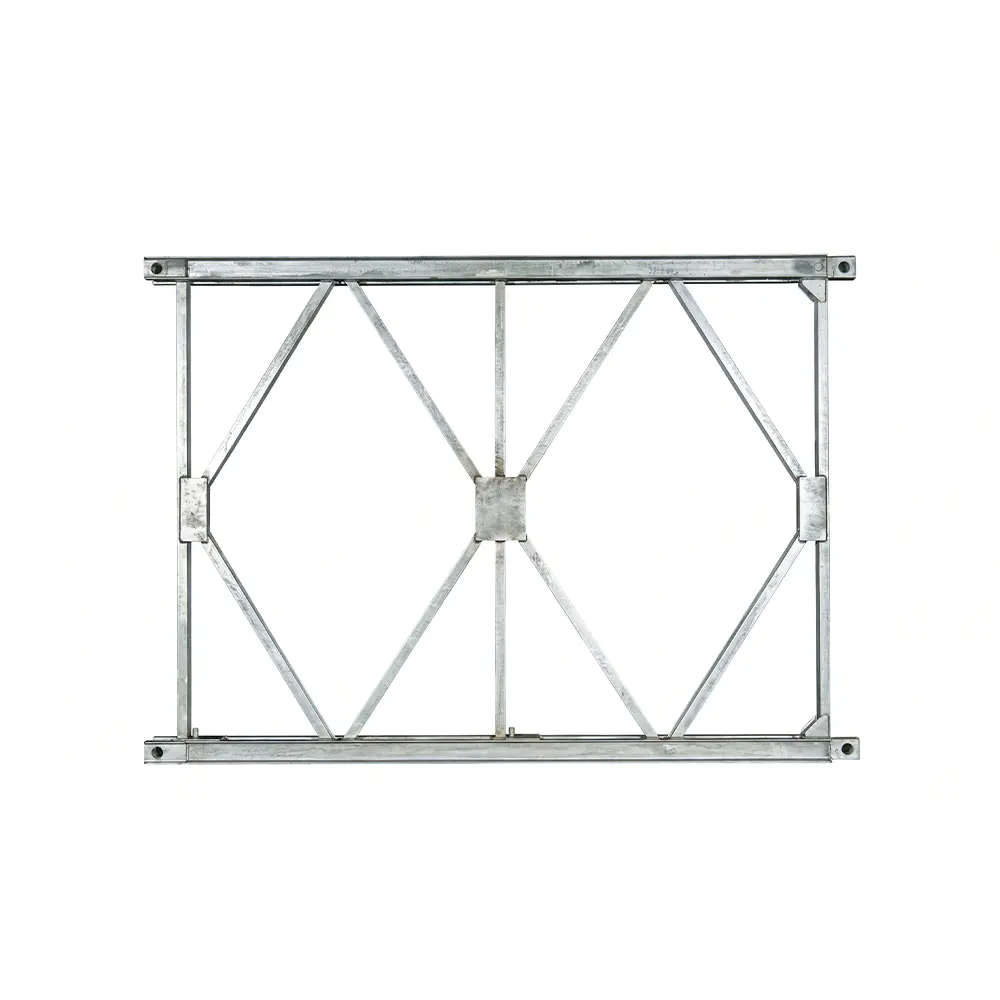
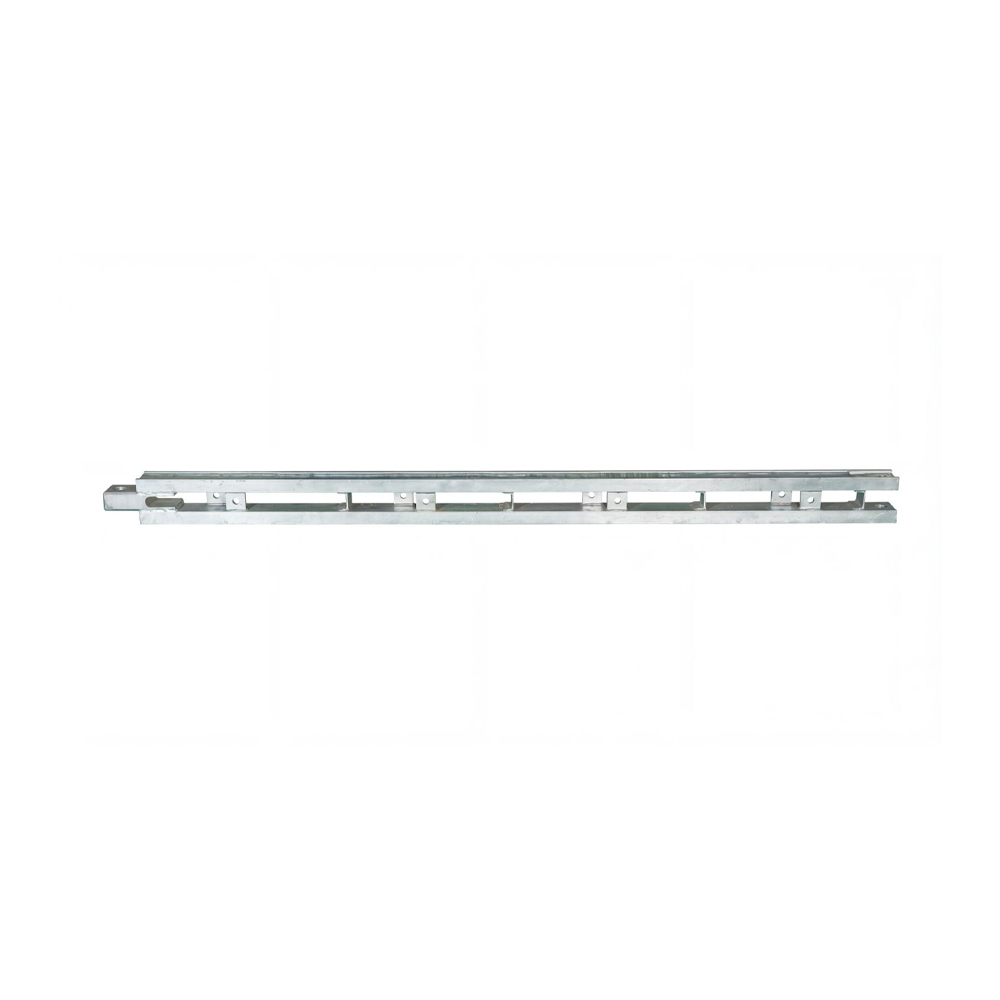
Modern bridge construction demands accuracy, speed, repeatability, and visible concrete quality. In substructure work, the pier column and cap beam are among the most important elements because they transfer superstructure loads to the foundation while also defining the visual appearance of the bridge. Pier and cap beam formwork is therefore not merely a temporary mold; it is a precision-engineered construction system that influences safety, productivity, concrete surface quality, dimensional accuracy, and project cost.
The pier and cap beam formwork described in this article is a modular steel formwork solution designed for highway bridges, railway bridges, municipal bridges, water conservancy crossings, and other transportation infrastructure projects. Its core advantages are sufficient rigidity, excellent joint sealing, reliable positioning, and flexible adaptation to circular, square, rectangular, and irregular pier or cap beam sections. When used properly, it helps contractors achieve accurate pier verticality, consistent cap beam flatness, smooth concrete surfaces after demolding, and reduced finishing work.
Compared with ordinary timber formwork, low-grade fabricated panels, or poorly sealed reusable molds, a high-quality steel pier and cap beam formwork system provides more stable geometry, better resistance to fresh concrete pressure, higher reuse value, and more predictable construction performance. It is especially suitable for standardized mass construction, high-strength concrete pouring, and projects where the appearance of exposed concrete is strictly inspected.
Product Overview
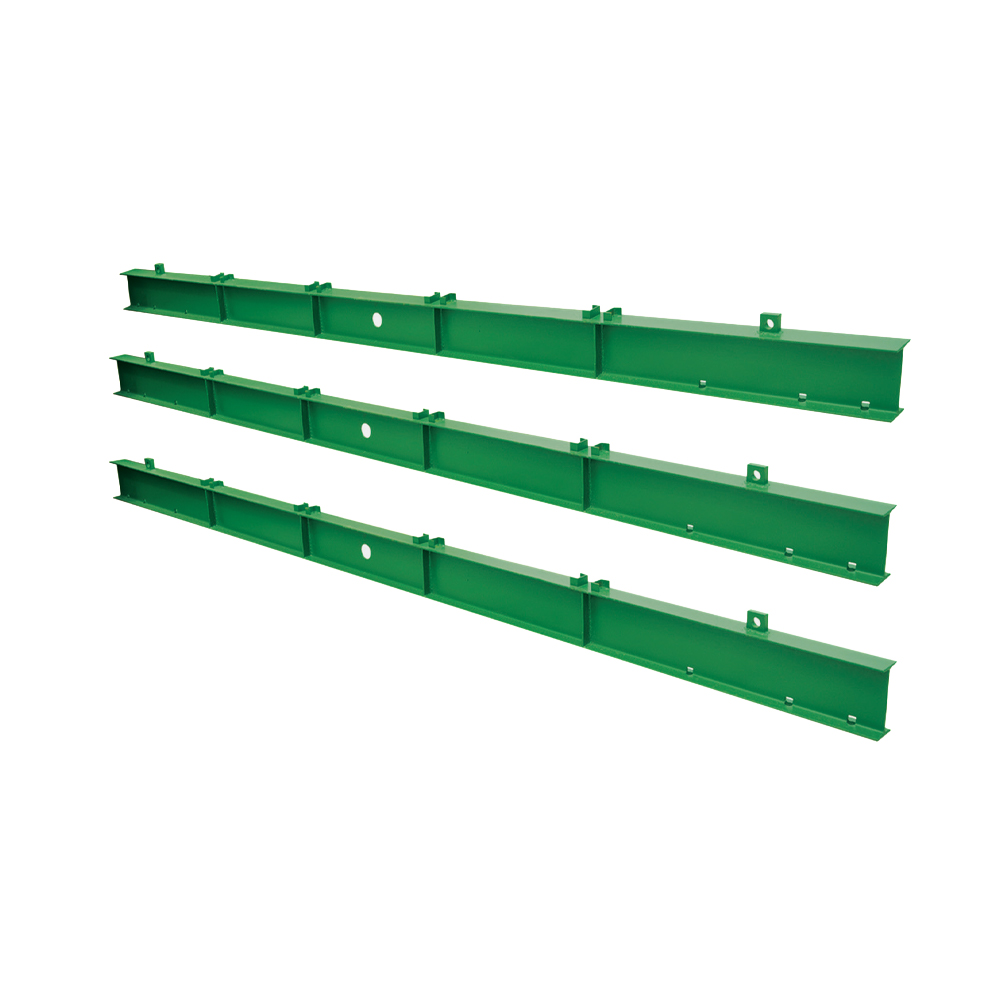
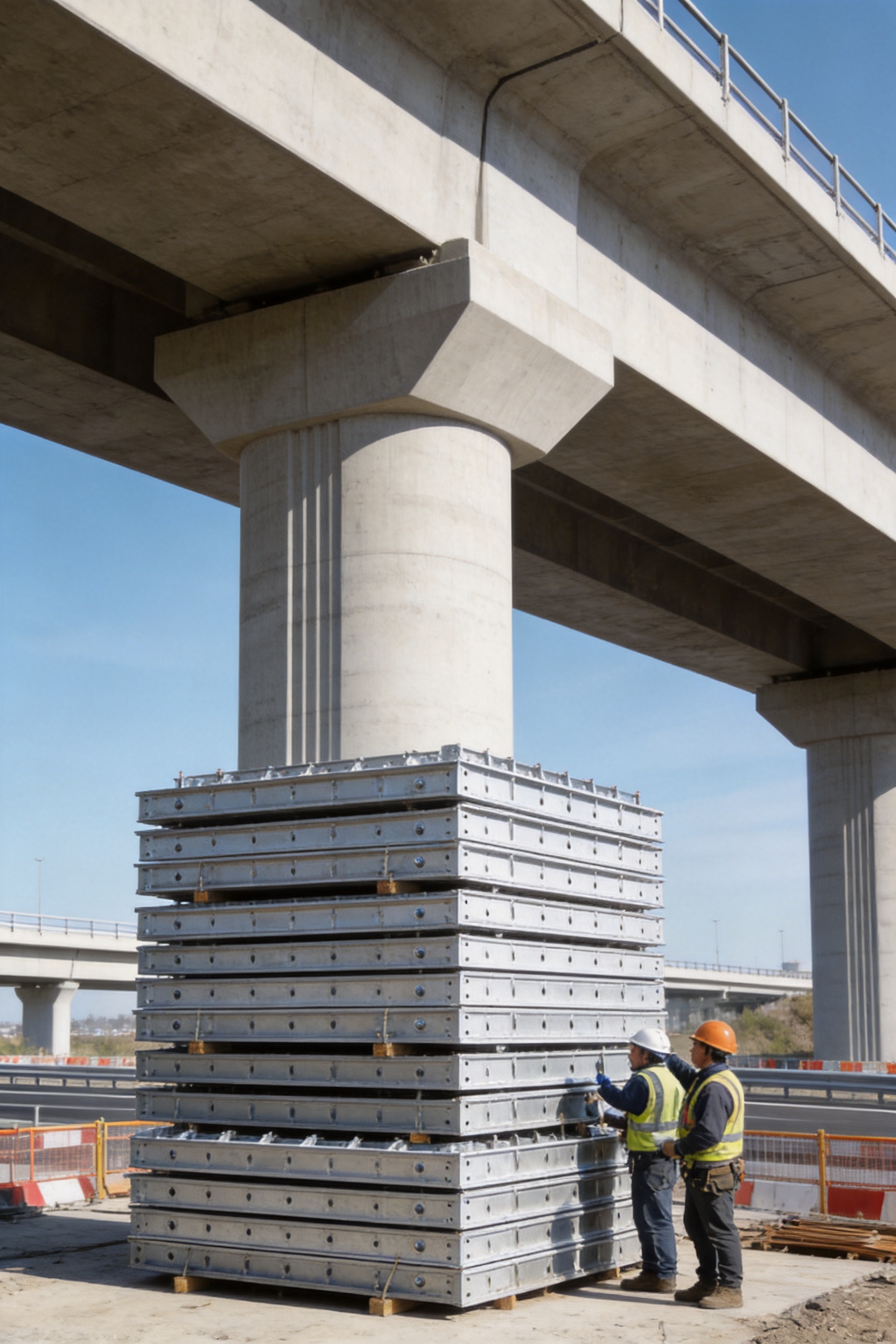
Pier and cap beam formwork is used to shape reinforced concrete bridge substructures during casting. The system normally includes face panels, stiffening ribs, walers, connection plates, bolts, positioning clips, alignment devices, working platforms, and other accessories required for safe assembly and accurate installation. It is engineered to hold wet concrete in the required shape until the concrete gains sufficient strength and the formwork can be removed.
The pier section may be circular, square, rectangular, oval, or custom-shaped according to bridge design. The cap beam section may be a simple rectangular beam, a variable-depth beam, a beam with chamfers, or an irregular cross-section designed to support bearings and superstructure loads. Because bridge projects often include repeated piers with similar dimensions, modular steel formwork can be reused multiple times, making it cost-effective over the total project cycle.
The product is designed around four practical goals: accurate geometry, smooth concrete surface, fast assembly, and long service life. These goals are achieved through steel plate fabrication, reinforced structural framing, controlled welding, precise machining, careful trial assembly, anti-corrosion surface treatment, and strict quality inspection before delivery.
Why Pier and Cap Beam Formwork Matters in Bridge Construction
Bridge substructure construction is not forgiving. A small dimensional error at the pier stage may later affect bearing installation, girder positioning, deck alignment, and overall structural performance. For this reason, contractors need formwork that can maintain shape under pressure, resist deformation during pouring, and provide reliable reference points for measurement and adjustment.
Fresh concrete exerts lateral pressure on formwork. The pressure increases with concrete density, pouring height, pouring speed, vibration intensity, temperature, and admixture selection. If the formwork is weak, the panel may bulge, the joint may leak slurry, or the finished pier may show uneven surfaces. If alignment is inaccurate, verticality may exceed tolerance, creating correction work or acceptance risk.
A well-designed steel formwork system addresses these issues through structural rigidity and tight connection details. Reinforced ribs and walers support the panel. High-strength bolts hold modules together. Positioning clips help maintain correct placement. Joint sealing details reduce leakage and honeycombing. The result is a more controlled casting process and a better finished concrete element.
Core Advantages of the Pier and Cap Beam Formwork
High Rigidity for Stable Concrete Geometry
One of the most important advantages of this formwork is its sufficient rigidity. Rigidity determines whether the formwork can resist fresh concrete pressure without excessive deformation. When steel panels and stiffeners are properly designed, the pier column remains straight, the cap beam remains flat, and the final shape closely matches the engineering drawings.
Compared with lightweight or poorly reinforced formwork, rigid steel formwork performs better during high-strength concrete pouring and heavy vibration. It reduces the likelihood of panel bulging, misalignment, surface waves, or inconsistent concrete cover. This is particularly important for tall piers, large cap beams, and infrastructure projects where strict tolerances are required.
Excellent Joint Sealing
Joint sealing is another major advantage. In concrete casting, slurry leakage at panel joints can lead to sand streaks, surface defects, honeycombing, weak edges, and additional repair work. High-quality pier and cap beam formwork uses precise panel edges, reliable bolt connections, and sealing measures to improve joint tightness.
Good joint sealing directly improves the appearance of the finished concrete. After demolding, the concrete surface is smooth and clean, reducing the need for grinding, patching, plastering, or cosmetic repair. This saves labor, shortens the construction schedule, and supports higher acceptance quality.
Accurate Control of Pier Verticality and Cap Beam Flatness
The formwork can be combined with dedicated positioning clips and alignment devices to control pier column verticality and cap beam flatness. These components help workers locate the formwork quickly and adjust it precisely during installation. Accurate positioning is essential because the pier and cap beam are reference structures for later bridge erection work.
Verticality control helps ensure that loads are transmitted properly and that the pier meets design and inspection requirements. Flatness control in cap beams is important for bearing pads, girder seats, and load distribution. A cap beam with good flatness reduces corrective work before superstructure installation.
Smooth Concrete Surface After Demolding
A key selling point of the system is that the concrete surface after demolding is smooth and flawless, often requiring no additional finishing. Smooth exposed concrete is not only visually better but also more durable because it reduces weak repair layers and surface irregularities that may trap water or contaminants.
This advantage is especially valuable in urban bridge projects, railway viaducts, elevated roads, and landmark infrastructure where the pier appearance is visible to the public. It also reduces environmental and labor burdens by minimizing secondary repair materials, dust-producing grinding, and repeated surface treatments.
Flexible Adaptation to Multiple Cross-Sections
Bridge projects do not use one pier shape only. Designers may choose round piers for hydraulic performance and aesthetics, square or rectangular piers for simple reinforcement arrangement, or irregular sections for architectural and structural reasons. The formwork can be flexibly adapted to circular, square, and irregular cross-sections by changing panel modules, corner components, connection layouts, and customized fabricated sections.
This flexibility allows contractors to use a consistent formwork strategy across multiple bridge sections. It also supports OEM and project-specific customization for unusual dimensions, chamfers, decorative lines, variable slopes, or special cap beam shapes.
High Reuse Value
Steel formwork has higher initial investment than simple timber formwork, but it offers superior reuse value. When cleaned, maintained, and stored correctly, steel panels can be used repeatedly over many casting cycles. For projects with multiple piers of the same or similar design, the cost per use becomes very competitive.
High reuse also supports standardized mass construction. Repetition allows workers to become familiar with the system, improving installation speed and reducing errors. The more consistent the formwork, the more consistent the concrete results.
Comparison with Conventional Formwork Options
In the market, contractors may choose from timber formwork, plywood systems, ordinary welded steel molds, aluminum formwork, composite forms, and engineered modular steel formwork. Each option has a place, but bridge pier and cap beam construction usually benefits from the strength and precision of well-designed steel formwork.
| Evaluation Item |
Engineered Steel Pier and Cap Beam Formwork |
Conventional Timber or Low-Grade Formwork |
Practical Benefit |
| Rigidity |
High rigidity with reinforced ribs, walers, and controlled fabrication |
Lower stiffness and more likely to deform under pressure |
Better dimensional accuracy and reduced bulging |
| Joint Sealing |
Precise panel edges and reliable connections improve sealing |
Joints are often inconsistent and prone to slurry leakage |
Smoother concrete surface and fewer repairs |
| Reuse |
Designed for repeated casting cycles |
Limited reuse, especially after moisture damage or deformation |
Lower cost per use on repetitive bridge projects |
| Surface Quality |
Smooth steel contact surface supports high-quality exposed concrete |
Surface defects may appear due to panel wear, swelling, or leakage |
Less grinding, patching, and finishing work |
| Customization |
Can be fabricated for circular, square, and irregular shapes |
Customization is possible but often less accurate and less durable |
Better fit for complex bridge designs |
| Construction Speed |
Modular design supports faster assembly after workers are trained |
More cutting, measuring, and on-site adjustment may be required |
Shorter cycle time and more predictable progress |
| Safety |
Stable steel structure can integrate platforms and lifting points |
Temporary arrangements may vary by crew and site condition |
Improved installation control and working safety |
The advantage of engineered steel formwork becomes clear when a project requires repeated high-quality results. Timber can be useful for small non-repetitive work, but it is often less suitable for large-scale bridge construction where strict tolerances, appearance quality, and cycle efficiency are important.
Manufacturing Strength Behind the Product
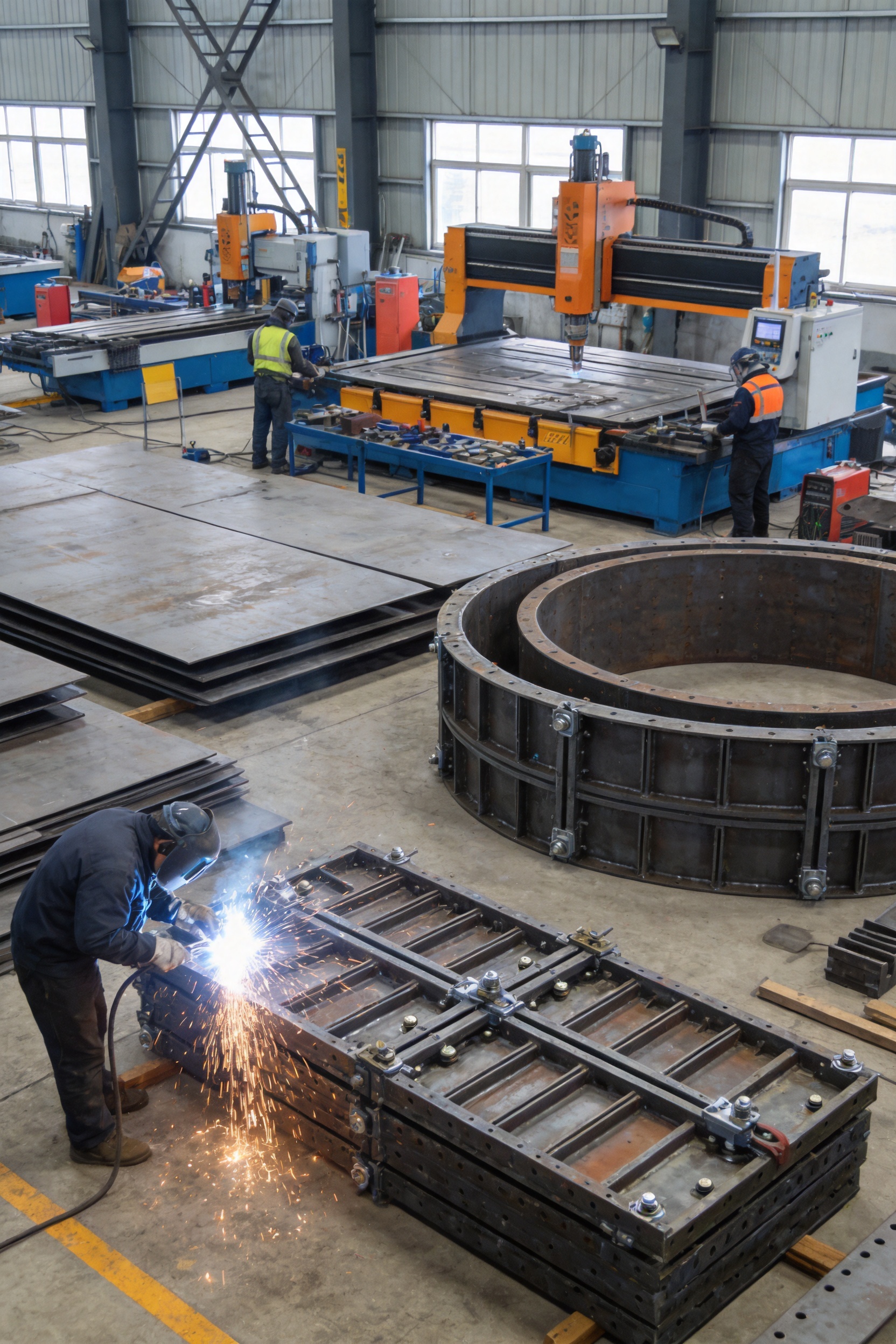
The performance of pier and cap beam formwork depends heavily on manufacturing quality. A design may look strong on paper, but if cutting, welding, machining, and assembly are not controlled, the finished formwork may leak, twist, or fail to meet tolerance. This is why advanced manufacturing capability is a key competitive strength.
Zhenjiang Jinhao Road & Bridge Supporting Engineering Co., Ltd. is located in Zhenjiang City, Jiangsu Province, China, and has developed into a comprehensive enterprise engaged in the design, manufacturing, erection, and leasing of Bailey bridges, bridge launching gantry systems, hanging baskets, pier formwork, and various steel formwork products. Its experience in engineered steel structures supports the production of reliable formwork systems for bridge construction.
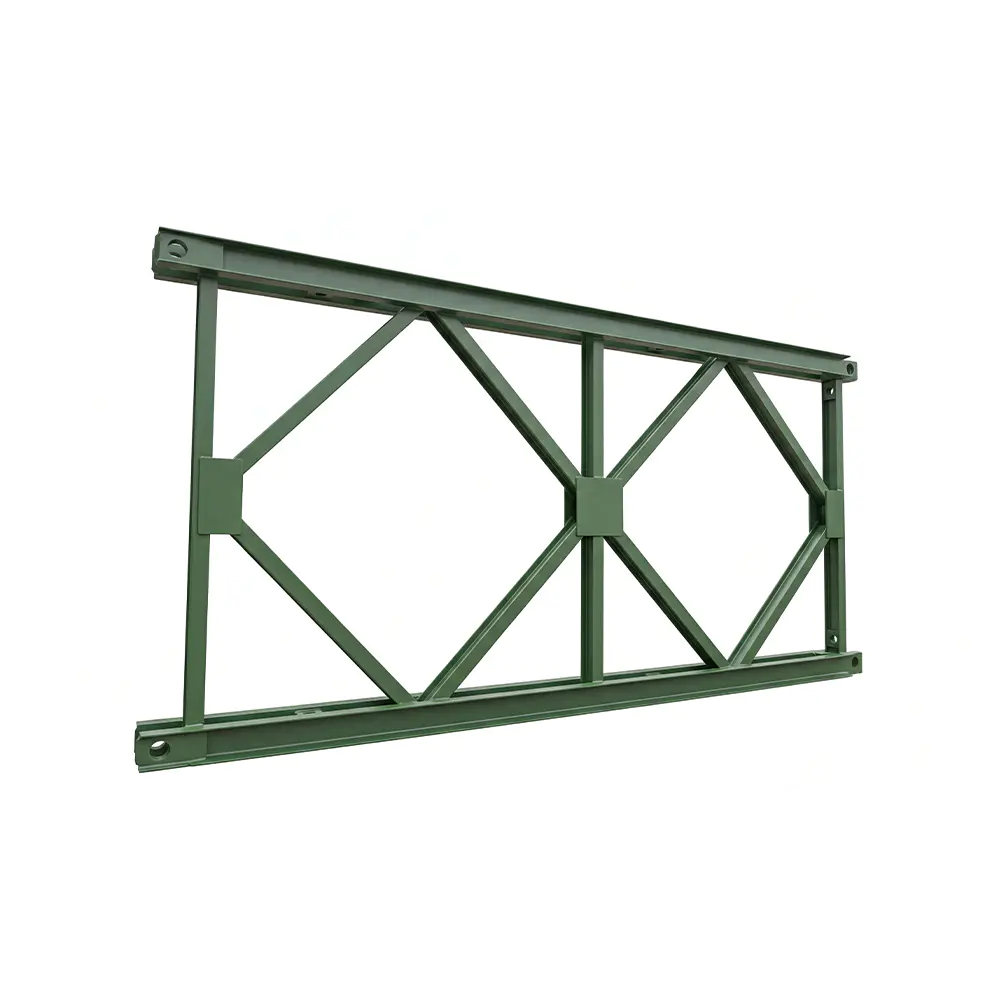
The company’s broader product background includes Bailey steel bridges, Type 321 Bailey truss sections, HD200 and Type 200 Bailey truss sections, triangular and diamond hanging baskets, bridge steel formwork, and related structural steel products. This engineering foundation is important because bridge formwork must be treated as a load-bearing temporary structure, not simply as a sheet metal product.
Design and System Planning
Before manufacturing begins, the technical team studies the bridge drawings, concrete dimensions, construction sequence, lifting conditions, pouring method, and site constraints. The formwork is then divided into modules that are practical for transportation, lifting, assembly, and reuse. Panel thickness, stiffener spacing, bolt arrangement, and support locations are considered according to expected concrete pressure and project requirements.
For repeated pier construction, the design may focus on rapid cycling and interchangeability. For irregular pier or cap beam construction, the design may focus on special panel geometry and precise matching. For high piers or large cap beams, the design may include additional stiffening and enhanced connection details.
Material Selection
Good formwork begins with suitable steel. Material selection affects strength, weldability, durability, and deformation resistance. Steel plates and structural sections are selected according to the required load capacity and service conditions. For components exposed to repeated lifting and assembly, the material must provide both strength and toughness.
High-quality steel materials also improve dimensional stability during fabrication. Inferior materials may warp during welding or deform during use. By selecting appropriate plates, ribs, and connection hardware, the manufacturer improves the long-term reliability of the formwork system.
Precision Cutting and Forming
Accurate cutting is essential for tight joints. If panel edges are inconsistent, workers may struggle to assemble the system, bolt holes may not align, and slurry leakage may occur. Advanced cutting and forming processes help ensure that each module is produced according to the drawings.
For circular piers and curved surfaces, rolling and forming accuracy is especially important. The radius must be consistent so that modules connect smoothly and create a clean circular concrete surface. For irregular shapes, accurate cutting and bending help preserve the designed geometry.
Controlled Welding
Welding gives the formwork its structural integrity, but uncontrolled welding can cause distortion. A professional manufacturer uses planned welding sequences, suitable fixtures, and experienced welders to reduce deformation and maintain panel flatness. Weld quality also affects service life because formwork experiences repeated handling, vibration, and load cycles.
Strong and consistent welding helps the stiffeners and face panels work together as a stable structure. It also reduces the risk of cracks or loosening during repeated use. For bridge contractors, this means fewer maintenance interruptions and more reliable field performance.
Machining and Hole Alignment
Bolt holes, connection plates, positioning points, and accessory interfaces must align accurately. Poor hole alignment can waste time on site and may force workers to modify components, which reduces quality and safety. Proper machining and drilling processes support quick assembly and repeatable installation.
Accurate hole alignment is particularly important for modular formwork because panels are repeatedly assembled and disassembled. Interchangeability allows one panel to match another without excessive adjustment. This is one of the characteristics that separates engineered modular formwork from rough fabricated molds.
Trial Assembly and Inspection
Before delivery, trial assembly can be used to verify fit, alignment, connection accuracy, and overall geometry. Trial assembly helps identify potential issues before the formwork reaches the jobsite. This reduces delays and prevents costly modifications during construction.
Inspection may include dimensional checks, flatness checks, weld inspection, surface condition review, and accessory verification. Quality management throughout production ensures that the system delivered to the contractor is ready for efficient use.
Surface Treatment and Protection
Steel formwork must resist corrosion during storage, transportation, and site use. Surface treatment may include cleaning, anti-rust coating, painting, or other protective processes according to project requirements. A smooth and properly treated formwork surface also helps concrete release more easily when used with an appropriate release agent.
Good surface treatment supports longer service life and better concrete appearance. It reduces rust staining, improves maintenance convenience, and protects the owner’s investment in reusable equipment.
Applications in Highway and Railway Bridge Projects
The formwork is suitable for the construction of bridge substructures in highway and railway projects. Highway bridges often require fast construction cycles because traffic-related infrastructure projects operate under tight schedules. Railway bridges and viaducts often have strict dimensional and quality requirements because of alignment, vibration, and load standards.
In highway bridge construction, the formwork can be used for standard piers, ramp bridge piers, interchange structures, river-crossing bridge substructures, and elevated road supports. The modular nature of the system allows crews to repeat the same procedure from pier to pier, improving efficiency.
In railway bridge construction, the system can support high-quality casting of piers and cap beams where verticality, flatness, and appearance are closely inspected. Railway viaducts often include numerous repeated piers, making steel formwork reuse especially valuable.
In municipal engineering, the formwork is useful for urban elevated bridges, pedestrian bridges, transit corridors, and overpasses. Urban projects often have limited working space and high public visibility, so smooth concrete appearance and fast site progress are important.
In water conservancy and transportation-related structures, the formwork can help create durable substructures exposed to moisture, flow, or harsh environments. Well-compacted concrete with smooth surfaces and accurate geometry contributes to long-term performance.
Value in Standardized Mass Construction
Standardized mass construction is one of the strongest use cases for this product. Many bridge projects include dozens or hundreds of similar pier columns and cap beams. If each element is built with improvised formwork, quality may vary and schedule control becomes difficult. Modular steel formwork solves this problem by creating a repeatable construction method.
Once the crew learns the assembly sequence, the formwork can be cycled from one pier to the next. Repeated use reduces learning time, improves safety awareness, and allows project managers to predict daily or weekly output more accurately. The result is better schedule management and lower risk of rework.
Standardization also improves quality documentation. Inspection teams can use the same checkpoints for each cycle: foundation preparation, reinforcement clearance, formwork assembly, verticality adjustment, joint sealing, pre-pour inspection, concrete placement, curing, demolding, cleaning, and maintenance. This repeatable quality process supports consistent results.
Performance During High-Strength Concrete Pouring
High-strength concrete is increasingly used in bridge structures to improve load capacity and durability. However, high-strength concrete mixtures may have specific flow characteristics and may require controlled vibration and placement methods. If the formwork lacks rigidity or sealing, defects can appear quickly.
The pier and cap beam formwork is well-suited for high-strength concrete pouring because its reinforced steel structure can resist pressure and vibration more effectively than many lighter alternatives. Tight joints help retain cement paste, which is essential for dense, high-quality surface concrete. Properly designed connection systems prevent panel movement during placement.
When combined with good concrete practice, the formwork supports dense concrete, clean edges, consistent surfaces, and accurate dimensions. Contractors should still follow engineering guidance for pour rate, vibration method, release agent selection, and curing, because even the best formwork must be used correctly.
Contribution to Appearance Quality
Appearance quality is often underestimated until the formwork is removed. At that moment, every joint, panel defect, leakage mark, and alignment error becomes visible. For exposed bridge piers, poor surface quality can lead to costly repair and dissatisfied owners.
The smooth steel panel surface helps create a clean concrete finish. Excellent joint sealing reduces grout loss and visible seam defects. High rigidity reduces surface waves caused by pressure deformation. Accurate positioning maintains visual symmetry and structural alignment.
The result is a finished pier or cap beam that requires little or no additional surface finishing. This advantage is not only aesthetic; it also reduces labor cost, shortens the work cycle, and minimizes the risk of repair materials separating from the original concrete over time.
Installation and Construction Workflow
A typical construction workflow begins with review of drawings, site preparation, reinforcement inspection, and foundation or previous-stage concrete cleaning. Surveyors mark control lines and elevation references. The formwork panels are cleaned, inspected, and coated with a suitable release agent before installation.
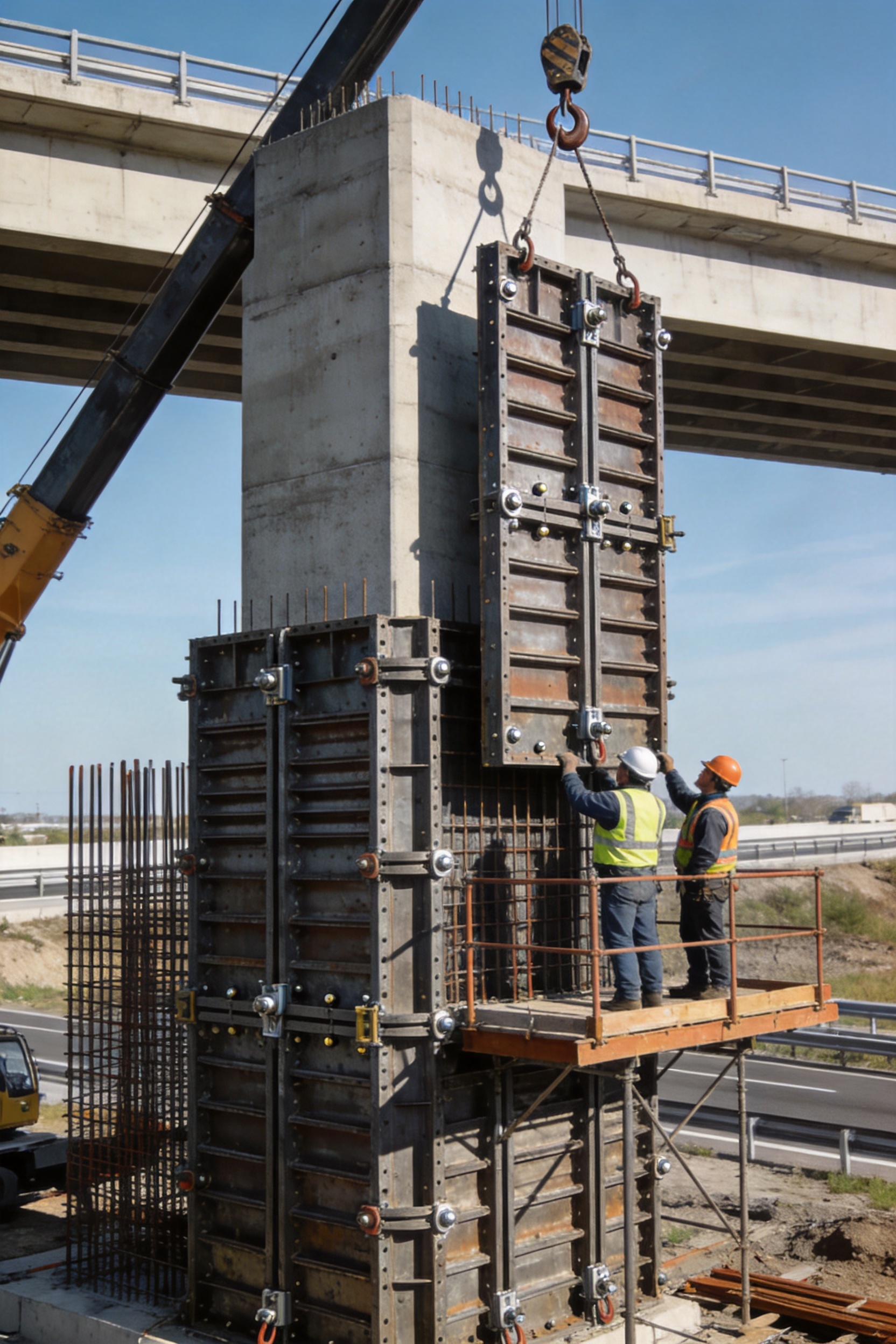
For pier columns, panels are lifted into position and connected according to the assembly sequence. Positioning clips and alignment accessories are used to adjust location and verticality. Bolts are tightened in the proper order. Joints are checked for sealing. Working platforms and safety accessories are installed as required.
For cap beams, support conditions and load paths must be carefully considered. Cap beam formwork may require brackets, supports, tie systems, or falsework depending on the project design. Flatness and elevation are checked before pouring. Bearing seat areas require particular attention because they affect later girder installation.
Before concrete placement, the team performs a pre-pour inspection. This includes checking formwork dimensions, reinforcement clearance, embedded parts, bolt tightness, joint sealing, supports, access platforms, and safety measures. During pouring, concrete should be placed evenly and vibration should be controlled to avoid segregation or excessive pressure. After curing, the formwork is removed carefully to protect both the concrete and the panels.
Maintenance for Long Service Life
Steel formwork is a reusable asset. Its service life depends on proper maintenance. After each use, panels should be cleaned to remove concrete residue. The surface should be inspected for dents, deformation, rust, or damaged connection points. Bolts and accessories should be collected, cleaned, and stored properly.
Release agent should be applied evenly before each pour. Excessive release agent may stain concrete, while insufficient release agent may make demolding difficult. Lifting should follow designated lifting points to prevent panel deformation. Storage should keep panels stable, protected from standing water, and organized for easy reuse.
Routine maintenance helps preserve panel flatness and joint accuracy. This directly affects future concrete surface quality. A well-maintained formwork system can provide repeated value across multiple projects.
Safety Considerations
Although formwork is temporary, it carries significant loads during construction. Safety must be integrated into design, manufacturing, installation, pouring, and removal. The formwork should be used according to approved method statements and engineering requirements. Workers should receive training on assembly sequence, lifting procedures, bolt tightening, platform use, and emergency response.
During installation, lifting equipment must be suitable for the panel weight. Workers should avoid standing under suspended loads. Temporary supports should be stable. Working platforms should include guardrails and safe access where required. During pouring, supervisors should monitor for abnormal movement, leakage, or sound.
Demolding should begin only after the concrete has reached sufficient strength. Removing panels too early may damage concrete edges or compromise safety. A disciplined approach protects workers, equipment, and project quality.
Company Capabilities and Competitive Strength
Zhenjiang Jinhao Road & Bridge Supporting Engineering Co., Ltd. has built its capabilities around bridge-related steel systems. The company’s experience in Bailey bridges, launching systems, hanging baskets, and steel formwork gives it practical insight into temporary works, modular assembly, transportation constraints, field erection, and structural reliability. This background strengthens its ability to deliver pier and cap beam formwork that performs well on real construction sites.
The company provides customized fabrication, design and system planning, technical support, and quality management. These services are important because formwork must match each project’s pier dimensions, concrete pressure, lifting conditions, and construction sequence. A supplier that understands both manufacturing and bridge engineering can help contractors reduce mismatch risk and improve jobsite efficiency.
Another competitive strength is product diversity. Because the company manufactures Bailey bridge components, bridge steel formwork, engineered steel structures, and related systems, it can support contractors with integrated temporary works solutions. This can be valuable for projects that require access bridges, erection support, hanging baskets, and substructure formwork within the same construction program.
The company’s operating philosophy emphasizes customer-first service, integrity, pragmatic operation, innovation-driven growth, win-win cooperation, advanced technology, and sustainable development. In practical terms, these values support responsive communication, project-specific design, continuous improvement, and attention to quality.
Why Contractors Choose Engineered Steel Formwork
Contractors choose engineered steel pier and cap beam formwork because it reduces uncertainty. In bridge construction, uncertainty often becomes cost. If formwork deforms, leaks, or takes too long to assemble, the schedule suffers. If the concrete surface requires repair, labor cost rises. If geometry is outside tolerance, the project may face inspection delays or structural correction work.
High-quality steel formwork reduces these risks through predictable performance. The panels are designed to hold shape. The joints are designed to seal. The modules are designed to assemble repeatedly. The system is designed for the bridge construction environment, not only for one-time casting.
Compared with competitors that rely on generic molds or less controlled fabrication, a specialized manufacturer can offer better engineering support, more accurate customization, stronger welding quality, improved modular coordination, and more reliable quality inspection. These advantages help contractors complete work faster and with greater confidence.
Economic Benefits Over the Project Life Cycle
The value of formwork should be evaluated over the entire project life cycle, not only by initial purchase price. A cheaper system may become expensive if it causes leakage, deformation, slow assembly, or poor concrete appearance. Repair labor, schedule delay, wasted materials, and inspection problems can exceed the savings from a low initial price.
Engineered steel formwork provides economic benefits in several ways. First, it reduces finishing work because the demolded concrete surface is smooth. Second, it improves productivity because modular panels can be assembled quickly after the crew becomes familiar with the system. Third, it reduces rework by improving dimensional accuracy. Fourth, it can be reused across many casting cycles. Fifth, it can support better safety planning, reducing disruption caused by unsafe temporary arrangements.
For repetitive bridge projects, the cost per pour can become highly competitive. When the same formwork is reused for multiple piers and cap beams, the initial investment is distributed across many concrete elements. This makes engineered steel formwork a practical choice for contractors seeking both quality and cost control.
Customization for Different Project Requirements
Each bridge project has unique conditions. Some projects require tall circular piers. Others require rectangular piers with chamfered corners. Some cap beams are long and straight, while others have variable sections or special bearing seat geometry. Customization ensures that the formwork matches the actual design rather than forcing the site team to compromise.
Customization may include panel size adjustment, special curved panels, irregular corner modules, embedded part openings, lifting point design, platform interfaces, tie rod arrangement, surface finish requirements, and transportation packaging. Proper customization improves assembly speed and final concrete quality.
OEM and ODM service capability is especially useful for international contractors and engineering companies that need formwork aligned with local standards, project drawings, and construction habits. Clear communication during the design stage helps confirm dimensions, tolerances, material requirements, surface treatment, and delivery schedule.
Quality Management from Design to Delivery
Quality management begins before steel is cut. It starts with understanding the project requirements and converting them into accurate production drawings. During manufacturing, each process must be controlled: material preparation, cutting, forming, welding, machining, assembly, surface treatment, inspection, marking, and packaging.
Dimensional control is especially important. If modules differ from the drawing, the formwork may not assemble correctly. If panel surfaces are uneven, the concrete surface may show defects. If welds are weak, service life may be reduced. If accessories are missing, site installation may be delayed.
A reliable manufacturer treats quality management as a complete chain. Each step affects the next step. This is why trial assembly, inspection records, and careful packaging are important. The goal is to deliver a system that can be used efficiently after arrival at the construction site.
Environmental and Sustainability Considerations
Reusable steel formwork supports more sustainable construction than single-use or low-reuse materials. Timber formwork may generate significant waste, especially when it is cut for special shapes and discarded after limited use. Steel formwork can be reused many times, repaired when necessary, and recycled at the end of its service life.
By reducing concrete surface defects, the formwork also reduces repair materials and secondary finishing work. Less grinding and patching means less dust, less waste, and less labor exposure. Faster construction cycles can also reduce equipment idle time and site disturbance.
Sustainability in bridge construction is not only about materials; it is also about durable results. Accurate, dense, smooth concrete substructures can contribute to long-term bridge performance and reduce maintenance needs over time.
Best Practices for Achieving Excellent Results
To gain the full benefit of pier and cap beam formwork, contractors should follow best practices. First, confirm all drawings and dimensions before production. Second, plan lifting, assembly, and pouring methods in advance. Third, train workers on the specific formwork system. Fourth, inspect panels and accessories before each use. Fifth, apply release agent correctly. Sixth, control concrete pouring speed and vibration. Seventh, maintain proper curing. Eighth, demold carefully and clean the panels immediately after use.
Survey control is also essential. Even the most accurate formwork must be installed according to correct reference lines and elevations. Positioning clips and adjustment devices help, but measurement and verification remain necessary.
Communication between supplier, contractor, and site engineers improves results. If site conditions change, technical support can help adjust assembly methods, pouring plans, or maintenance procedures. Good coordination prevents small issues from becoming major delays.
Typical Buyers and Project Users
The product is suitable for bridge contractors, government infrastructure agencies, engineering companies, railway construction units, highway construction enterprises, municipal contractors, and project developers. It is especially useful for buyers who require reliable reusable formwork for repeated bridge substructure casting.
International buyers may value a supplier that can provide customized manufacturing, technical communication, export packaging, and engineering support. Since bridge projects often involve strict schedules and remote sites, dependable supply and clear documentation are important.
For contractors working on emergency, temporary, or fabricated bridge systems as well as permanent infrastructure, a manufacturer with broad bridge steel experience can provide additional value. Knowledge gained from modular steel bridges, launching systems, and engineered temporary works supports practical formwork design.
Frequently Asked Questions
What is pier and cap beam formwork used for?
Pier and cap beam formwork is used to mold reinforced concrete bridge piers and cap beams during casting. It supports fresh concrete until the concrete reaches sufficient strength and helps create the required shape, dimensions, alignment, and surface finish.
What are the main advantages of this steel formwork system?
The main advantages are high rigidity, excellent joint sealing, precise positioning, smooth concrete surface after demolding, reduced finishing work, flexible adaptation to different cross-sections, and high reuse value for repetitive bridge construction.
Can the formwork be used for circular and irregular piers?
Yes. The system can be customized for circular, square, rectangular, and irregular pier sections. Curved panels, special corner modules, and project-specific connection details can be designed according to the bridge drawings.
Why is joint sealing important?
Joint sealing prevents cement slurry leakage during concrete pouring. Good sealing reduces honeycombing, sand streaks, weak edges, and surface defects. It also improves the appearance of the finished concrete and reduces repair work.
How does the formwork help control verticality and flatness?
The system can be used with positioning clips and alignment accessories that help locate and adjust the formwork accurately. This supports pier verticality and cap beam flatness, which are important for structural performance and later superstructure installation.
Is steel formwork more cost-effective than timber formwork?
For small one-time jobs, timber may have a lower initial cost. However, for bridge projects with repeated piers and cap beams, engineered steel formwork is often more cost-effective because it can be reused many times, improves quality, reduces finishing work, and shortens construction cycles.
What concrete surface quality can be expected?
When the formwork is properly manufactured, maintained, and used with correct concrete practice, the demolded concrete surface can be smooth and clean, often requiring little or no additional finishing.
What manufacturing factors affect formwork quality?
Important factors include steel material selection, cutting accuracy, forming precision, welding control, hole alignment, trial assembly, surface treatment, inspection, and packaging. These factors determine whether the system fits well and performs reliably on site.
Can the system be customized for international projects?
Yes. The formwork can be customized according to project drawings, local construction requirements, lifting conditions, transportation limits, surface finish expectations, and repeated-use plans.
How should steel formwork be maintained?
After each use, the panels should be cleaned, inspected, repaired if necessary, and stored properly. Release agent should be applied before each pour. Bolts and accessories should be protected and organized to ensure efficient reuse.
Conclusion
Pier and cap beam formwork is a critical tool for high-quality bridge substructure construction. Its role goes far beyond shaping concrete. It affects dimensional accuracy, surface appearance, construction speed, labor cost, safety, and long-term project value. A rigid, well-sealed, precisely manufactured steel formwork system can help contractors achieve consistent results across highway, railway, municipal, and water conservancy bridge projects.
The product’s key strengths include sufficient rigidity, excellent joint sealing, dedicated positioning support, smooth demolded concrete surfaces, reduced finishing requirements, flexible cross-section adaptation, and suitability for standardized mass construction and high-strength concrete pouring. These advantages make it a strong alternative to conventional timber or low-grade formwork systems, especially where repeated use and strict appearance quality are required.
Backed by manufacturing experience in bridge steel systems, modular bridge components, launching equipment, hanging baskets, and steel formwork, Zhenjiang Jinhao Road & Bridge Supporting Engineering Co., Ltd. offers the engineering understanding and fabrication capability needed to produce reliable customized formwork. For contractors and engineering companies seeking efficient, durable, and accurate bridge substructure solutions, engineered pier and cap beam formwork provides a practical path to better quality, faster progress, and lower life-cycle cost.
References
American Concrete Institute. Guide to Formwork for Concrete.
American Association of State Highway and Transportation Officials. AASHTO LRFD Bridge Construction Specifications.
British Standards Institution. Temporary Works Equipment and Formwork Design Guidance.
International Federation for Structural Concrete. Structural Concrete Textbook on Behaviour, Design and Performance.
Concrete Society. Formwork: A Guide to Good Practice.
Construction Industry Research and Information Association. Formwork and Falsework Guidance for Concrete Construction.


 Français
 Español
 عربى