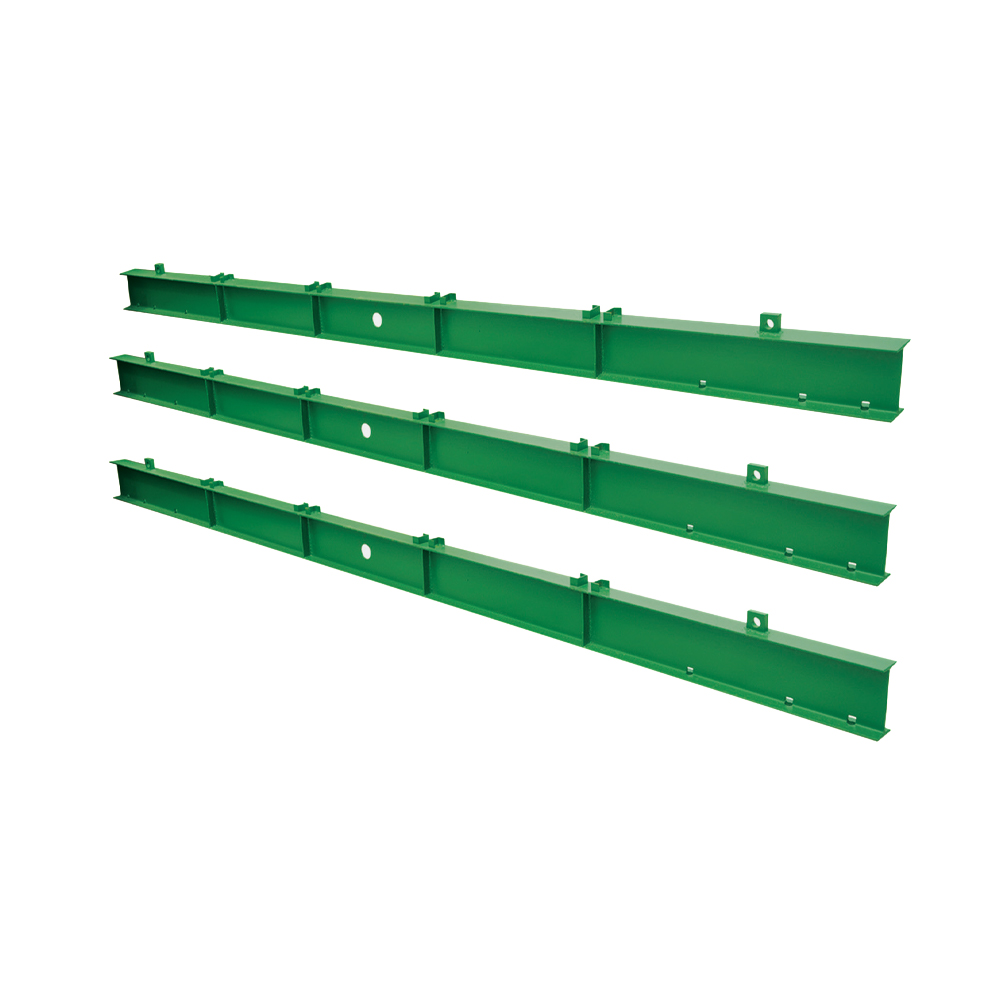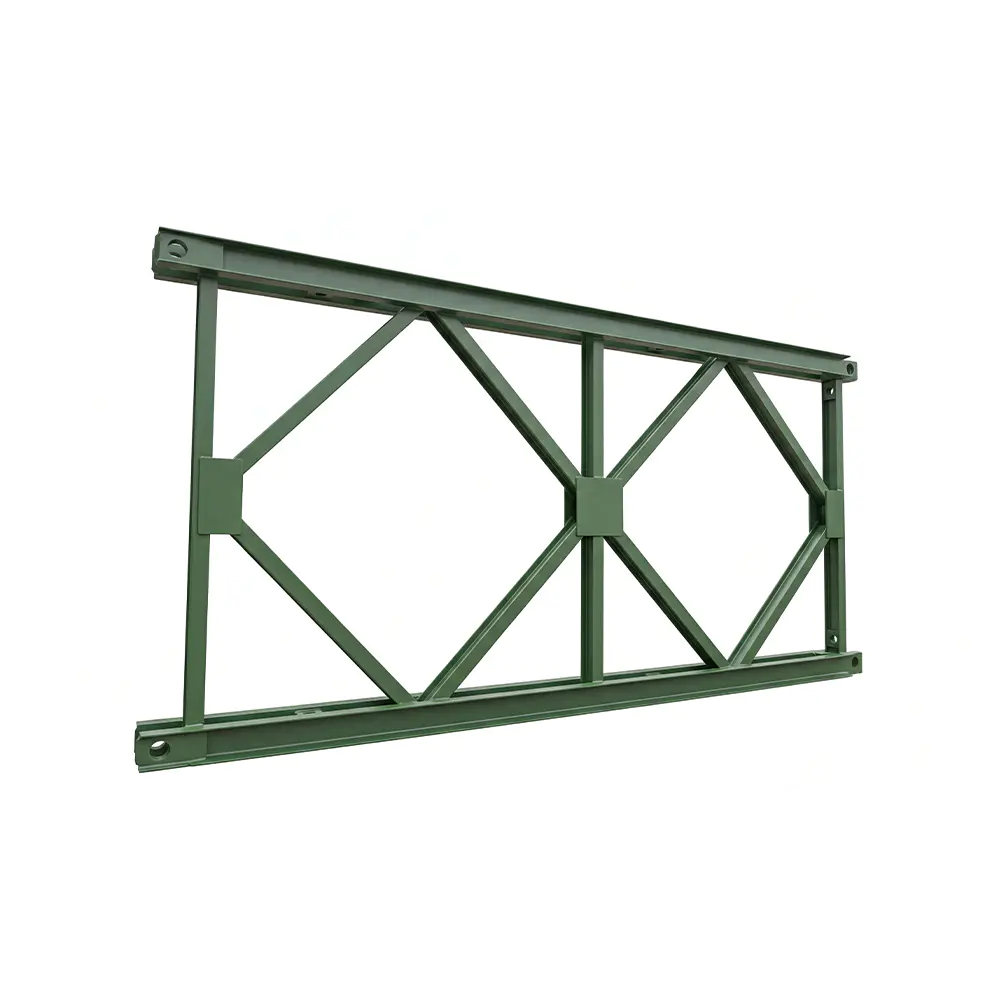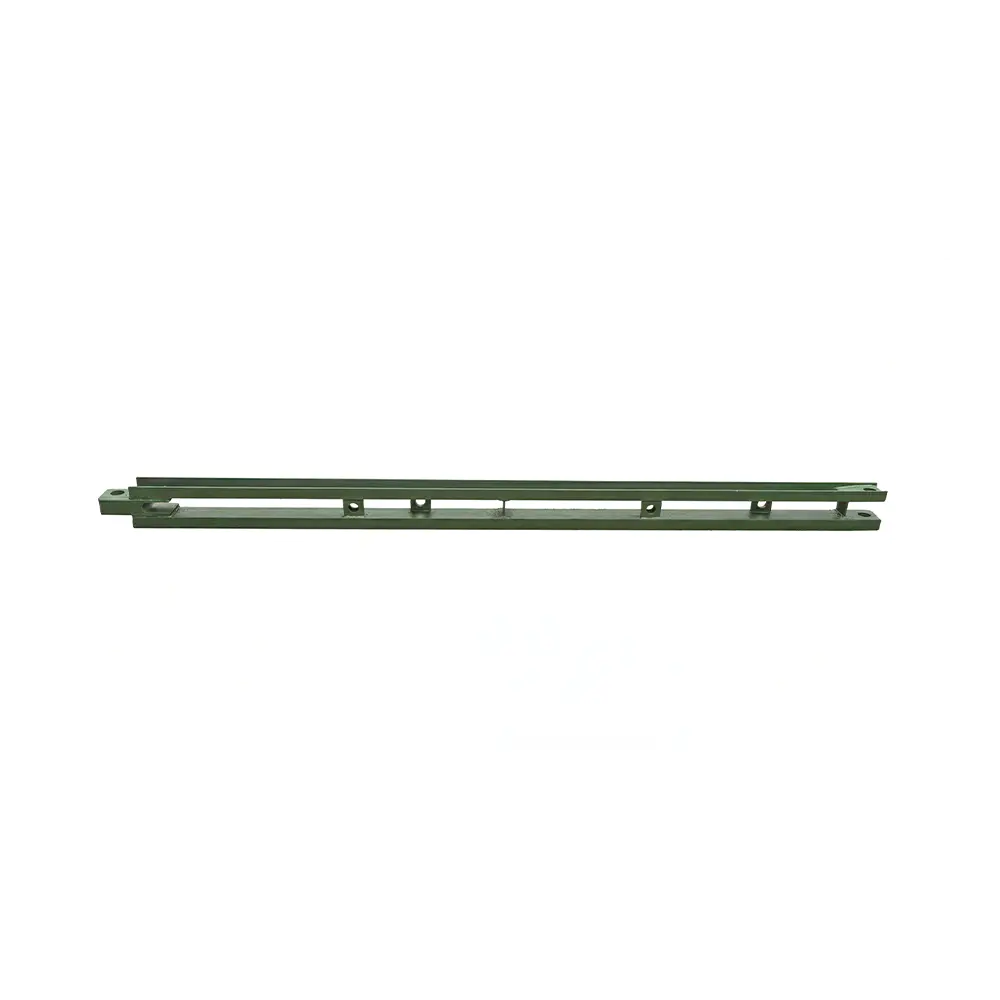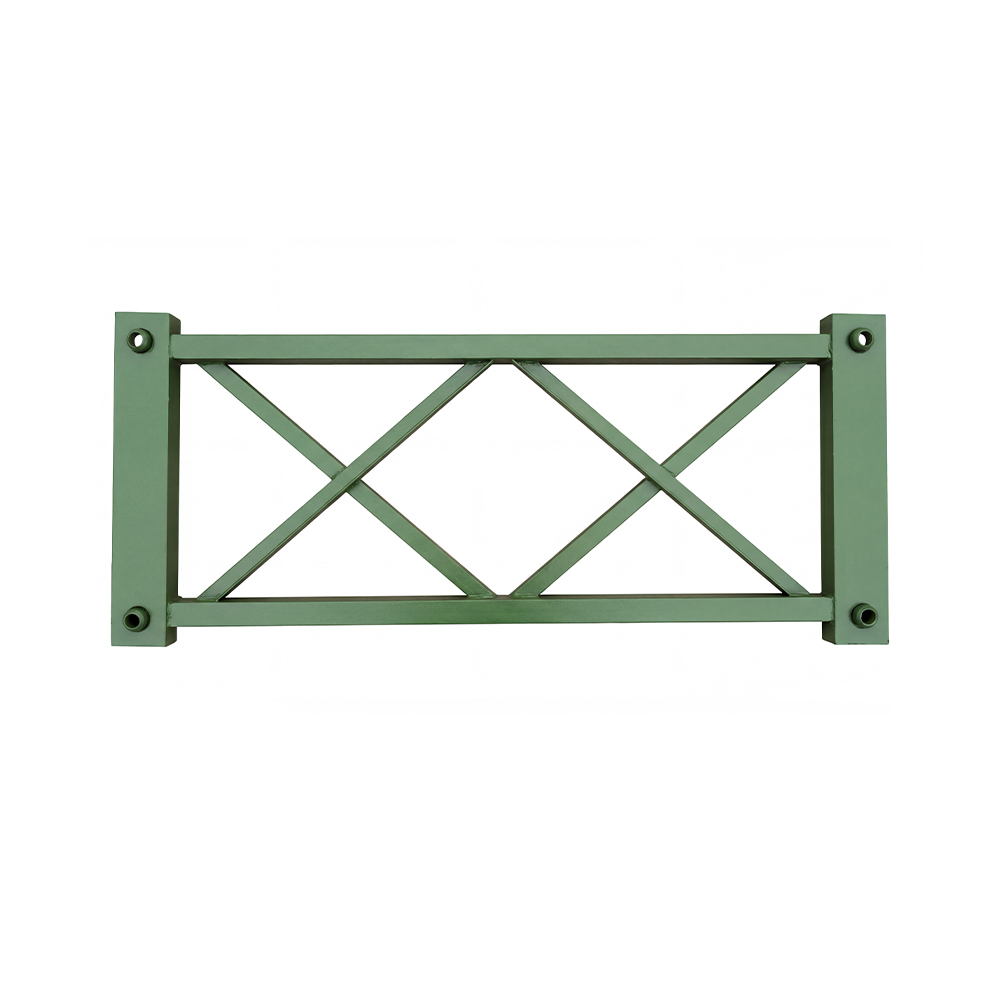
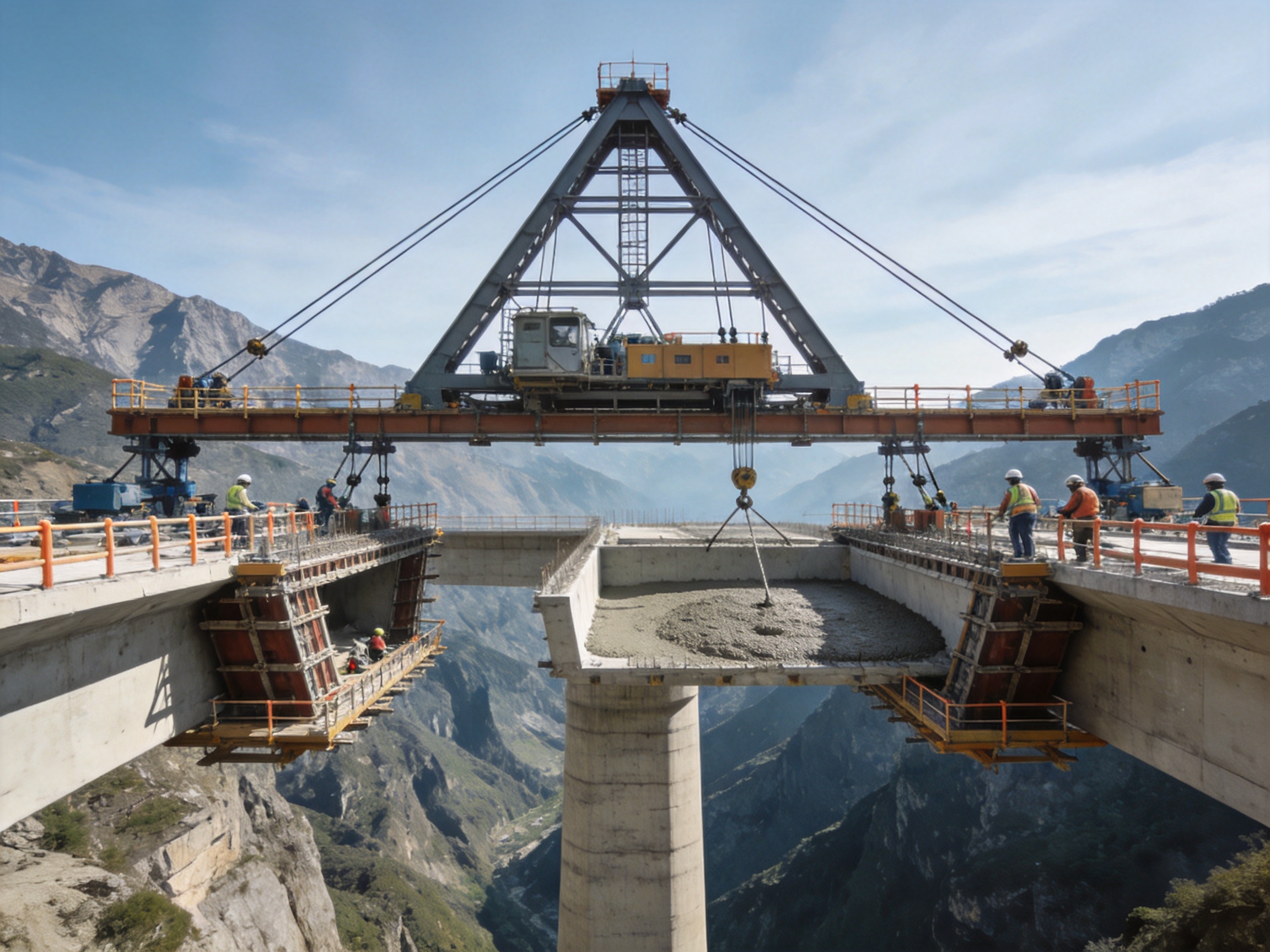
Modern bridge construction increasingly depends on equipment that can combine structural reliability, construction efficiency, and precise control of geometry. For large-span bridges built by the balanced cantilever method, the form traveler is one of the most important systems on the project. It supports the formwork, construction loads, workers, and fresh concrete while allowing each segment of the bridge deck or box girder to be cast progressively from a pier. The performance of the form traveler directly affects construction safety, cycle time, concrete quality, and the final alignment of the bridge.
The Triangular Form Traveler is designed specifically for this demanding environment. Its main load-bearing structure is arranged in a triangular configuration, creating a stable and direct force-transfer system. Compared with heavier or more complicated traveler arrangements, the triangular design can provide strong anti-overturning performance with a relatively low self-weight. It is particularly suitable for high-altitude construction, restricted working areas, steep terrain, and bridge sites where large lifting equipment is difficult to position.
As a specialized product in the field of cantilever launching gantries and bridge steel formwork, the Triangular Form Traveler offers a practical solution for contractors seeking a balance between structural stability, transportability, installation convenience, and dimensional accuracy. It can be engineered for different bridge types, segment lengths, cross-sections, construction loads, and site conditions. With appropriate structural calculation, fabrication control, assembly inspection, and site commissioning, the system can support safe and repeatable cantilever casting operations throughout the bridge project.
This article examines the working principles, structural advantages, manufacturing strengths, application conditions, installation process, quality controls, and competitive value of the Triangular Form Traveler.
1. The Role of a Form Traveler in Cantilever Bridge Construction
Balanced cantilever construction is widely used for prestressed concrete bridges, especially when a bridge must cross rivers, valleys, highways, railways, urban areas, or other obstacles where extensive ground-based falsework is impractical. In this method, bridge segments are cast successively on both sides of a pier, keeping the structure balanced as construction progresses. The form traveler moves forward after each concrete segment reaches the required strength.
A form traveler normally performs several functions at the same time. It supports the external formwork and internal formwork, carries the weight of newly placed concrete, transfers construction loads to the completed bridge segment, provides working platforms for reinforcement and concrete operations, and maintains the designed geometry of the segment. It must also resist wind, vibration, temporary eccentricity, impact from construction activities, and the repeated forces generated during moving and anchoring.
Because the traveler is used repeatedly, its design must support a large number of construction cycles without excessive deformation, fatigue damage, or connection wear. Every cycle requires the system to be released, moved, adjusted, anchored, inspected, and reused. A traveler that is too heavy may increase lifting requirements and impose additional loads on the bridge. A traveler that is too flexible may cause dimensional errors in the concrete segment. A traveler with complicated force paths may require more components, longer assembly time, and greater maintenance effort.
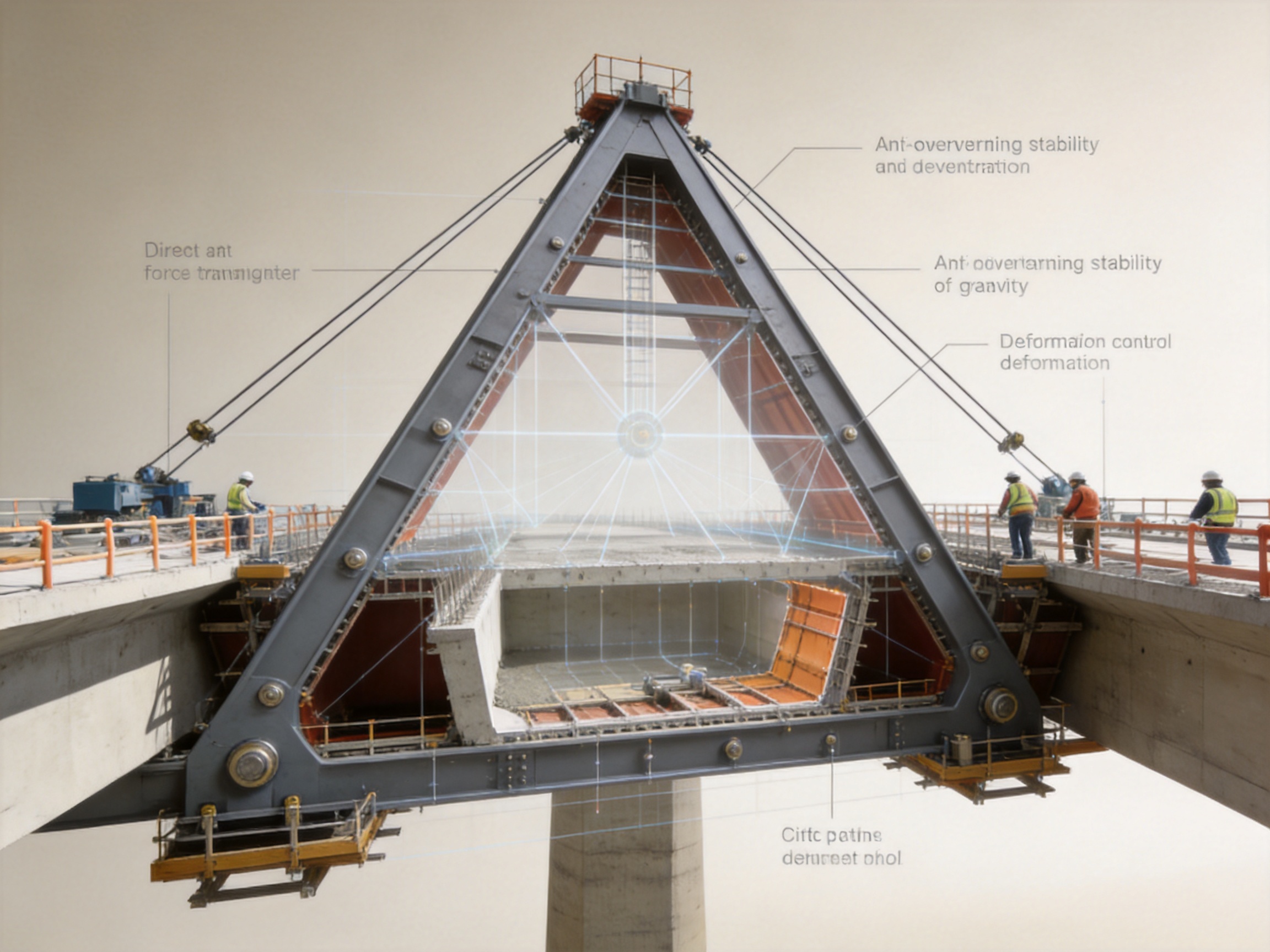
The Triangular Form Traveler addresses these requirements through a compact load-bearing arrangement. Its principal structural members form a triangular framework, which helps create geometric stability and efficient load distribution. The design is intended to keep the center of gravity controlled, reduce unnecessary structural weight, and transmit loads through direct paths to the supporting points on the completed bridge structure.
2. Structural Concept of the Triangular Form Traveler
The triangular configuration is the defining feature of this form traveler. In a typical arrangement, the main truss or frame includes inclined members, longitudinal members, transverse members, suspension components, and anchoring devices. These elements work together to create a stable three-dimensional system above and around the bridge segment being cast.
A triangle is inherently resistant to geometric distortion when its joints and members are properly designed. Under vertical construction loads, the inclined members help transfer forces toward the anchoring and supporting positions. Under horizontal forces or temporary eccentric loading, the triangular arrangement can provide a more stable response than an open frame with insufficient triangulation. The design does not eliminate the need for detailed engineering analysis, but it offers an efficient structural basis for controlling movement and overturning tendencies.
The main force path can generally be described as follows: the fresh concrete and formwork loads are transferred to the supporting beams and suspension members; these forces then pass into the main triangular frame; the frame distributes the loads to the front and rear anchoring areas; and the completed bridge segment carries the resulting reactions. Depending on the specific design, additional forces may be resisted through tie rods, anchor boxes, bearing plates, cross beams, or other engineered components.
A simple and direct force path provides several practical benefits. It can reduce the number of heavily loaded secondary members, make the structure easier to inspect, and reduce uncertainty during assembly. It may also simplify structural calculations and improve the predictability of deformation. The final configuration must always be confirmed by project-specific design, because the traveler must match the bridge cross-section, segment length, concrete density, reinforcement arrangement, construction sequence, and allowable deflection.
The triangular system can be adapted to single-cell box girders, multi-cell box girders, T-shaped sections, variable-depth girders, and other bridge superstructure forms. Adjustable beams, working platforms, formwork supports, and suspension elements can be configured according to the project requirements. This adaptability is important because bridge geometry can change along the span, particularly near piers or in areas with variable girder depth.
3. Main Advantages of the Triangular Form Traveler
3.1 Strong Anti-Overturning Stability
Anti-overturning stability is one of the most important characteristics of any traveler used for overhead concrete casting. During construction, the equipment may be subjected to uneven loading, wind pressure, concrete placement sequence, worker movement, formwork adjustment, and temporary conditions that do not exist in the completed bridge.
The triangular main frame helps maintain a stable relationship between the upper structure, the supporting points, and the formwork assembly. Its inclined members can improve resistance to rotation, while the anchoring arrangement keeps the traveler connected to the completed segment. This is especially valuable when the traveler is installed at a considerable height above the ground or when access for emergency support is limited.
Anti-overturning performance depends on more than the shape of the main frame. Correct anchorage, adequate connection strength, proper load sequencing, accurate installation, and regular inspection are equally important. Nevertheless, the triangular structural concept provides a strong foundation for achieving the required stability without relying on excessive mass.
3.2 Lightweight Design
A form traveler must be strong enough to carry construction loads, but unnecessary weight can create several problems. Heavy equipment requires larger cranes or lifting devices, increases the temporary load on the bridge, complicates transport, and may extend assembly time. In remote valleys, mountainous regions, or urban construction areas, access for large lifting equipment can be especially difficult.
The Triangular Form Traveler uses structural efficiency to reduce its own weight while preserving load-bearing performance. Direct force transfer, reduced structural redundancy, and rational member arrangement can help limit steel consumption. The resulting system is easier to transport in separate modules and more convenient to assemble at the bridge site.
Lightweight design does not mean reducing safety margins or replacing engineering analysis with simple geometry. The system must be checked for strength, stiffness, buckling, fatigue, connection capacity, local stability, and serviceability. When these requirements are addressed through appropriate design and manufacturing, a lighter traveler can offer significant economic and logistical advantages.
3.3 Convenient Assembly and Disassembly
Construction sites often have limited space for storage, welding, and lifting. A traveler that can be divided into manageable modules provides greater flexibility during mobilization. The main frame, cross beams, suspension components, platforms, and formwork supports can be fabricated, inspected, and transported as separate units before being assembled in a controlled sequence.
The triangular configuration can simplify the relationship between major structural members. Standardized connection details, bolted joints, marked components, and clear assembly documentation can further reduce installation errors. Once the project is complete, the equipment can be dismantled and prepared for transport to another site.
Efficient assembly is especially valuable when the bridge crosses active roads, railways, waterways, or environmentally sensitive areas. Shorter installation periods can reduce disruption and lower the amount of temporary work required below the bridge.
3.4 Accurate Forming and Deformation Control
Bridge construction requires accurate control of elevation, alignment, cross-section, segment length, and girder geometry. The form traveler supports the formwork during concrete placement, so its deformation must remain within the limits established by the design and construction method.
A properly engineered triangular traveler can provide a stiff and stable support structure with predictable deformation behavior. This makes it easier for construction teams to set the initial elevation and apply the required construction camber. During concrete placement, the traveler can maintain the desired position while the loads increase. After the concrete hardens, the system can be released and moved to the next segment without damaging the completed work.
Accurate forming depends on coordinated control of the traveler, formwork, reinforcement, embedded items, concrete placement sequence, temperature, curing, and surveying. The traveler is not a substitute for site measurement, but its stable structure creates better conditions for achieving consistent results.
3.5 Adaptability to Difficult Sites
The Triangular Form Traveler is well suited to construction environments where conventional falsework is unsuitable. These conditions may include deep valleys, steep slopes, wide rivers, dense urban districts, rail corridors, highways, and areas with restricted access. Since the main traveler is supported by the bridge structure rather than by extensive ground-based scaffolding, it can reduce dependence on the terrain beneath the bridge.
Its relatively light weight also supports installation where crane capacity is limited. Components can be lifted in stages, assembled above the pier, or installed using temporary lifting arrangements designed for the project. The exact method must be confirmed by the contractor and engineer, but the equipment concept provides greater flexibility than systems that depend on large ground-level assembly areas.
4. Comparison with Heavier or More Complicated Traveler Systems
Different bridge projects require different construction systems, and no single traveler is ideal for every condition. However, the Triangular Form Traveler has several competitive advantages when compared with heavy, highly redundant, or less integrated arrangements.
| Evaluation Item | Triangular Form Traveler | Potentially Heavier or More Complex System |
|---|
| Main structural concept | Triangulated load-bearing frame with direct force transfer | Multiple frames, secondary members, or more complicated load paths |
| Self-weight | Relatively lightweight when optimized through engineering design | May require greater steel quantity and larger lifting capacity |
| Anti-overturning behavior | Stable triangular geometry supported by engineered anchorage | May depend more heavily on mass, additional bracing, or numerous connections |
| Site assembly | Suitable for modular delivery and staged erection | May require larger assembly areas and more lifting operations |
| Transportability | Major components can be separated for shipment | Large integrated sections may be more difficult to move |
| Adaptability | Can be configured for different cross-sections and segment conditions | Some systems may require extensive modification for new projects |
| Deformation control | Direct structural behavior can support predictable adjustment | More joints and secondary members may increase adjustment complexity |
| Maintenance | Clearer inspection of primary force-bearing members and connections | More components may increase inspection and maintenance demands |
The comparison is intended to explain the design philosophy rather than establish an absolute ranking. A heavy traveler may be appropriate for very large segment loads or unusual bridge geometries. A specialized system may also provide features required by a particular construction method. The Triangular Form Traveler is competitive because it delivers a strong combination of stability, low weight, practical assembly, and precision for a broad range of cantilever bridge applications.
5. Engineering Design Considerations
A reliable traveler begins with accurate project information. Before design or fabrication, the supplier and contractor should confirm the bridge cross-section, maximum segment length, segment weight, concrete density, reinforcement arrangement, formwork weight, construction equipment loads, working platforms, wind conditions, temperature range, moving method, anchoring method, and required construction cycle.
The design should consider the most unfavorable construction stages rather than only the condition in which concrete placement is completed. Typical cases include the traveler before concrete placement, partial concrete placement, full fresh-concrete loading, movement to the next segment, temporary eccentric loading, emergency stopping during movement, and the condition immediately before or after anchoring.
Important structural checks may include:
1. Strength of primary beams, trusses, brackets, suspension members, and connection plates.
2. Global stability of the triangular frame under vertical and horizontal loads.
3. Local buckling of compression members and plates.
4. Deflection of the traveler and formwork during concrete placement.
5. Capacity of anchor bolts, tie rods, bearing plates, and embedded anchorage components.
6. Stability during forward movement and temporary release.
7. Fatigue performance of frequently reused members and welded details.
8. Working platform capacity and access safety.
9. Compatibility between the traveler and the bridge’s permanent reinforcement and prestressing system.
10. Effects of wind, temperature, vibration, and construction tolerances.
The required design safety factors, load combinations, material grades, welding standards, inspection requirements, and allowable deformations should follow the applicable project specifications and relevant national or international standards. The manufacturer should provide drawings and technical documents that clearly identify member dimensions, connection details, lifting points, adjustment ranges, and installation sequences.
6. Manufacturing Process and Production Strengths
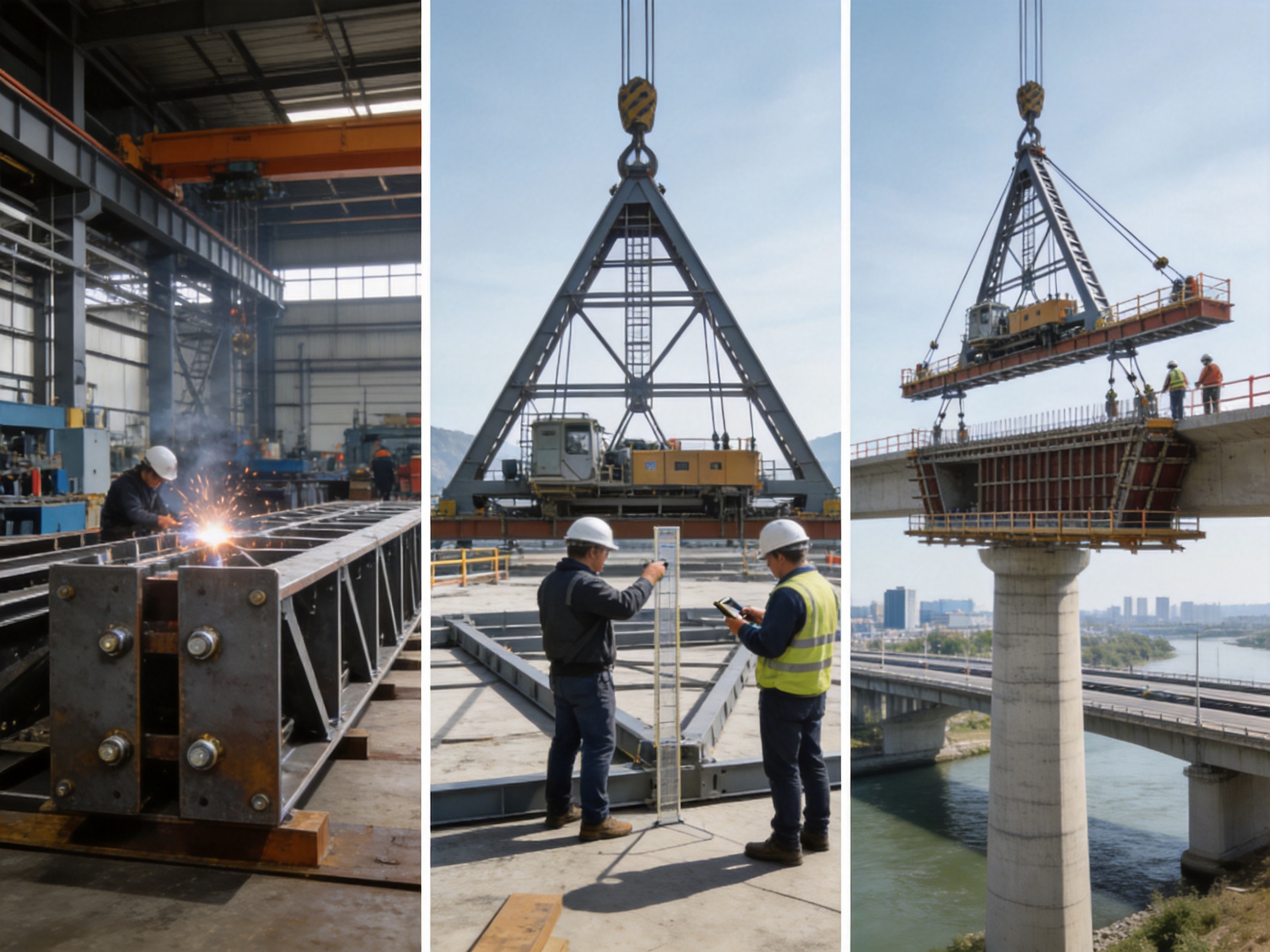
The performance of a form traveler depends heavily on manufacturing quality. A well-designed system can fail to deliver its intended benefits if steel preparation, welding, dimensional control, surface treatment, or assembly inspection is inadequate. For this reason, manufacturing must be managed as a complete process from material procurement through final delivery.
6.1 Engineering Review and Production Planning
Production begins with a technical review of the bridge requirements and the traveler design. Engineers examine the load-bearing concept, component list, fabrication drawings, weld details, bolted connections, transportation limits, assembly sequence, and site installation method. Potential conflicts with reinforcement, prestressing ducts, access openings, and formwork components should be identified before cutting steel.
A production plan is then prepared. It may include material purchasing, cutting schedules, welding procedures, machining requirements, trial assembly, inspection points, coating operations, packing, and delivery. Clear production planning helps reduce fabrication errors and ensures that the components required for each assembly stage are available in the correct sequence.
6.2 Material Selection and Traceability
Primary load-bearing members should be manufactured from structural steel grades suitable for the expected strength, toughness, weldability, and service environment. Material certificates and inspection records should be retained so that the origin and properties of critical steel plates, sections, tubes, bolts, pins, and other components can be verified.
Material traceability is particularly important for reusable equipment. Each major component can be assigned a code or identification mark. These markings help match parts with fabrication drawings, inspection records, and maintenance files. They also reduce the risk of installing a component in the wrong location during site assembly.
6.3 Precision Cutting and Component Preparation
Steel plates and sections must be cut according to approved drawings. Accurate cutting reduces the need for excessive correction during assembly and helps maintain the designed geometry of the triangular frame. Edges may require treatment to remove burrs, sharp projections, slag, or other irregularities that could interfere with fit-up or create stress concentrations.
Connection plates, stiffeners, brackets, gussets, and bearing surfaces should be prepared using controlled methods. Holes for bolts and pins must be located accurately because misalignment can create installation difficulty, unintended secondary stresses, or excessive wear. Where machining is required, the dimensional tolerances should be clearly specified and checked.
6.4 Controlled Welding
Welding is one of the most important manufacturing operations for the main frame and supporting assemblies. Welding procedures should be established for the relevant material thicknesses, joint types, welding positions, and consumables. Qualified welders and appropriate inspection personnel should be assigned to critical work.
Good welding practice includes proper joint preparation, control of preheating where required, correct electrode or wire storage, suitable welding parameters, and management of weld sequence. Distortion control is essential because excessive welding deformation can affect the alignment of truss members, connection plates, and bearing surfaces.
Inspection may include visual examination, dimensional checks, and nondestructive testing according to project requirements. Critical welds may require ultrasonic, magnetic particle, dye penetrant, or other examination methods. The inspection scope should be defined in the quality plan rather than left to informal judgment.
6.5 Trial Assembly and Dimensional Verification
Trial assembly is a valuable stage in the manufacturing process. Major components can be assembled in the workshop to verify fit, connection alignment, adjustment ranges, access arrangements, and overall dimensions. This process helps identify problems before the equipment reaches the bridge site, where correction may be more difficult and expensive.
During trial assembly, engineers can check whether pins and bolts can be installed without interference, whether formwork supports align with the intended bridge cross-section, and whether the traveler can be separated into transportable modules. The assembled system can also be measured for level, diagonals, centerline, and key connection dimensions.
Trial assembly improves construction efficiency because site workers receive components that have already been checked for compatibility. It also provides an opportunity to mark components, record assembly photographs, and prepare clearer installation instructions.
6.6 Surface Treatment and Corrosion Protection
Steel bridge equipment may be exposed to rain, humidity, concrete slurry, dust, coastal air, and repeated handling. Appropriate surface preparation and protective coating can extend service life and reduce maintenance requirements. Before painting, surfaces should be cleaned and prepared to the specified condition. Coating systems should be selected according to the expected environment and project requirements.
Areas that are difficult to coat, such as narrow gaps, connection interfaces, and concealed surfaces, should receive special attention. Bolted or sliding components may require a coating approach that does not interfere with connection performance. After coating, dry-film thickness, appearance, adhesion where specified, and repair areas should be inspected.
6.7 Final Inspection and Documentation
Before shipment, the manufacturer should conduct a final inspection covering component identity, dimensions, weld quality, bolt and pin specifications, surface treatment, adjustment devices, lifting points, safety platforms, and accessories. The equipment should be supplied with relevant technical documents, including assembly drawings, component lists, inspection records, operating procedures, maintenance recommendations, and safety instructions.
Strong documentation is a practical manufacturing advantage. It helps the contractor plan erection, train workers, monitor inspections, and maintain the equipment during repeated construction cycles. It also supports future reconfiguration or reuse on another bridge project.
7. Company Capabilities and Integrated Bridge Equipment Experience
Zhenjiang Jinhao Road & Bridge Supporting Engineering Co., Ltd. is located in Shangdang Town Industrial Park, Dantu District, Zhenjiang City, Jiangsu Province, China. Established in 2017, the company developed from an enterprise focused on construction materials, industrial materials, and metal processing materials into a comprehensive business serving bridge and structural engineering projects.
The company’s activities include the design, manufacture, erection, and leasing of Bailey bridges, bridge launching gantry systems, hanging baskets, pier formwork, and various steel formwork products. This broad product range is relevant to the manufacture of Triangular Form Travelers because it reflects experience with temporary steel structures, modular components, bridge construction loads, field assembly, and project-specific engineering requirements.
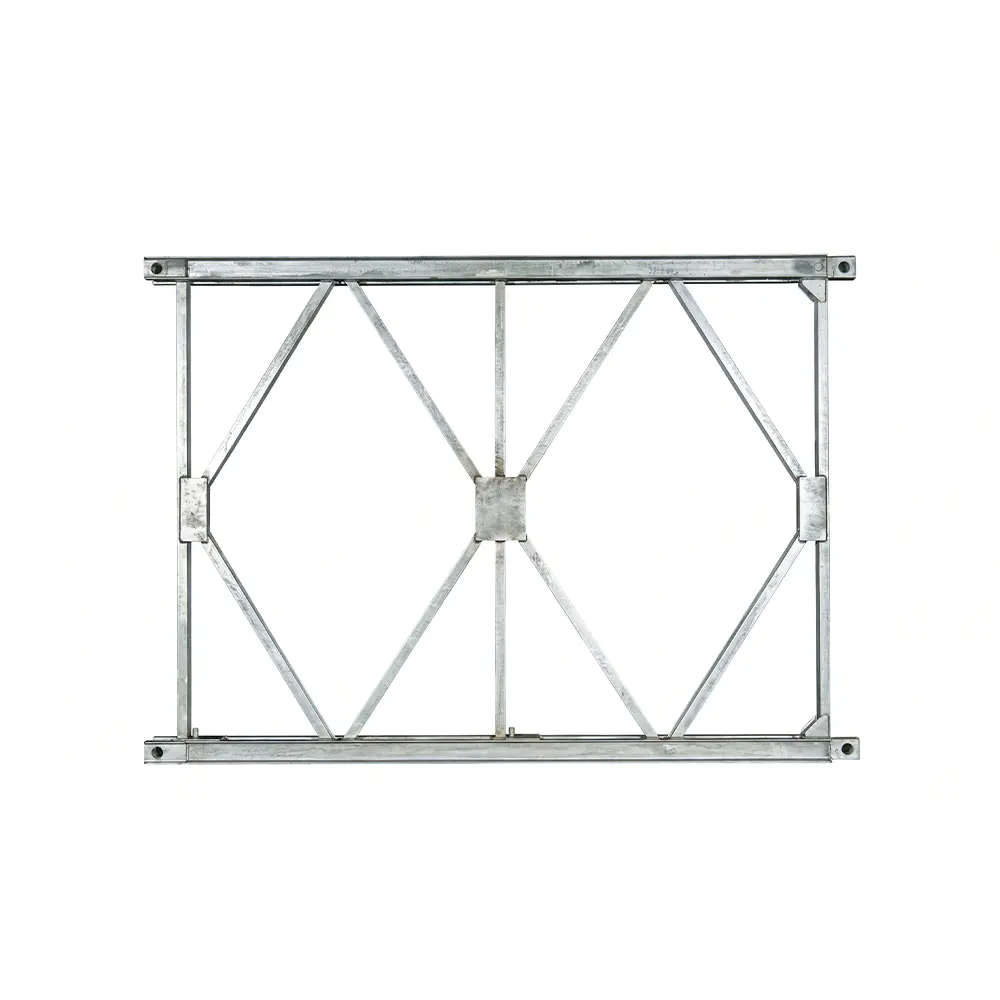
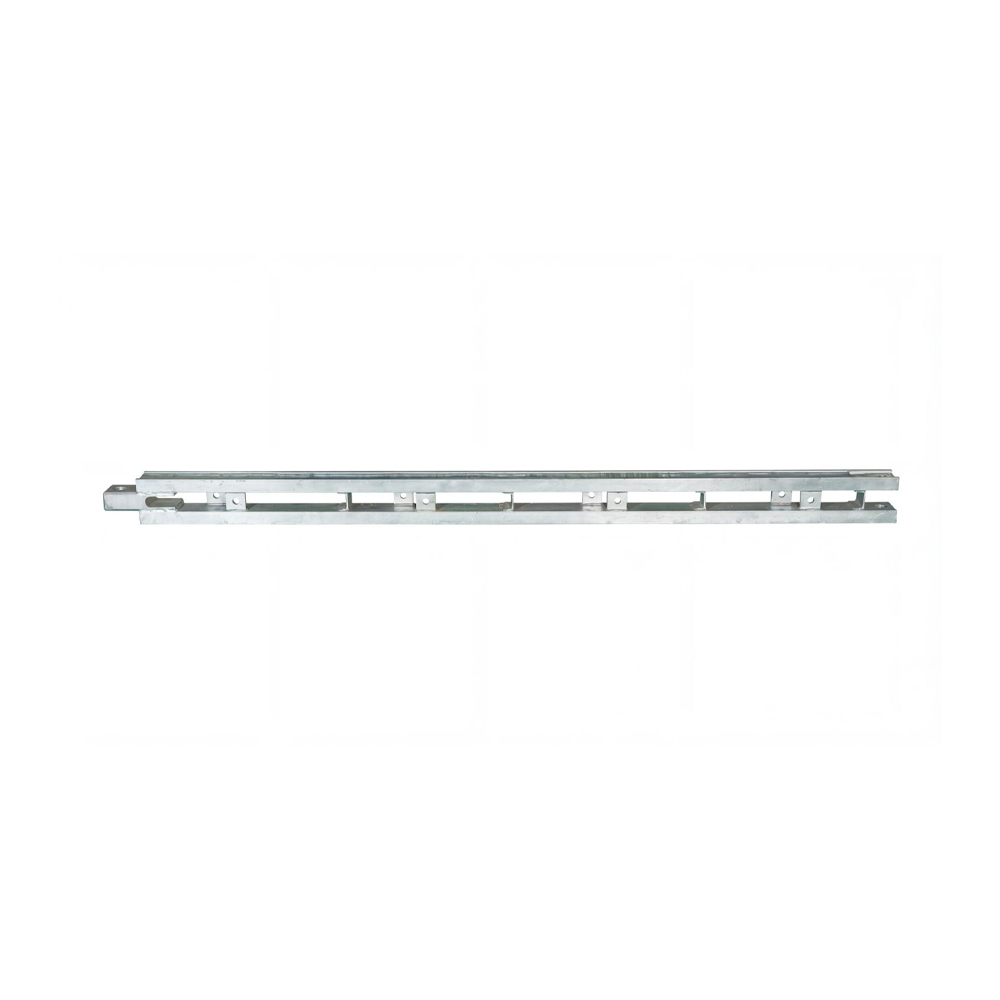
Its product portfolio includes Bailey steel bridges, Type 321 Bailey truss sections, HD200 or Type 200 Bailey truss sections, triangular and diamond hanging baskets, bridge steel formwork, and related engineered steel structures. These products are used in transportation engineering, municipal construction, water conservancy, railway projects, and other applications where temporary or permanent steel systems are required.
Experience across several categories of bridge equipment can provide practical advantages. Engineers who understand Bailey bridge assembly are familiar with modular connections, transport constraints, and field erection. Teams experienced in hanging baskets understand cantilever construction, anchorage, formwork alignment, and repeated movement cycles. Personnel involved in steel formwork can better coordinate surface finish, dimensional tolerances, concrete interfaces, and adjustment mechanisms.
The company also provides customized fabrication, design and system planning, technical support, and quality management. This integrated approach allows customers to discuss the bridge structure, construction sequence, equipment configuration, delivery schedule, and site requirements with a coordinated supplier rather than managing unrelated vendors for each part of the system.
8. Application in Different Construction Environments
8.1 High-Altitude and Mountainous Projects
Mountain bridges often involve deep valleys, steep slopes, limited access roads, and considerable elevation differences. Transporting a heavy traveler or building extensive temporary support below the bridge can be difficult. A modular and relatively lightweight triangular system can reduce the lifting and assembly burden.
The equipment can be delivered in sections and installed through a planned sequence that takes account of the site’s access limitations. The anti-overturning characteristics of the triangular frame are also beneficial where wind exposure is significant. Detailed wind assessment, anchorage design, and temporary stability procedures remain essential.
8.2 River and Waterway Crossings
For river bridges, ground-based falsework may obstruct navigation, alter water flow, or be vulnerable to flood conditions. Cantilever construction supported from piers can reduce the amount of equipment placed in the water. The Triangular Form Traveler operates above the waterway and can be moved along the completed bridge as segments are cast.
Waterway projects require special attention to corrosion protection, wind, humidity, flood levels, rescue arrangements, and restrictions on work over navigable channels. The construction plan should also consider the safe handling of concrete, formwork, and tools at height.
8.3 Urban and Transportation Corridors
Bridges crossing highways, railway lines, and developed urban areas often have limited working space and strict requirements for traffic protection. A traveler that reduces the need for ground-based staging can minimize interference with existing transportation infrastructure.
The lightweight design may also reduce the size of cranes and temporary exclusion zones. However, work over active roads or railways requires carefully coordinated lifting windows, protective platforms, communication systems, and emergency procedures.
8.4 Variable-Depth Bridge Sections
Many balanced cantilever bridges have a deeper box girder near the pier and a shallower section toward midspan. The traveler must accommodate these changes without compromising stability or forming accuracy. Adjustable support members, telescopic elements, interchangeable components, or project-specific modifications may be used depending on the design.
Early coordination between the equipment supplier and the bridge designer is important. The form traveler should be checked against the full range of cross-sectional dimensions, not only the most common segment.
9. Installation and Commissioning Procedure
Installation should follow an approved method statement prepared for the specific bridge. The following sequence describes a general approach and must be adapted to the actual equipment design.
First, the completed pier segment and initial working area are inspected. The contractor confirms concrete strength, anchor locations, embedded components, bridge geometry, and access conditions. Any deviation from the approved drawings should be addressed before the traveler is assembled.
Second, components are received, identified, and inspected. The site team checks for transport damage, missing bolts or pins, coating damage, deformation, and incorrect markings. Damaged structural components should not be installed without engineering assessment and approval.
Third, the main frame and supporting modules are assembled according to the installation drawings. Bolted and pinned connections should be tightened or secured in the prescribed sequence. Temporary supports and lifting devices must be suitable for the calculated loads.
Fourth, the formwork, working platforms, access ladders, guardrails, suspension systems, and adjustment devices are installed. The formwork should be checked for cleanliness, release-agent application, alignment, and compatibility with reinforcement placement.
Fifth, the assembled traveler is aligned with the bridge centerline and adjusted to the required elevation and camber. Surveying instruments should be used to confirm the front and rear positions, crossfall, longitudinal gradient, and key dimensions.
Sixth, the anchoring system is installed and inspected. All anchor bolts, tie rods, bearing plates, locking devices, and load-transfer components must be fully engaged before concrete placement begins.
Seventh, a commissioning inspection is completed. This may include checking platform capacity, access safety, hydraulic or mechanical movement systems where applicable, communication arrangements, lifting points, and emergency stopping procedures. Only after the responsible engineer or authorized supervisor approves the system should casting begin.
10. Operation During Repeated Casting Cycles
During each casting cycle, the traveler should be inspected before reinforcement and formwork operations begin. The team should confirm that the traveler remains correctly anchored, no member has visible damage, all connection devices are secure, and the formwork is in the correct position.
Concrete should be placed according to the approved sequence. Uneven or uncontrolled placement can create temporary eccentric loading that exceeds the assumptions used in the design. The construction team should monitor concrete quantity, placement speed, vibration, temperature, and changes in elevation during casting.
After casting, the concrete must achieve the specified strength before the traveler is released or moved. The release sequence should avoid sudden impact or uncontrolled transfer of load. Any hydraulic jacks, rollers, sliding plates, lifting devices, or temporary supports must be operated by trained personnel.
Before moving, the work area should be cleared and all loose materials secured. The movement path must be checked for interference with reinforcement, prestressing ducts, formwork, utilities, and other equipment. The traveler should move slowly under controlled supervision, with communication maintained between operators at all relevant positions.
Once the traveler reaches the next position, it must be anchored, leveled, aligned, and rechecked. The construction cycle should not be rushed because small errors repeated over many segments can accumulate into significant geometric deviations.
11. Quality Management and Inspection
Quality management should cover both factory production and field use. At the factory, inspections should verify materials, welding, dimensions, connections, coatings, and trial assembly. At the construction site, inspections should verify anchorage, alignment, deformation, wear, movement systems, platforms, and safety accessories.
Inspection frequency should reflect the intensity of use. Critical inspections may be required before the first casting, after unusual loading, after strong wind, after impact, following a long storage period, or whenever abnormal noise, movement, cracking, deformation, or connection loosening is observed.
Common field inspection items include:
1. Cracks, buckling, bending, or corrosion in primary members.
2. Loose, missing, damaged, or incorrectly installed bolts and pins.
3. Deformation or wear at anchor boxes, bearing plates, rollers, and sliding surfaces.
4. Condition of welds and connection plates.
5. Security of suspension rods, tie rods, brackets, and adjustment devices.
6. Integrity of working platforms, guardrails, toe boards, ladders, and access routes.
7. Accuracy of formwork position and bridge segment geometry.
8. Performance of hydraulic or mechanical components, if included.
9. Cleanliness and condition of components exposed to concrete slurry.
10. Correct completion of inspection records and corrective actions.
Maintenance should be preventive rather than limited to emergency repair. Threads, pins, bearings, rollers, sliding surfaces, and adjustment mechanisms should be cleaned and lubricated as appropriate. Damaged coatings should be repaired, and components showing unacceptable wear should be replaced or assessed by qualified engineers.
12. Safety Considerations
Work with a form traveler takes place at height and involves heavy components, fresh concrete, temporary structures, and moving equipment. A safe operation depends on engineering design, competent supervision, worker training, proper personal protective equipment, and disciplined procedures.
The site should establish exclusion zones below and around the traveler. Materials should be secured against falling, and working platforms should have suitable guardrails and toe boards. Workers should use approved fall-protection systems where required. Access routes must remain clear, especially during movement and concrete placement.
Weather conditions should be monitored. High winds, lightning, heavy rain, flooding, or poor visibility may require work to be suspended. The project should define wind limits for casting, inspection, and traveler movement. Emergency procedures should address equipment instability, power loss, hydraulic failure, falling objects, worker injury, and sudden weather changes.
Only authorized personnel should operate movement or adjustment devices. Communication between the operator, signaler, surveyor, and site supervisor should be clear and continuous. A single responsible person should coordinate the movement sequence to prevent conflicting instructions.
13. Economic and Project Management Benefits
The value of a Triangular Form Traveler extends beyond its structural performance. A lighter system can reduce transportation and lifting costs. Faster assembly can shorten the period before the first casting cycle. Predictable deformation can reduce rework associated with alignment and form correction. Reusability can improve the equipment’s economic value over multiple bridge projects.
For contractors, a modular system can simplify project planning. Components can be scheduled for delivery according to the erection sequence, and the equipment can be stored or transported between sites. For owners, efficient cantilever construction can reduce disruption to roads, waterways, railways, and surrounding communities.
Rental or leasing options may also be useful for contractors that do not want to purchase and maintain a complete fleet of specialized bridge equipment. A supplier with design, erection, and technical support capabilities can help match the equipment configuration to the project, reducing the risk of selecting an unsuitable system.
14. Customization and Technical Support
Bridge projects differ in span arrangement, girder geometry, segment weight, construction cycle, environmental exposure, and site access. For this reason, the Triangular Form Traveler should be treated as an engineered system rather than a generic product with a single fixed configuration.
Customization may involve the main frame dimensions, cross beams, formwork support, suspension arrangement, anchorage details, working platforms, moving devices, adjustment mechanisms, and surface protection. The equipment can be planned for a particular bridge cross-section and then checked against the construction sequence.
Technical support is valuable before, during, and after delivery. During the design stage, the supplier can review project parameters and propose a suitable arrangement. During manufacturing, the customer may review drawings, inspection plans, and trial assembly records. During erection, technical personnel can assist with component identification, assembly sequence, alignment, and commissioning. During operation, support can address movement procedures, maintenance, and troubleshooting.
Jinhao’s broader experience with Bailey bridges, launching gantries, hanging baskets, pier formwork, and steel formwork supports this integrated service model. The company’s ability to design, manufacture, erect, and lease bridge-related equipment allows it to serve contractors, government projects, and engineering companies seeking coordinated steel construction solutions.
15. Recommended Selection Checklist
Before selecting a Triangular Form Traveler, the project team should prepare a complete technical checklist. The following questions can help establish whether the proposed configuration is suitable:
1. What are the bridge cross-sectional dimensions and allowable formwork tolerances?
2. What is the maximum length and weight of each cast segment?
3. What are the weight and arrangement of reinforcement, embedded parts, and temporary construction equipment?
4. What are the maximum expected wind loads and temperature conditions?
5. How will the traveler be delivered and lifted to the pier?
6. What anchorage and embedded components are available in the completed bridge segment?
7. What is the required casting cycle and movement speed?
8. Can the traveler accommodate changes in girder depth or width?
9. What access platforms, ladders, guardrails, and fall-protection systems are required?
10. What inspection documents, material certificates, weld records, and trial assembly records will be supplied?
11. What technical support is available during erection and operation?
12. Can the system be adapted, reused, leased, or modified for future bridge projects?
A clear answer to these questions helps ensure that the traveler is selected according to engineering requirements rather than only initial purchase price.
16. Frequently Asked Questions
16.1 What is a Triangular Form Traveler?
A Triangular Form Traveler is a temporary bridge construction system used for casting concrete segments by the balanced cantilever method. Its main load-bearing members form a triangular structure that supports the formwork, fresh concrete, workers, and construction equipment while the bridge segment is being built.
16.2 Why is the triangular structure advantageous?
The triangular arrangement provides geometric stability and a direct force-transfer path. It can improve anti-overturning performance, control deformation, and reduce unnecessary structural weight when properly designed and anchored.
16.3 Is the traveler suitable for all bridges?
It is suitable for many large-span bridge projects using cantilever casting, but suitability must be confirmed through project-specific engineering. Segment weight, bridge geometry, anchorage, wind conditions, construction sequence, and access limitations must all be reviewed.
16.4 Can the traveler be used for variable-depth box girders?
It can often be configured or modified for variable-depth sections. Adjustable supports, formwork components, and suspension arrangements may be required. The full range of bridge geometry should be included in the design review.
16.5 Does a lightweight traveler have sufficient safety?
Lightweight design and structural safety are compatible when the traveler is properly engineered. The system must be checked for strength, stiffness, stability, buckling, fatigue, connection capacity, and temporary construction conditions. Lower self-weight should result from efficient design, not from removing necessary structural capacity.
16.6 How does the traveler control concrete deformation?
The main frame, supports, anchorage, and formwork are designed to provide predictable stiffness. Surveying and adjustment devices are used to set elevation and camber before casting. During concrete placement, the construction team monitors geometry and follows the approved placement sequence.
16.7 How is the traveler moved to the next segment?
After the concrete reaches the required strength, the traveler is released according to the approved sequence and moved using the specified mechanical, hydraulic, rolling, or sliding system. The movement area must be inspected, and all personnel must follow coordinated instructions.
16.8 What manufacturing controls are important?
Important controls include material certification, traceability, accurate cutting, qualified welding, nondestructive testing where required, dimensional inspection, trial assembly, coating inspection, and final documentation. These controls help ensure that the completed equipment matches the approved design.
16.9 Can the equipment be reused?
Yes. A properly maintained traveler can generally be dismantled, transported, inspected, and reused. Before reuse, the main members, welds, connections, anchorage components, moving devices, and formwork supports should be inspected and approved for the next project.
16.10 What support can a specialized supplier provide?
A specialized supplier may provide design assistance, system planning, customized fabrication, erection guidance, commissioning support, operation instructions, maintenance recommendations, leasing, and technical service during construction.
16.11 What documents should be requested from the manufacturer?
Customers should request approved fabrication drawings, component lists, material certificates, welding and inspection records, assembly instructions, operating procedures, maintenance recommendations, load data, adjustment ranges, and quality inspection records.
16.12 What makes this system competitive for difficult sites?
Its combination of anti-overturning stability, relatively low self-weight, modular assembly, adaptable configuration, and accurate formwork control makes it useful for high-altitude, confined, mountainous, urban, river-crossing, and transportation-corridor projects.
17. Conclusion
The Triangular Form Traveler is a practical and efficient system for balanced cantilever construction of large-span bridges. Its triangular main load-bearing structure provides a stable foundation for resisting overturning, distributing construction loads, and controlling deformation. Its relatively lightweight design can simplify transport, lifting, assembly, and movement, particularly where construction takes place at high altitude or in restricted terrain.
The system’s competitive value is strengthened by its direct force path, modular configuration, adaptability to different bridge geometries, and potential for repeated reuse. However, these benefits depend on correct engineering design, reliable anchorage, controlled manufacturing, accurate assembly, and disciplined operation. A successful traveler is the result of cooperation between the bridge designer, equipment manufacturer, contractor, survey team, and safety personnel.
Zhenjiang Jinhao Road & Bridge Supporting Engineering Co., Ltd. offers relevant experience across Bailey bridges, launching gantry systems, hanging baskets, pier formwork, and bridge steel formwork. Its capabilities in customized fabrication, design planning, erection, technical support, leasing, and quality management provide a foundation for delivering integrated bridge construction equipment.
For contractors and engineering companies evaluating equipment for cantilever bridge construction, the Triangular Form Traveler offers a balanced combination of stability, lightweight efficiency, installation convenience, and forming precision. When matched carefully to the bridge design and supported by advanced manufacturing and professional technical service, it can contribute to safer construction, improved geometry control, shorter installation periods, and more efficient project execution.
References
1. General principles of balanced cantilever construction for prestressed concrete bridges.
2. Structural steel design practices for temporary bridge construction equipment.
3. Welding quality management and nondestructive testing procedures for fabricated steel structures.
4. Construction safety principles for temporary works, work at height, and lifting operations.
5. Quality control practices for bridge formwork, launching gantries, and reusable steel construction systems.
6. Technical guidance for concrete segment casting, geometric control, camber adjustment, and construction surveying.
7. Engineering methods for load analysis, stability verification, buckling assessment, and connection design of temporary steel structures.
8. Manufacturer-provided design, fabrication, inspection, assembly, operation, and maintenance documentation for Triangular Form Travelers.
9. Project-specific bridge construction specifications, approved method statements, and site safety plans.


 Français
 Español
 عربى