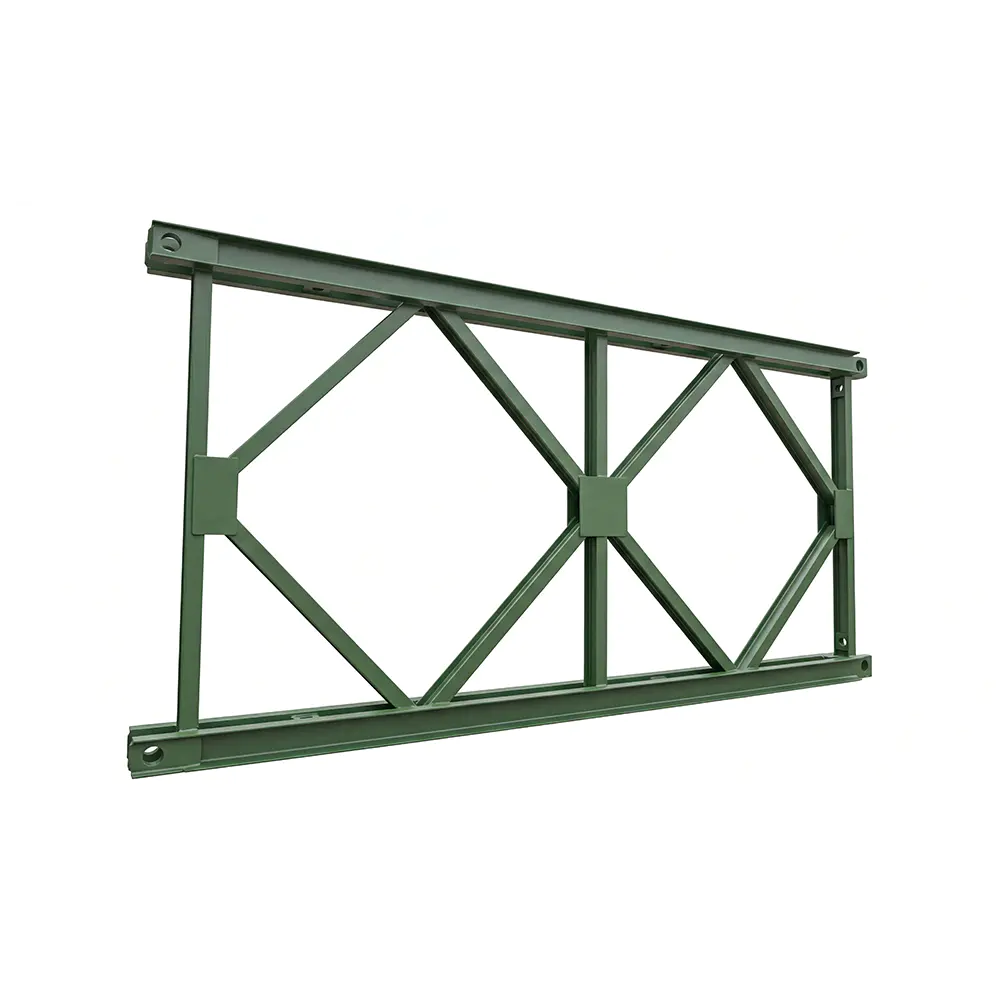
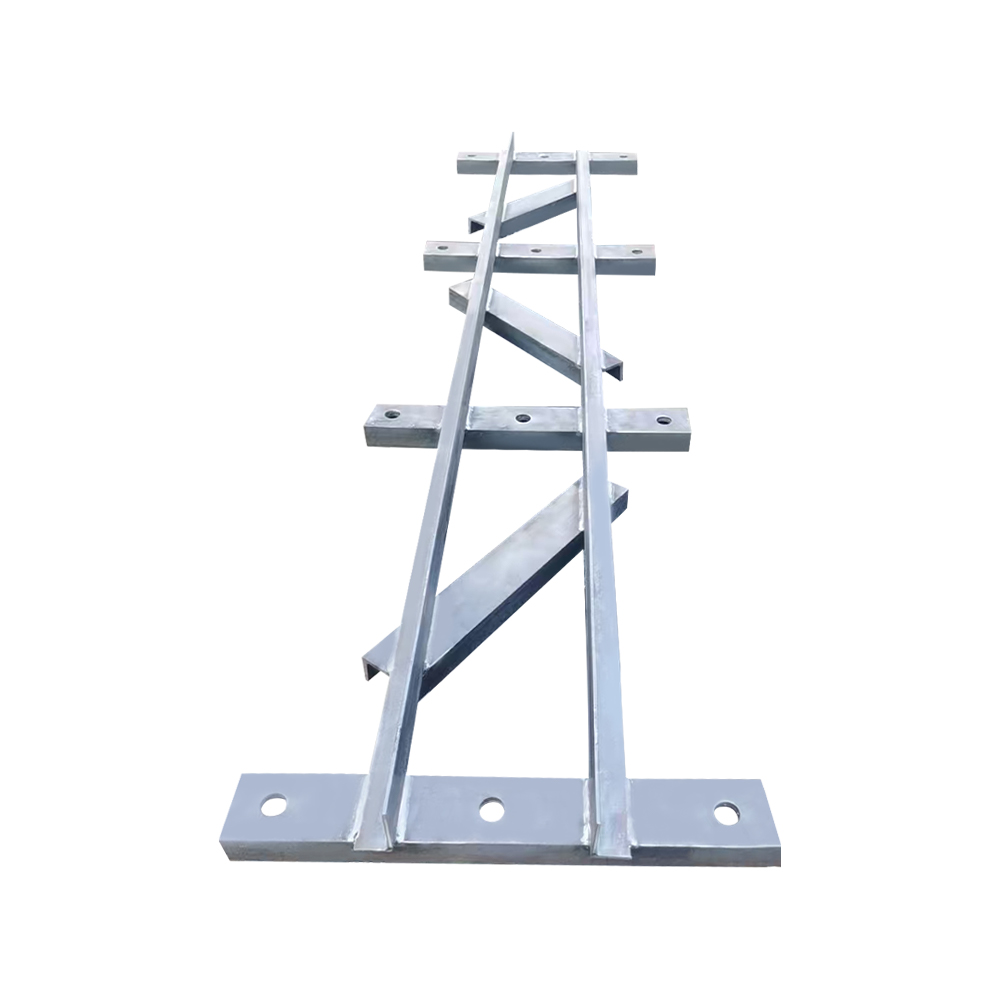
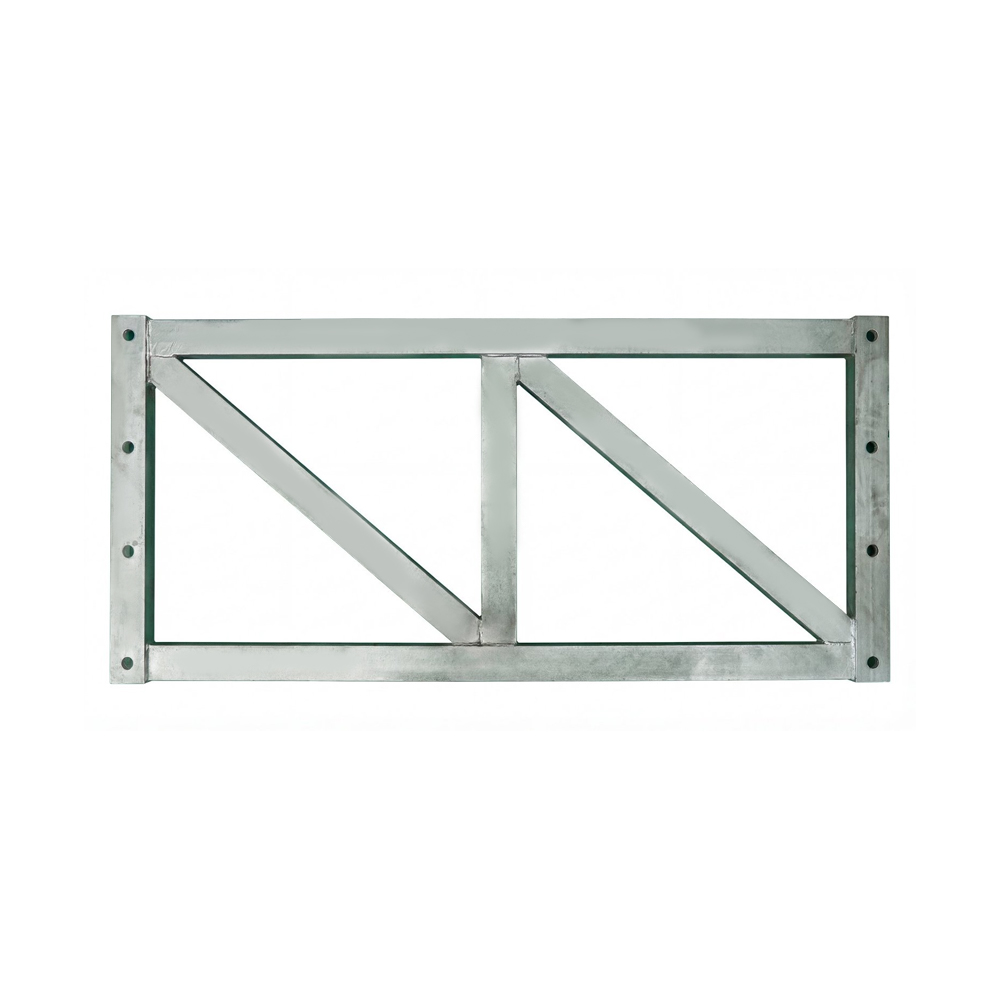
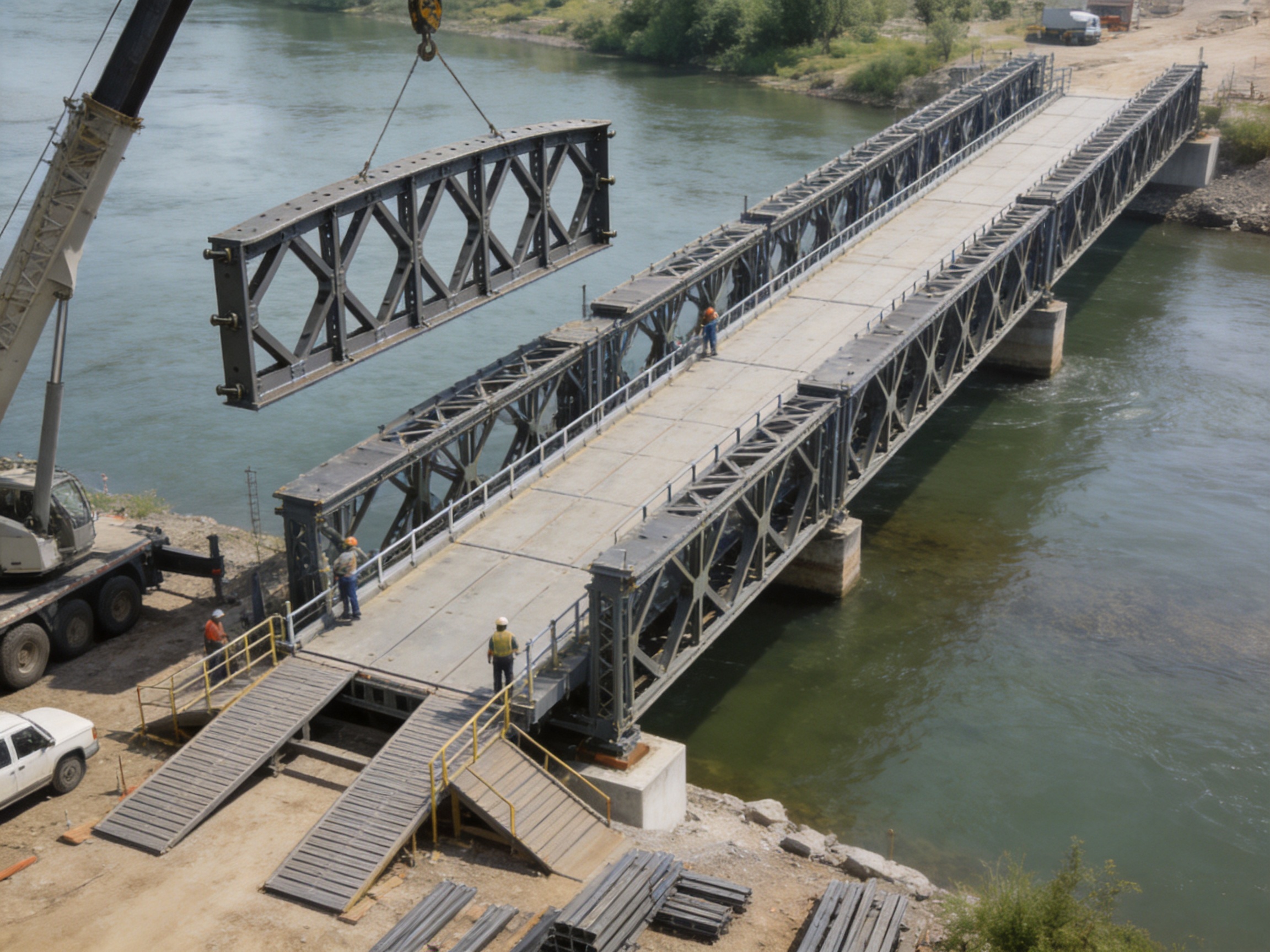
Pre-cambered Bailey bridge panels are engineered steel truss components designed to support the rapid construction of temporary, emergency, semi-permanent, and construction access bridges. By incorporating a calculated camber into each panel during fabrication, the assembled bridge can achieve a flatter operating profile after its own structural weight and service loads are applied. This design approach helps address one of the most important practical concerns in modular bridge construction: controlling deflection while retaining the speed, flexibility, and transportability associated with prefabricated bridge systems.
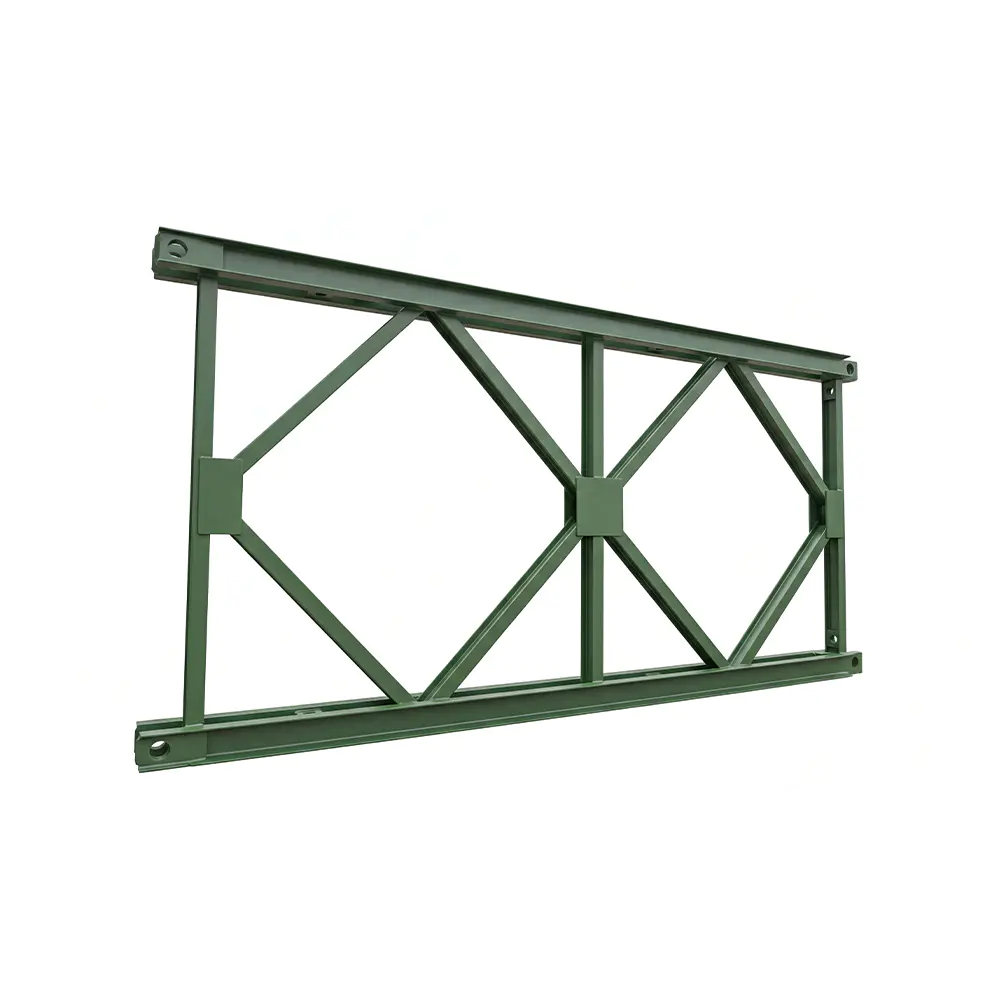
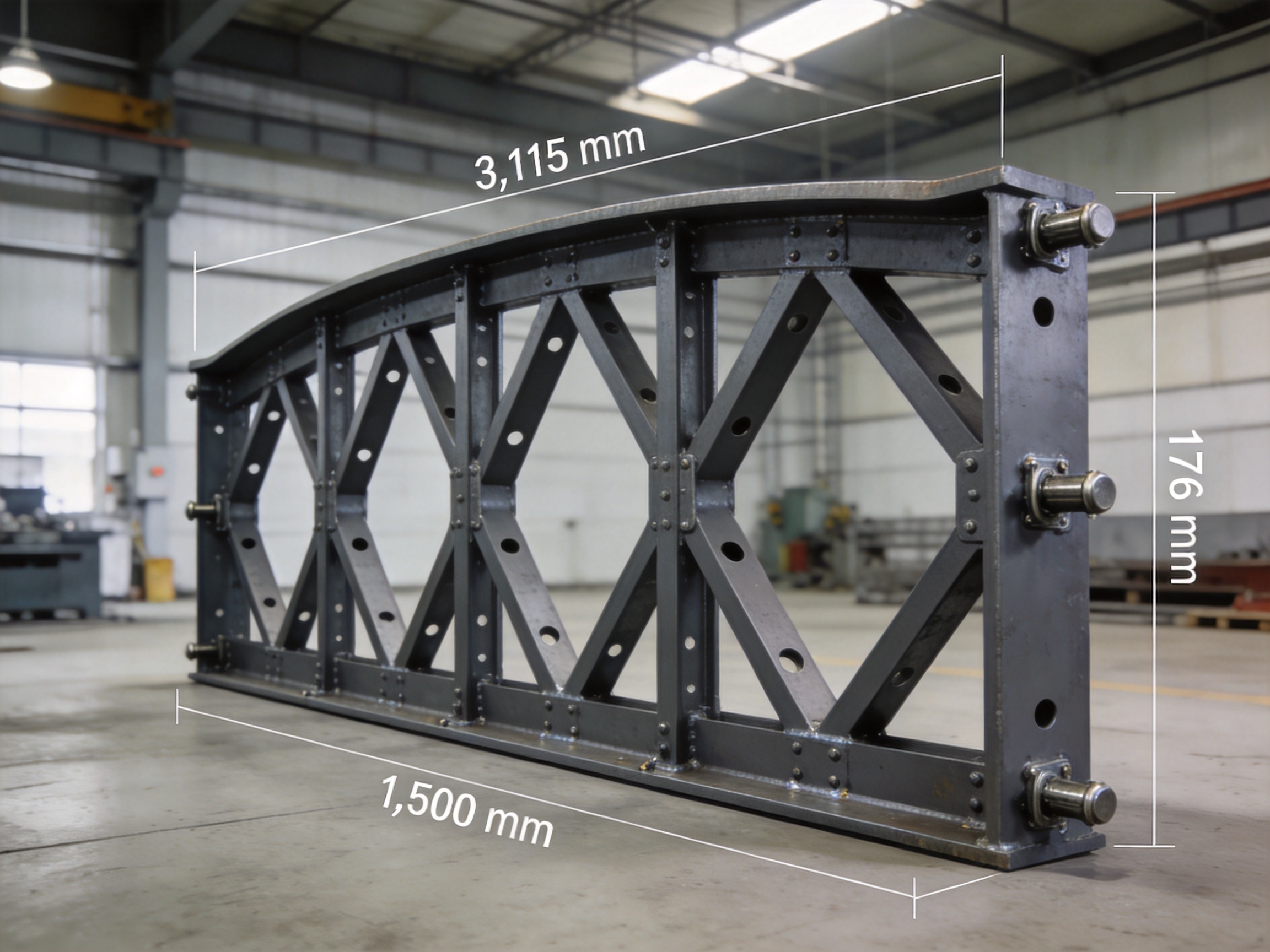
The YG Bailey bridge panel is a representative pre-cambered truss component manufactured from Q355B structural steel. Its external dimensions are 3,115 mm in length, 1,500 mm in height, and 176 mm in width. These standardized dimensions enable efficient connection with compatible modular bridge components while supporting convenient production, shipment, storage, assembly, and replacement.
Unlike conventional site-built bridge structures that require extensive formwork, long construction periods, and significant quantities of equipment, a modular Bailey bridge is assembled from repeatable factory-manufactured components. The panels are connected into trusses, combined with decks, transoms, bracing systems, bearings, ramps, and other accessories, and then erected according to the required span, loading condition, and project environment. This system provides a practical solution where construction speed, temporary access, structural adaptability, and controlled project cost are essential.
Zhenjiang Jinhao Road & Bridge Supporting Engineering Co., Ltd. combines component manufacturing with bridge design support, system planning, erection assistance, leasing services, and steel structure expertise. This integrated capability allows customers to procure more than an individual panel. They can obtain a coordinated modular bridge solution developed around span requirements, traffic conditions, site restrictions, construction sequencing, and expected service duration.
Understanding the Pre-Cambered Bailey Bridge Panel
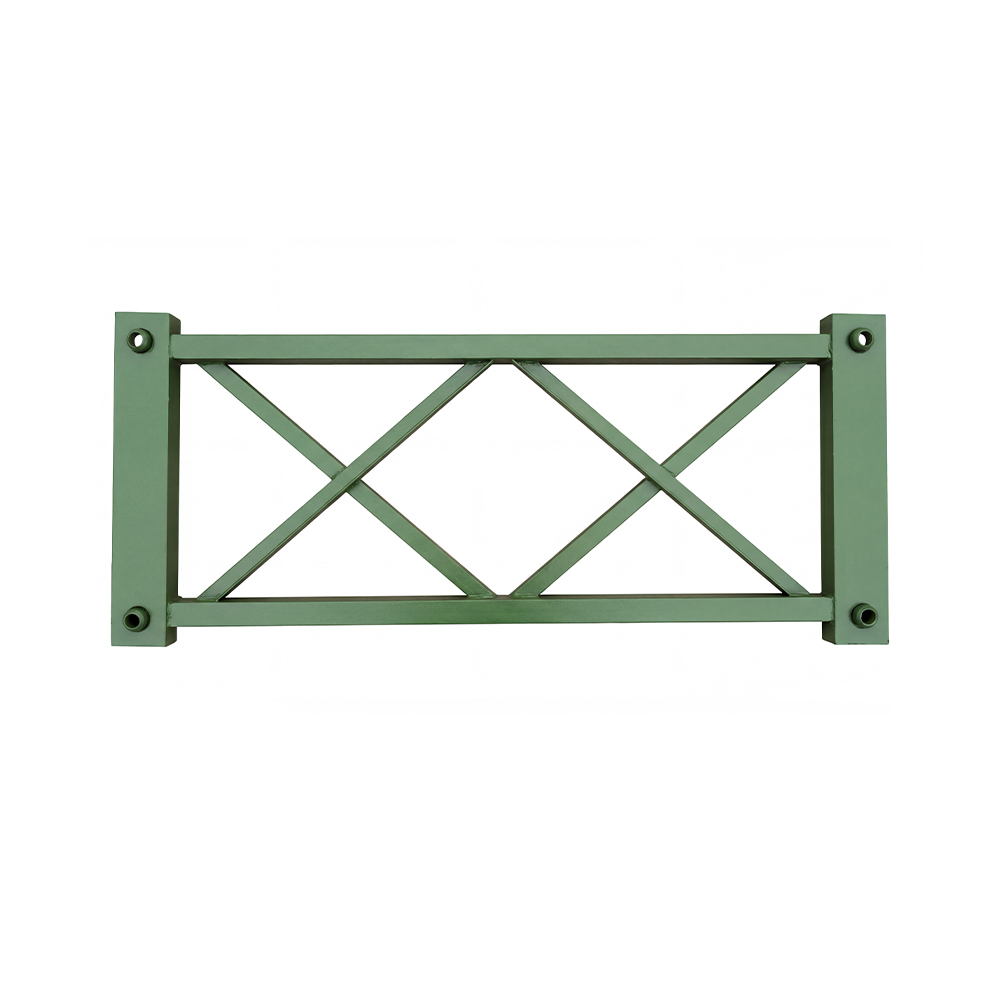
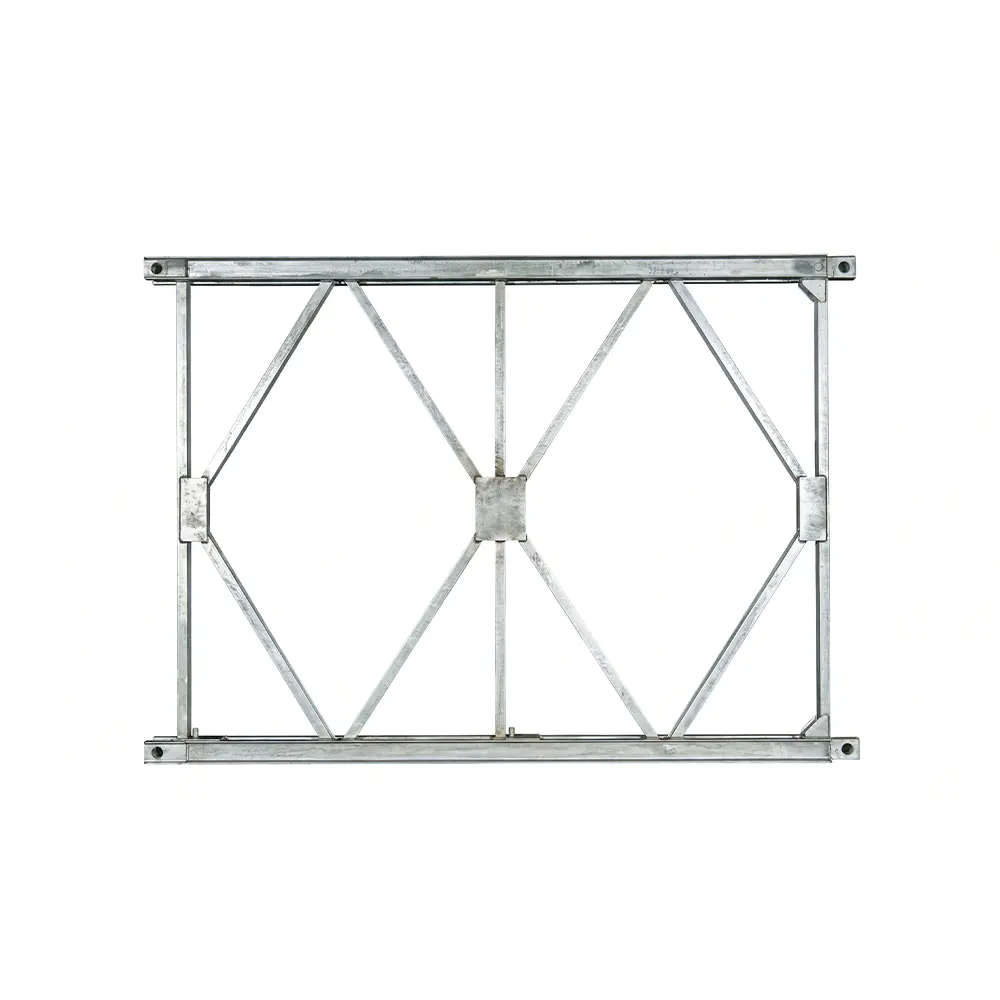
A Bailey bridge panel is a primary truss unit used to form the longitudinal load-bearing structure of a modular steel bridge. Multiple panels are connected end to end and side by side to create trusses with the required length, width, and structural capacity. The panel normally includes top and bottom chords, vertical members, diagonal members, connection details, and standardized pin or bolt interfaces, depending on the applicable bridge system.
In a conventional modular truss, the assembled structure may experience downward deflection under its own weight and under traffic or construction loads. Deflection is a normal characteristic of all flexible bridge structures, but excessive or uncontrolled deformation can affect riding comfort, drainage, deck alignment, connection behavior, and user confidence. Pre-cambering addresses this condition by fabricating the component with a predetermined upward curvature or geometric offset.
The pre-camber value is selected according to the bridge configuration, expected dead load, design live load, span arrangement, material properties, connection conditions, and applicable engineering requirements. During assembly, the individual panels form a slightly raised profile. After the bridge deck, bracing, surfacing, traffic loads, and other permanent components are installed, the structure settles toward the intended design line.
The purpose of pre-cambering is not to eliminate every possible movement under every loading condition. Instead, it provides a controlled initial geometry that compensates for predictable dead-load effects and helps the completed bridge achieve a more suitable service profile. Engineering calculations and project-specific verification remain necessary for each bridge application, particularly where heavy vehicles, long spans, unusual support conditions, or demanding service requirements are involved.
The YG pre-cambered panel is therefore more than a standard flat steel truss member. It is a geometrically controlled component intended to improve the performance of the assembled system. Its value comes from the combination of structural design, accurate fabrication, standardized connections, suitable material selection, and practical field assembly.
Key Product Specifications
Product type |
Pre-cambered Bailey bridge panel |
Model designation |
YG Bailey bridge panel |
External dimensions |
3,115 × 1,500 × 176 mm |
Primary material |
Q355B structural steel |
Structural function |
Modular longitudinal truss component |
Typical applications |
Temporary bridges, emergency bridges, construction access bridges, municipal works, water conservancy projects, and gantry crane systems |
Principal benefits |
Pre-set camber, rapid erection, high load capacity, interchangeability, transport efficiency, and adaptability |
The listed dimensions provide a standardized basis for system integration. Standardization is especially important when bridge components must be combined with previously purchased panels, replacement components, or accessories from the same compatible modular family. Consistent geometry reduces field adjustment, limits installation uncertainty, and allows contractors to plan transportation and lifting operations more efficiently.
Why Pre-Cambering Matters in Modular Bridge Construction
Bridge deflection is influenced by span length, load magnitude, structural stiffness, material properties, connection behavior, deck weight, support settlement, and construction tolerances. A modular bridge must be designed not only to carry load safely but also to maintain a practical service profile. If a bridge settles excessively at midspan, the resulting gradient may affect vehicle movement, surface drainage, expansion details, and the perceived quality of the completed structure.
Pre-cambering introduces a planned geometric allowance before loading. This approach offers several practical advantages:
First, it helps compensate for the self-weight of the assembled bridge. Since modular panels are manufactured with a controlled initial profile, the structure can move toward a more level condition after the permanent dead load is applied.
Second, pre-cambering can improve the appearance of a completed temporary or semi-permanent bridge. A bridge that maintains a well-controlled alignment presents a more professional and reliable solution to road users, project owners, inspectors, and construction teams.
Third, a pre-cambered system can simplify project planning. When the intended geometric behavior is established during fabrication, the erection team has a clearer reference for checking the bridge during assembly. This does not replace surveying or engineering inspection, but it supports more predictable construction control.
Fourth, controlled geometry may reduce the need for improvised correction at the worksite. Site-based modification of structural members can introduce quality risks, delay, and inconsistency. Factory-controlled camber allows the structural correction to be incorporated before shipment, when production conditions are more stable and measurement equipment is more readily available.
Finally, pre-cambering is particularly useful where construction access is limited. Temporary bridges are often installed over rivers, excavations, highways, rail corridors, flood channels, or active work zones. The less adjustment required over the obstacle, the more efficiently the construction team can complete the installation.
Q355B Steel and Structural Performance
The YG panel is manufactured from Q355B steel, a structural steel grade widely used for load-bearing fabrication. The designation indicates a specified yield strength level associated with the grade, while the “B” classification identifies a particular impact toughness and quality category under the relevant material standard. The exact mechanical, chemical, welding, and inspection requirements should be confirmed against the governing project specification and applicable standard.
Q355B is suitable for modular bridge components because it offers a practical combination of strength, weldability, availability, and fabrication performance. Its strength supports efficient load-bearing members without requiring unnecessarily heavy sections. Its fabrication characteristics also make it suitable for controlled cutting, forming, fit-up, welding, inspection, surface preparation, and protective treatment.
Material selection must always be supported by traceability and quality control. A reliable manufacturing process should identify incoming steel by heat or batch number, verify documentation, inspect plate and section condition, and ensure that the material used in production matches the approved technical requirements. These controls are particularly important for bridge components because the panels are repeatedly assembled, transported, loaded, dismantled, and potentially reused.
The use of a standardized structural steel grade also supports repair and replacement planning. Contractors and bridge owners can more readily identify compatible materials for approved maintenance work. When components are used in temporary bridge fleets, consistent material selection simplifies inventory management and helps maintain a predictable level of structural performance across different projects.
Advanced Manufacturing Process
The performance of a pre-cambered Bailey panel depends on much more than the nominal material grade. The panel must be manufactured with accurate geometry, stable welds, consistent connection locations, suitable surface protection, and dependable dimensional repeatability. Jinhao’s manufacturing approach combines engineering preparation, steel processing, controlled assembly, welding management, inspection, and final verification.
Engineering Preparation and Production Planning
Manufacturing begins with the review of product drawings, technical specifications, required camber, connection details, material requirements, and intended application. Production personnel must understand whether the panels will be used in a single-span bridge, a multi-span arrangement, a launching configuration, a construction access route, or another modular system.
Before cutting begins, the manufacturing team develops a production plan that defines the sequence of operations, material utilization, welding procedures, inspection points, handling requirements, and final acceptance criteria. This preparation reduces avoidable variation and ensures that the pre-camber value is treated as a controlled engineering parameter rather than an informal fabrication adjustment.
For customized projects, the engineering process may also consider bridge width, traffic lane arrangement, deck type, support conditions, approach ramps, lateral restraint, erection method, and load class. These factors determine how many panels are required, how the trusses should be arranged, and which accessories must be included in the complete delivery.
Material Inspection and Traceability
Incoming Q355B steel is checked for visible defects, dimensions, identification marks, and supporting material documentation. The steel should be stored in a way that protects it from unnecessary contamination, deformation, and mix-up with other grades. Clear identification is essential when multiple orders or material specifications are being processed at the same facility.
Traceability provides a connection between the finished panel and the original raw material. This information supports quality records, customer documentation, future maintenance, and internal process review. For bridge projects requiring formal inspection files, material certificates and production records can be organized as part of the project quality dossier.
Precision Cutting and Component Preparation
Steel plates, sections, and connection components are cut according to approved drawings and production tolerances. Accurate cutting supports proper fit-up and reduces the need for excessive corrective work. The prepared pieces are then marked, inspected, and organized for assembly.
Connection locations are especially important because Bailey bridge panels depend on repeated interfaces. Small dimensional errors can accumulate when many panels are connected in a long truss. Controlled preparation helps maintain alignment across pin holes, bolt interfaces, end connections, bracing points, and structural member intersections.
Controlled Assembly and Camber Formation
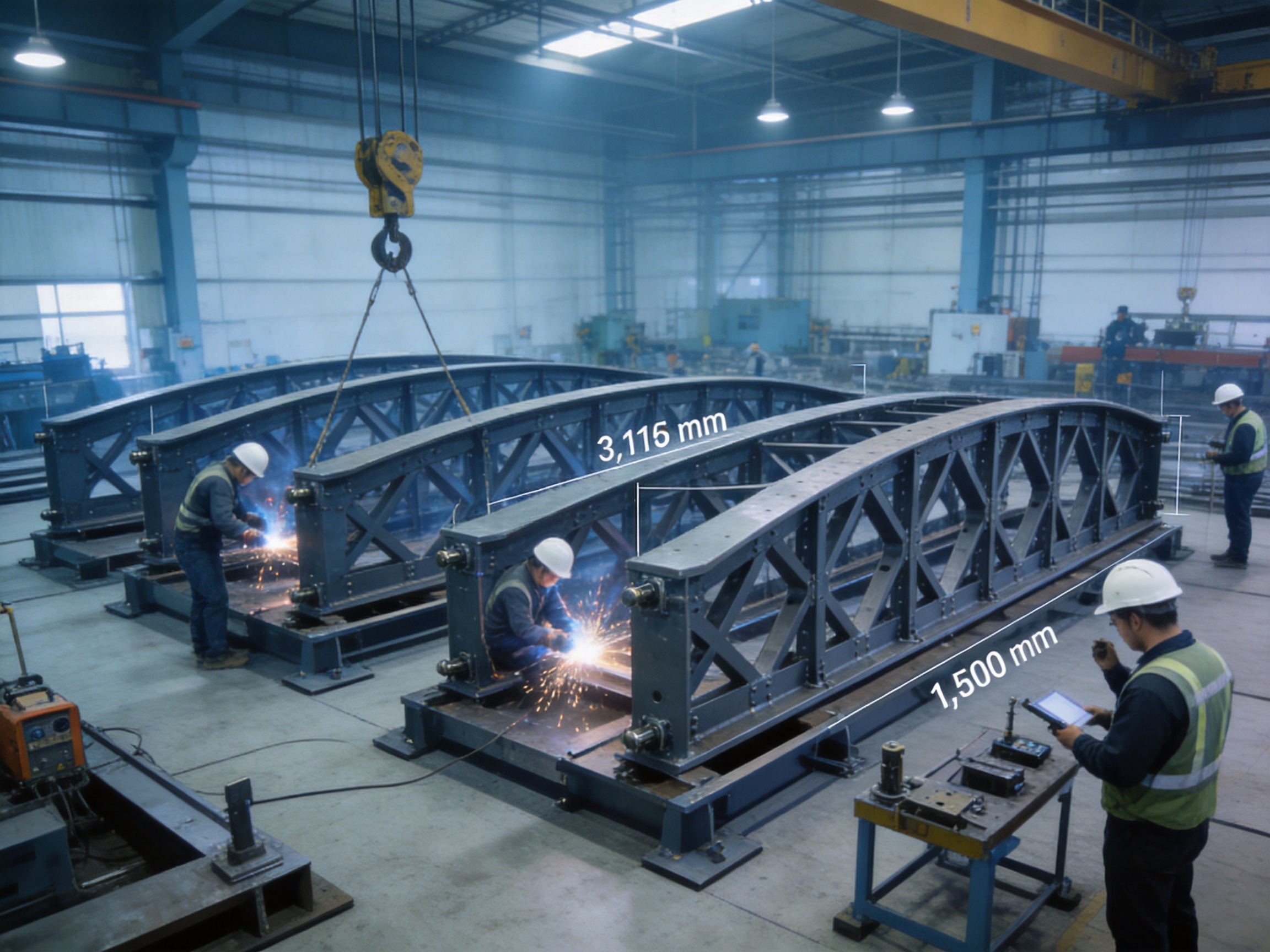
The panel is assembled on a controlled fabrication platform or suitable jig that establishes the required dimensions and pre-camber profile. The assembly fixture helps position the chords and web members accurately while maintaining the intended relationship between connection points.
Camber formation must be carried out in a planned sequence. If members are forced into position without adequate control, residual stresses or dimensional deviations may be introduced. A controlled fixture and an established welding sequence help distribute heat and minimize distortion. The objective is to achieve the required pre-set geometry while maintaining sound structural connections.
The fabrication team checks the panel’s length, height, width, diagonal alignment, connection locations, and camber at defined inspection stages. Measuring during production is more effective than discovering deviations only after all welding and surface treatment have been completed.
Welding Process Control
Welding is one of the most important operations in the manufacture of a steel bridge panel. Weld quality affects strength, fatigue resistance, dimensional stability, and long-term service reliability. Welding personnel should follow qualified procedures appropriate to the material thickness, joint design, welding position, and project requirements.
Important controls include joint preparation, fit-up, preheating where required, welding consumable management, heat input, interpass cleaning, weld sequence, and visual inspection. Where specified, non-destructive testing may be used to identify surface or internal discontinuities. The scope of testing depends on the governing standard, customer requirements, structural details, and risk profile of the project.
Welding distortion is managed through fixture use, balanced welding sequences, controlled tack welding, appropriate heat input, and post-weld dimensional inspection. Because the panel is pre-cambered, distortion control is particularly significant. The fabrication team must distinguish between the intended camber and unintended deformation so that the final product meets the approved geometry.
Surface Preparation and Protection
After fabrication and inspection, the steel surface is prepared for protective treatment. Surface preparation removes contaminants, loose scale, welding residue, and other substances that could reduce coating adhesion. The selected coating system should correspond to the expected environment, storage period, transport conditions, and service duration.
Temporary bridges may be exposed to rain, humidity, mud, splash water, deicing substances, river environments, or industrial conditions. A suitable protective system can help reduce corrosion and extend the useful life of panels that are repeatedly deployed. Coating quality is influenced by surface cleanliness, environmental conditions during application, coating thickness, curing time, edge treatment, and handling after painting.
For projects with special corrosion requirements, customers may specify additional coating systems, galvanized treatment, enhanced edge protection, or inspection documentation. These requirements should be established before production so that the manufacturing process, cost, schedule, and delivery records can be coordinated.
Final Dimensional and Quality Inspection
Before shipment, each panel should undergo final inspection covering appearance, dimensions, connection details, weld condition, camber, marking, coating condition, and packaging. Inspection records provide evidence that the component has been evaluated against the applicable requirements.
Dimensional inspection may include the overall length, height, width, diagonal measurements, connection alignment, and camber profile. The inspection method should be suitable for the panel size and the required accuracy. Where large quantities are produced, sampling plans and process-control records may be used together with individual checks of critical interfaces.
Final identification marks help customers sort components quickly at the project site. Clear markings can identify the model, production batch, orientation, or other information required for assembly. Proper packaging protects pin interfaces, machined surfaces, painted areas, and smaller accessories during transportation.
Advantages Compared with Conventional and Competing Bridge Solutions
Pre-cambered Bailey panels offer a distinct combination of speed, mobility, reuse, and structural practicality. They are not intended to replace every permanent bridge type, but they can outperform conventional site-built approaches in situations where rapid deployment and flexible reuse are priorities.
Faster Project Completion
Because the primary truss components are manufactured in advance, field work focuses on foundation preparation, component delivery, assembly, launching or lifting, deck installation, and finishing operations. This can substantially reduce the time required compared with fabricating a complete steel bridge at the construction site.
Speed is especially valuable for emergency detours, flood response, damaged road crossings, mining access, utility construction, railway works, and urban projects where traffic disruption must be limited. A shorter installation period can reduce indirect costs associated with labor, equipment standby, road closures, and temporary site facilities.
Controlled Factory Quality
Factory manufacturing provides a more controlled environment than open-site fabrication. Materials, tools, fixtures, welding stations, inspection equipment, and production records can be organized systematically. The pre-camber profile is established before delivery, and the panels can be inspected under repeatable conditions.
By contrast, conventional site-built fabrication may be more vulnerable to weather, restricted working space, inconsistent access to lifting equipment, and the pressure of maintaining an active construction schedule. Factory production does not remove the need for field inspection, but it transfers many quality-critical operations to a controlled manufacturing setting.
Modular Interchangeability
Standardized panel dimensions and connection details allow components to be assembled into different bridge configurations. Depending on the system and design, panels may be arranged in single or multiple trusses, with additional reinforcement or bracing used to achieve the required capacity.
Interchangeability also supports maintenance. A damaged or heavily worn panel can potentially be removed and replaced without rebuilding the entire bridge. Owners who operate a component inventory can redeploy panels across multiple projects, improving asset utilization over time.
Efficient Transportation
The panel dimensions are suitable for planned road transportation and organized site handling. Components can be stacked, bundled, and shipped in batches, subject to applicable transport limits and packaging requirements. Their modular nature allows bridge materials to reach sites where transporting a fully assembled bridge would be impossible or uneconomical.
Efficient transportation is important for remote construction sites, disaster areas, temporary bypasses, and projects with limited access roads. Smaller modular units can be delivered in stages, allowing the project team to align deliveries with foundation completion and erection progress.
Adaptability to Different Applications
A Bailey bridge system can be configured for many project purposes. It may serve as a temporary public road, construction access bridge, emergency crossing, pedestrian or service route, water conservancy access structure, or support system for gantry crane operations. The same basic panel family can be integrated into different arrangements when supported by suitable engineering design.
This adaptability provides an advantage over solutions designed for only one fixed location or one permanent geometry. Contractors can use modular components to respond to changing site conditions, phased construction, temporary diversions, and varying project schedules.
Reduced Dependence on Specialized Site Fabrication
Modular bridge assembly generally requires standard lifting, alignment, bolting, pinning, bracing, and decking operations. Although qualified supervision and suitable equipment are still necessary, the process can be more repeatable than constructing a bespoke bridge entirely in the field.
A repeatable erection method supports training, productivity, safety planning, and schedule control. It also allows contractors familiar with modular bridge systems to mobilize their experience from one project to another.
Applications of the YG Pre-Cambered Panel
Temporary Road Bridges
Temporary road bridges are used when an existing route is closed for reconstruction, when a permanent bridge has been damaged, or when a project requires a temporary traffic diversion. The modular panel system can provide a practical crossing while permanent works continue.
The final bridge arrangement should be selected according to vehicle type, traffic frequency, span, width, approach geometry, and local regulations. Traffic control equipment, guardrails, deck surfacing, drainage, and signage should be incorporated into the project plan.
Emergency and Disaster-Response Bridges
Floods, earthquakes, landslides, collisions, and other incidents can interrupt transportation networks with little warning. A prefabricated bridge system can support emergency restoration because components may be stored in advance, transported in sections, and erected comparatively quickly.
The pre-cambered profile is useful in emergency deployment because the bridge must often be assembled under difficult conditions with limited opportunity for extensive site correction. Proper pre-delivery engineering and inspection remain essential, but controlled factory geometry can simplify the field operation.
Construction Access Bridges
Large civil engineering projects frequently require temporary crossings for cranes, trucks, concrete delivery vehicles, excavators, and material transport. A Bailey bridge can provide access across rivers, drainage channels, excavations, roadways, and partially completed infrastructure.
Construction access bridges help separate work traffic from public traffic and can improve the movement of materials around a large project site. Their reusable nature is particularly attractive to contractors managing multiple projects or phased construction programs.
Municipal and Water Conservancy Projects
Municipal works may require temporary access during road widening, utility installation, pipeline construction, drainage improvement, or bridge replacement. Water conservancy projects may need crossings over canals, irrigation channels, floodways, reservoirs, or temporary diversion routes.
In these environments, the bridge must be coordinated with water levels, flow conditions, flood risk, maintenance access, and environmental restrictions. The modular structure can be installed, modified, or removed according to the project phase, provided that the supporting engineering design addresses the site conditions.
Gantry Crane and Temporary Support Systems
Bailey panels can also be used in systems related to gantry cranes, launching arrangements, guide beams, tower columns, bridge erection machines, and other temporary load-bearing configurations. In such applications, the panels may be subjected to load combinations different from those of a normal road bridge.
Each specialized use requires a dedicated design review. The component’s versatility is an advantage, but it should not lead to unverified substitutions. Connections, stability, lateral restraint, impact effects, moving loads, and support reactions must be assessed for the intended configuration.
Engineering and Erection Considerations
A high-quality panel is only one part of a successful modular bridge project. The complete system must be engineered, transported, assembled, inspected, and maintained in a coordinated manner. Jinhao supports customers with design and system planning so that the product can be integrated into a practical project solution.
Site Investigation
Before finalizing the bridge arrangement, the project team should confirm the clear span, ground conditions, support elevations, water levels, access routes, construction equipment, traffic requirements, and environmental constraints. Existing structures and underground utilities should also be considered.
Support conditions have a direct influence on bridge behavior. Uneven bearing elevations, foundation settlement, insufficient lateral restraint, or unstable temporary supports can create problems even when the panels themselves meet their manufacturing requirements.
Bridge Configuration
The number of panels, truss lines, deck arrangement, reinforcement, bracing, and support details should be determined by engineering calculations. A longer span, higher traffic load, or greater construction equipment load may require a heavier or more heavily braced configuration.
The pre-camber value should be considered in the erection sequence. The bridge may initially appear higher at midspan before the deck and permanent components are installed. This condition is expected within the design concept, but the project team should verify the geometry at appropriate stages.
Launching and Lifting
Depending on site conditions, the assembled truss may be launched from one bank, lifted into position in sections, or erected directly over temporary supports. Launching requires careful control of nose configuration, roller positions, counterweights, pushing or pulling forces, and temporary stability.
Lifting requires suitable cranes, rigging, lifting points, ground bearing checks, and a coordinated lifting plan. The erection method should prevent uncontrolled impact, torsion, or local damage to panels and connection components.
Connection Inspection
Pin, bolt, bracing, and deck connections must be installed correctly and checked before the bridge is opened to traffic or loaded with construction equipment. Incorrectly seated pins, missing retainers, loose bolts, misaligned holes, or incomplete bracing can compromise the system.
Inspection should be carried out progressively rather than only at the end. Each completed bay or erection stage can be checked for alignment, connection engagement, bracing installation, and visible damage. A final documented inspection should confirm readiness for service.
Deck and Traffic Safety
The bridge deck must be suitable for the intended vehicles and environmental conditions. Deck panels, timber or steel running surfaces, anti-skid treatment, curbs, guardrails, drainage provisions, and approach transitions should be selected as part of the complete bridge design.
Traffic signs, speed controls, load limits, lighting, barriers, and inspection routines are also important. A modular bridge should not be treated as a stand-alone truss without considering how people and vehicles will interact with it.
Jinhao’s Integrated Company Strengths
Zhenjiang Jinhao Road & Bridge Supporting Engineering Co., Ltd. was established in 2017 and operates in Shangdang Town Industrial Park, Dantu District, Zhenjiang City, Jiangsu Province, China. Its location near major transportation routes supports the movement of raw materials, fabricated components, equipment, and finished bridge systems.
The company has developed from a business focused on construction, industrial, and metal processing materials into a comprehensive enterprise serving the bridge engineering sector. Its activities include the design, manufacture, erection, and leasing of Bailey bridges, bridge launching gantries, hanging baskets, pier formwork, bridge steel formwork, and related engineered steel structures.
This product range provides an important systems advantage. Customers working on bridge construction projects may require access bridges, launching equipment, formwork, temporary supports, and other steel structures at the same time. A supplier with experience across these categories can better understand how separate temporary works interact during construction.
Jinhao’s main product capabilities include Type 321 Bailey truss sections, HD200 or Type 200 Bailey truss sections, triangular and diamond hanging baskets, bridge steel formwork, and related structural products. The YG pre-cambered panel fits within this broader modular bridge and temporary works portfolio.
The company serves contractors, government-related projects, infrastructure organizations, and engineering companies. Its service approach includes customized fabrication, design support, system planning, technical assistance, quality management, and project coordination. These capabilities help customers address the practical issues that often determine project success: compatibility, delivery sequence, erection method, inspection requirements, and future reuse.
A further strength is the company’s emphasis on customer-oriented cooperation. Modular bridge projects frequently involve changing site conditions and detailed coordination between owners, designers, contractors, transport providers, and erection teams. Responsive technical communication can help clarify specifications before production and reduce misunderstandings during delivery.
Quality Management and Reliability
Quality management for Bailey bridge panels should cover the entire product life cycle, from raw material purchasing through manufacturing, delivery, erection, operation, dismantling, storage, and reuse. A reliable supplier recognizes that a temporary bridge may be assembled many times during its service life and therefore must be designed for repeated handling.
Manufacturing quality begins with approved drawings, qualified materials, controlled welding, accurate fixtures, and defined inspection points. It continues with surface protection, careful packaging, transport protection, and technical documentation. Field quality depends on correct assembly, suitable supports, proper connection installation, and compliance with the approved bridge arrangement.
Inspection records may include material certificates, welding records, dimensional inspection reports, coating records, non-destructive testing results where applicable, and final product checklists. The precise documentation package should match the customer’s requirements and the regulations governing the project.
Reliability also depends on design discipline. A modular component must not be used outside its approved configuration without engineering review. For example, increasing span, changing traffic classification, removing bracing, altering support spacing, or applying concentrated construction loads may significantly change the structural behavior.
Jinhao’s combination of manufacturing and engineering support allows these issues to be considered together. The company can help customers select suitable components, develop a bridge arrangement, plan erection, and coordinate the required accessories rather than treating the panel as an isolated commodity.
Logistics, Storage, and Reuse
The modular nature of the panel makes logistics a central part of its value. Before shipment, components should be grouped by project, configuration, and erection sequence. Panels should be protected from impact, excessive moisture, contamination, and deformation during loading and unloading.
At the site, storage areas should be level, stable, and organized. Panels should be supported in a manner that prevents long-term distortion and should not be placed where floodwater, corrosive substances, construction traffic, or uncontrolled lifting operations may damage them.
After dismantling, each panel should be inspected for bent members, damaged connection holes, cracked welds, coating loss, corrosion, and missing accessories. Reuse should be based on inspection and engineering acceptance rather than visual appearance alone. Components that have experienced abnormal impact or overload may require more detailed evaluation.
Efficient reuse can reduce the environmental and financial burden associated with temporary works. Instead of discarding a bridge after one project, owners and contractors can maintain a component inventory and deploy the same panels for future access routes, emergency crossings, or construction stages.
How to Select a Suitable Bailey Bridge Panel Supplier
Buyers should evaluate more than price when selecting a supplier. Important factors include material quality, dimensional consistency, welding capability, pre-camber control, inspection procedures, coating options, production capacity, technical support, delivery planning, and experience with complete bridge systems.
The supplier should be able to explain how the camber is determined, measured, recorded, and verified. It should also clarify which dimensions are standardized, which accessories are available, and how the panels integrate with the customer’s intended bridge configuration.
Customers should request clear information about the applicable material standard, connection details, manufacturing tolerances, surface treatment, packaging, inspection documentation, and warranty or after-sales arrangements. For projects involving public traffic or heavy construction equipment, the supplier should coordinate with the responsible engineer regarding load requirements and system configuration.
Technical responsiveness is another important consideration. A supplier that can provide layout assistance, erection guidance, and practical recommendations may reduce the risk of errors during the transition from design to field assembly. This is particularly valuable for international customers who require clear communication and coordinated documentation.
Jinhao’s experience in Bailey bridges, launching gantries, hanging baskets, bridge formwork, and other steel structures positions it as a suitable partner for customers seeking a broader temporary works solution. Its ability to manufacture customized products while maintaining standardized modular principles supports both individual component orders and complete bridge projects.
Frequently Asked Questions
What is a pre-cambered Bailey bridge panel?
A pre-cambered Bailey bridge panel is a modular steel truss component manufactured with a planned upward curvature or geometric offset. After assembly and application of the bridge’s self-weight, the structure moves toward a flatter profile and can better meet the intended deflection requirements.
What are the dimensions of the YG panel?
The stated external dimensions are 3,115 mm in length, 1,500 mm in height, and 176 mm in width. These dimensions should be confirmed against the approved project drawings and the compatible modular bridge system before ordering.
What material is used?
The panel is manufactured from Q355B structural steel. Material certification, welding requirements, coating specifications, and inspection documentation should be confirmed according to the project standard and customer requirements.
Can the panel be used for a permanent bridge?
Bailey bridge panels are commonly used for temporary, emergency, construction access, and semi-permanent bridge applications. A permanent or long-term installation may be possible in certain projects, but it requires a dedicated engineering review covering fatigue, corrosion protection, traffic loads, foundations, inspection, maintenance, and applicable regulations.
How does pre-cambering improve bridge performance?
Pre-cambering compensates for predictable dead-load deflection and helps the completed bridge approach its intended alignment. It can improve service geometry and reduce the need for field correction, although it does not eliminate all deflection or replace structural calculations.
Can the panels be reused?
Yes. Modular Bailey panels are intended to support repeated assembly and disassembly when properly handled, inspected, stored, and maintained. Reuse should be approved after checking for deformation, corrosion, weld damage, connection wear, and other defects.
What projects commonly use these panels?
Typical applications include temporary road bridges, emergency crossings, construction access bridges, municipal projects, water conservancy works, railway-related construction, gantry crane systems, guide beams, and other temporary steel structures.
Does Jinhao provide complete bridge solutions?
Jinhao provides more than individual bridge components. Its services include customized fabrication, design and system planning, technical support, quality management, erection assistance, and leasing related to Bailey bridges, launching gantries, bridge formwork, hanging baskets, and other steel structures.
What should be confirmed before placing an order?
Customers should confirm span, width, load requirements, traffic type, support conditions, erection method, camber requirements, deck system, corrosion protection, delivery schedule, accessories, inspection documents, and applicable standards. These details allow the supplier to prepare a suitable technical and commercial proposal.
Conclusion
The pre-cambered YG Bailey bridge panel provides a practical balance of structural performance, manufacturing control, transport efficiency, rapid erection, and modular flexibility. Its planned camber helps compensate for predictable dead-load effects, while its standardized geometry supports interchangeability and efficient system assembly.
Manufactured from Q355B steel and produced through controlled material preparation, fabrication, welding, dimensional inspection, surface treatment, and final quality checks, the panel is designed for demanding temporary works and infrastructure applications. Its strengths become especially valuable where access must be restored quickly, construction traffic must cross an obstacle, or bridge components must be reused across multiple projects.
Compared with conventional site-built solutions, the modular pre-cambered approach can reduce field fabrication, shorten installation time, simplify logistics, and provide greater adaptability. Compared with basic non-cambered components, it offers a more controlled initial geometry and a clearer strategy for managing dead-load deflection.
Jinhao’s broader capabilities in Bailey bridges, launching gantries, bridge formwork, hanging baskets, customized steel fabrication, erection support, and leasing allow customers to obtain coordinated temporary works solutions from an experienced engineering manufacturer. With appropriate design verification, quality control, field inspection, and maintenance, pre-cambered Bailey bridge panels can provide dependable service for temporary, emergency, semi-permanent, and construction-related bridge projects.
References
1. Product technical information for the YG Pre-Cambered Bailey Bridge Panel, including stated dimensions, material, applications, and product characteristics.
2. Company profile and manufacturing information for Zhenjiang Jinhao Road & Bridge Supporting Engineering Co., Ltd.
3. General principles of modular steel bridge design, fabrication, erection, inspection, and maintenance.
4. Structural steel fabrication practice, including material traceability, welding procedure control, dimensional inspection, and protective coating application.
5. Engineering guidance concerning bridge deflection, pre-cambering, temporary works, modular truss systems, and construction-stage load assessment.


 Français
 Español
 عربى