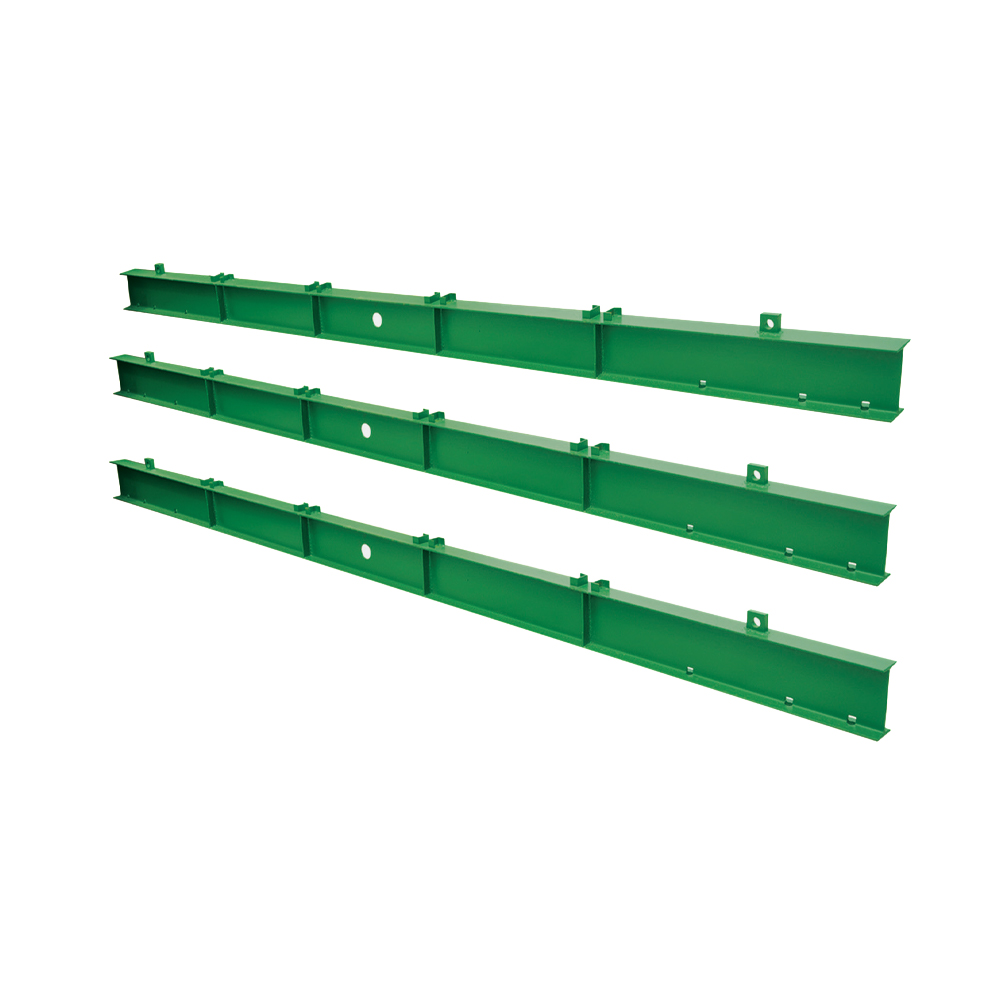
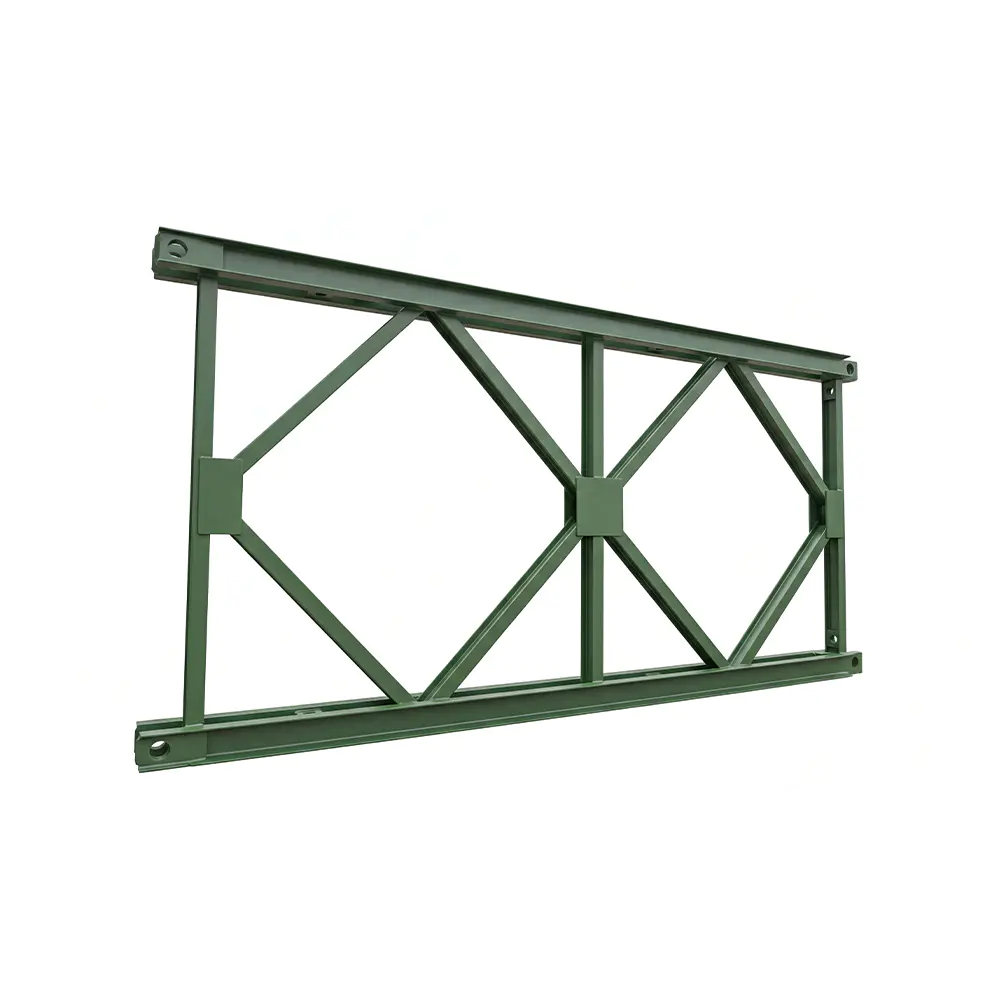
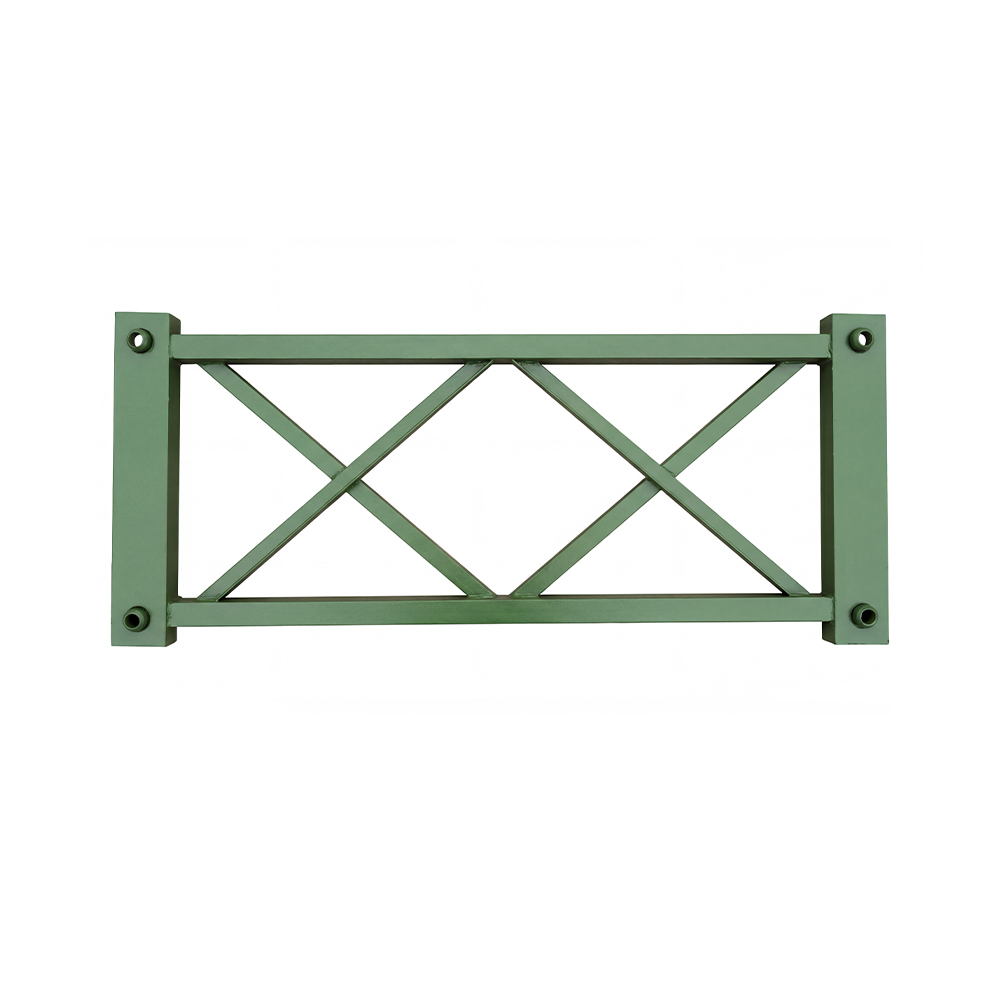
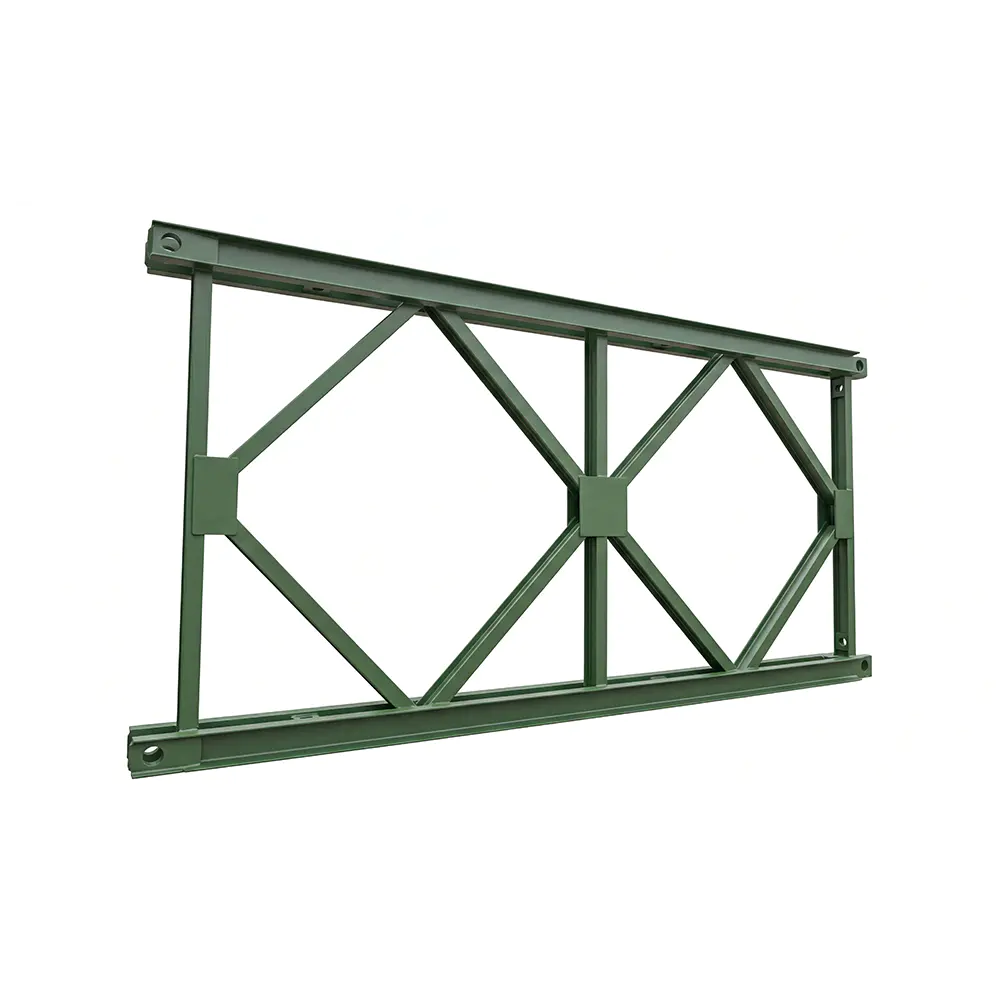
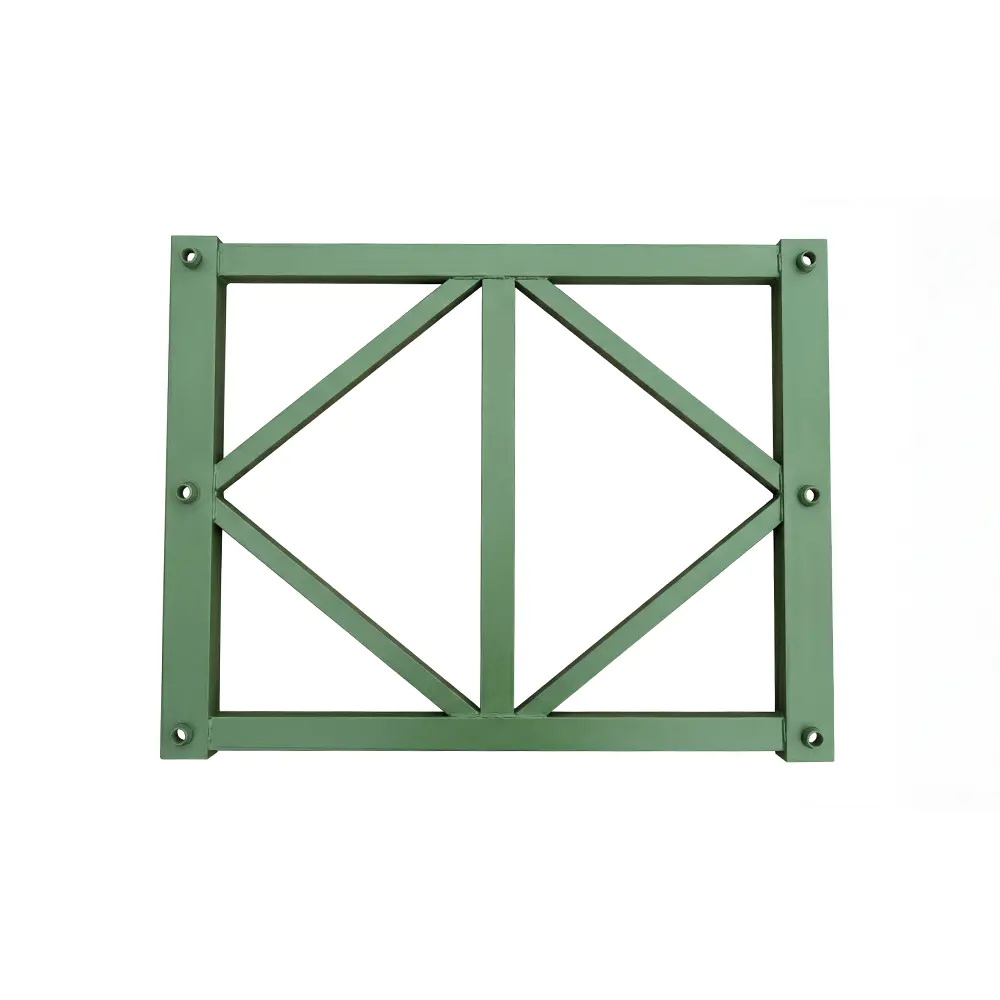
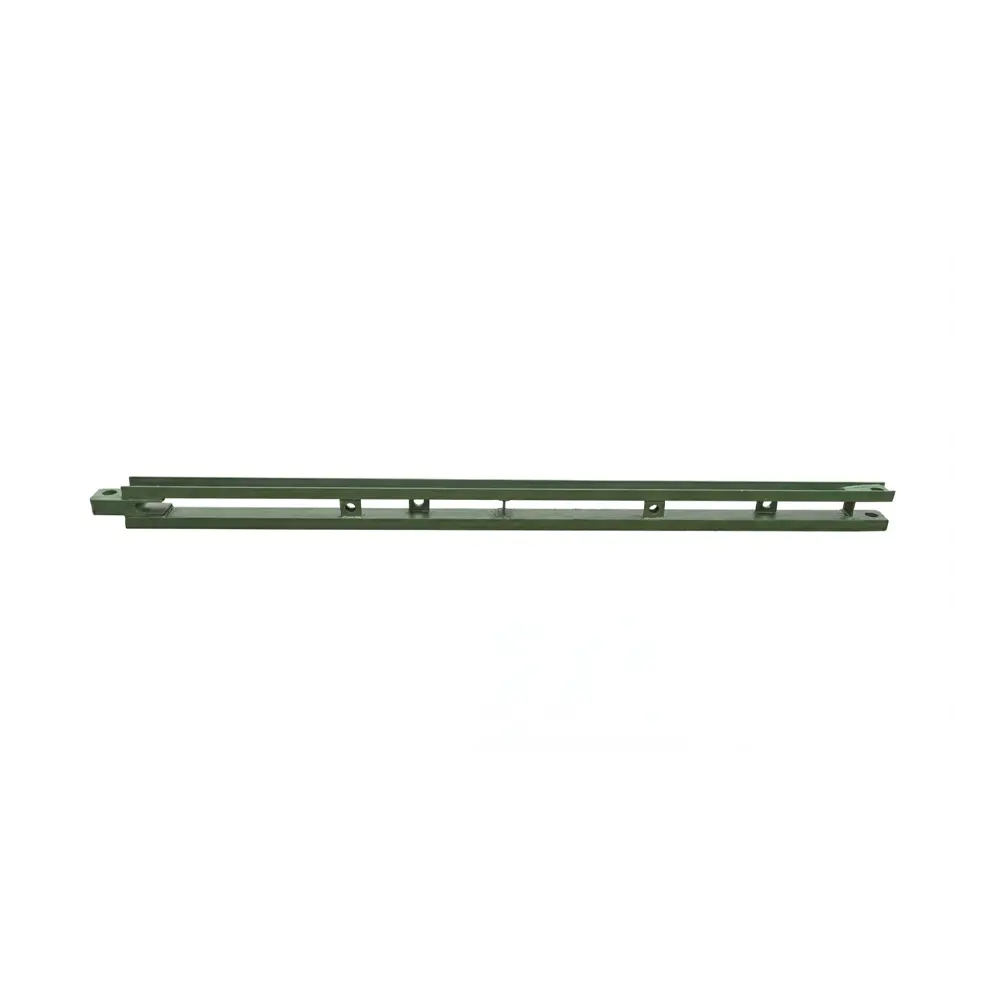
The Type 321 Reinforced Bailey Truss is a strengthening component designed for Type 321 prefabricated highway steel bridge systems and conventional span truss arrangements. It is used to increase the bending resistance, stiffness, and deformation control of Bailey bridge panels, especially in applications where the standard truss configuration must accommodate higher loads, longer effective spans, stricter deflection limits, or more demanding service conditions.
As a modular steel bridge component, the reinforced truss combines standardized geometry with practical site assembly. Its function is not simply to add more steel to a bridge structure. Properly designed and correctly connected reinforcement works with the original Bailey panels to create a stronger and more stable load-resisting system. This makes the component valuable for temporary bridges, emergency crossings, construction access bridges, military or civil defense applications, municipal infrastructure, water conservancy works, railway construction support, and semi-permanent transportation facilities.
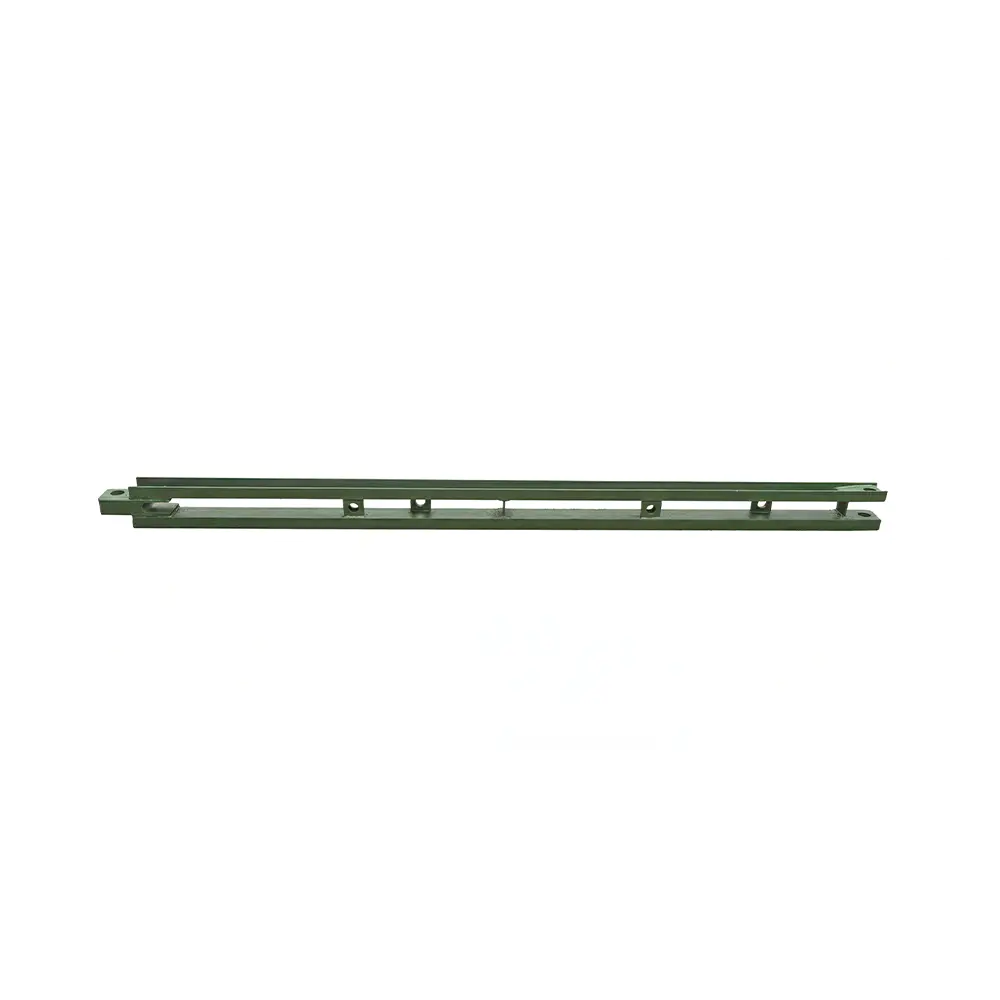
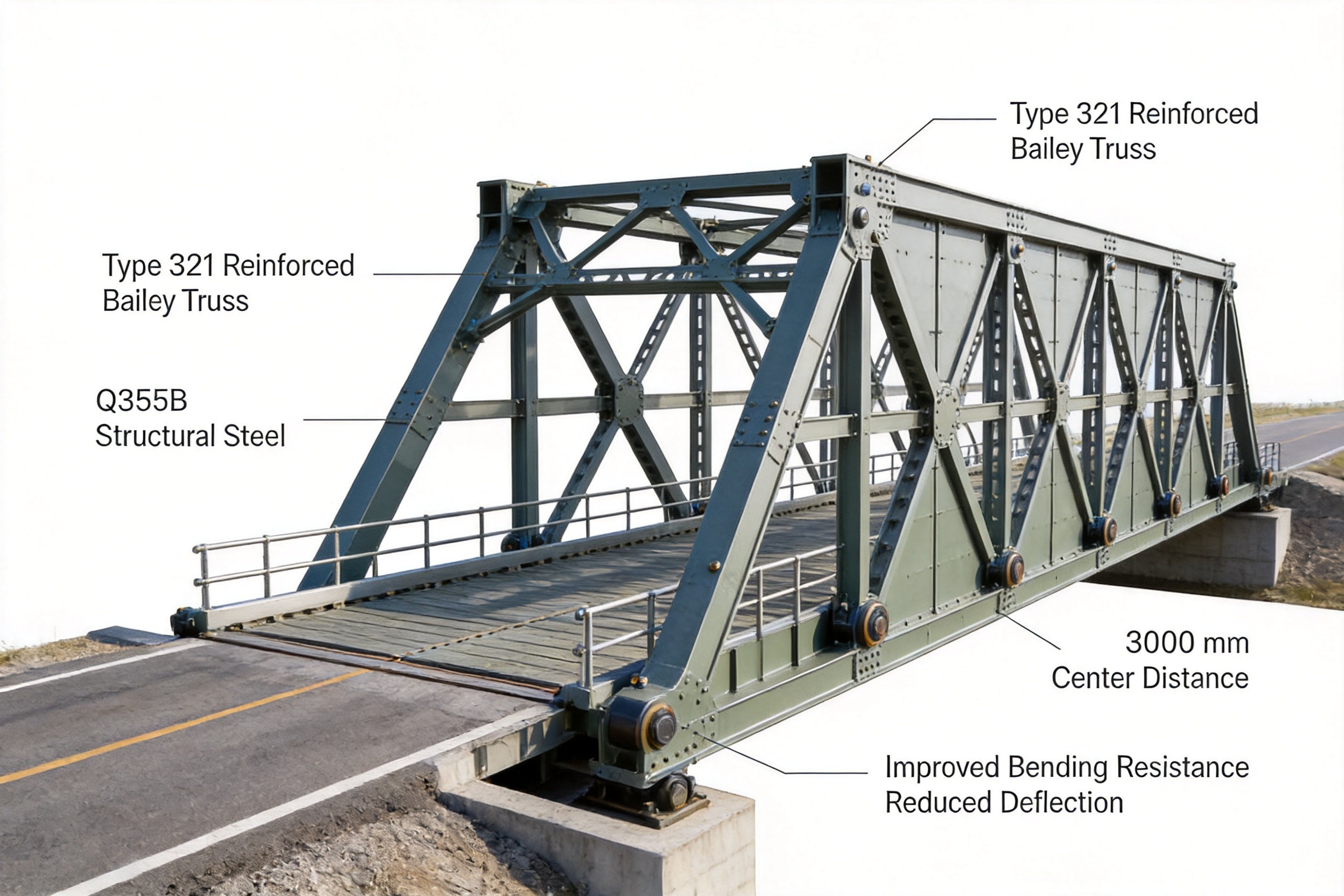
The component described in this article has outer dimensions of 3115 × 100 × 176 millimeters, a nominal center distance of 3000 millimeters, and is manufactured from Q355B structural steel. These standardized characteristics allow it to integrate with Type 321 Bailey bridge panels and related modular bridge accessories while supporting efficient transportation, handling, erection, inspection, and replacement.
1. The Role of Reinforcement in a Type 321 Bailey Bridge
A Bailey bridge is assembled from prefabricated steel panels, transoms, bracing members, deck components, ramps, and connection hardware. Its principal advantage is modularity: bridge elements can be transported in manageable units and assembled rapidly without requiring a large permanent construction plant at the site. However, every modular system has defined structural limits. When span length, vehicle loading, traffic frequency, environmental conditions, or deflection requirements increase, the basic panel arrangement may require additional reinforcement.
The Type 321 Reinforced Bailey Truss addresses this requirement by strengthening the main truss system. It is rigidly connected to the upper and lower chords of the Type 321 Bailey bridge panels. Through this connection, the reinforcement contributes to the overall resistance of the truss against bending and deformation. The result is a more stable structural assembly with greater stiffness at critical regions, particularly around the mid-span of a simply supported bridge arrangement.
Under vehicle loading, a bridge truss experiences a combination of bending, shear, axial force, local stress, and connection force. The upper chord generally experiences compression in a typical simply supported span, while the lower chord generally experiences tension. The web members transfer forces between these chords. As the span becomes more demanding, the main truss may experience increased chord forces and greater vertical deflection. Reinforcement helps distribute these actions through an expanded load-resisting arrangement.
The component is therefore best understood as a structural enhancement rather than an independent bridge. It works as part of a coordinated system that includes the original Type 321 panels, panel pins, transoms, sway bracing, deck units, bearings, ramps, and foundations. Engineering design remains essential. The number of reinforced trusses, their arrangement, the bridge width, the span, the support conditions, the live load, and the required service life must all be assessed before installation.
2. Principal Product Specifications
The dimensional and material information of the Type 321 Reinforced Bailey Truss is summarized below.
| Item |
Specification |
Engineering Significance |
| Product |
Type 321 Reinforced Bailey Truss |
Strengthening component for Type 321 Bailey bridge panel systems |
| Outer dimensions |
3115 × 100 × 176 mm |
Provides standardized geometry for system integration and handling |
| Nominal center distance |
3000 mm |
Supports alignment with the modular panel arrangement |
| Material |
Q355B structural steel |
Provides a strong and weldable structural material for bridge fabrication |
| Primary function |
Truss reinforcement |
Improves bending capacity, stiffness, and deformation resistance |
| Typical use |
Type 321 prefabricated highway steel bridges |
Suitable for temporary, emergency, construction, and semi-permanent bridge systems |
The stated dimensions are important for compatibility. In a modular bridge, even a small dimensional deviation can affect pin alignment, chord connection, bracing installation, deck positioning, or the ability to interchange components. Standardized manufacturing therefore supports not only structural performance but also rapid field assembly and maintenance.
Q355B is a commonly used structural steel grade with a favorable balance of strength, toughness, weldability, and availability. The exact mechanical properties used for design should be confirmed through current material certificates and the applicable project standards. Steel grade alone does not determine the capacity of a finished component. Plate thickness, weld quality, geometric accuracy, connection detailing, corrosion protection, fabrication tolerances, and inspection records are equally important.
Type 321 - Reinforced Bailey Truss
3. How the Reinforced Truss Improves Structural Performance
3.1 Increased bending resistance
The most important advantage of the reinforced truss is its contribution to the bending resistance of the Bailey bridge panel system. A bridge span behaves differently under light and heavy loading. Under light loading, the standard panel arrangement may provide adequate strength and acceptable deflection. Under heavier loading, chord forces and mid-span bending effects increase. Reinforcement helps the system resist these effects by adding a coordinated load path.
When the reinforcement is properly connected to the upper and lower chords, the effective structural depth and force distribution of the truss system can be improved. A greater effective resisting arrangement generally helps reduce chord stress and improves the ability of the bridge to carry repeated vehicle loads. The resulting system may be suitable for higher load grades than an unreinforced arrangement, subject to engineering verification.
3.2 Improved stiffness and reduced deflection
Strength and stiffness are related but not identical. A structure may have sufficient ultimate strength while still experiencing excessive service deflection. Excessive movement can affect vehicle comfort, deck performance, connection behavior, drainage, approach transitions, and public perception of safety.
The Type 321 Reinforced Bailey Truss increases the stiffness of the truss arrangement and helps control vertical deformation. This is especially useful in longer temporary spans, heavily trafficked construction routes, emergency bridges carrying loaded trucks, and semi-permanent installations where users expect a more stable riding surface.
Reduced deflection also helps maintain more consistent contact between the deck system and its supporting transoms. This can reduce undesirable local effects and support better distribution of wheel loads. Nevertheless, the final deflection must be calculated according to the actual bridge configuration and applicable design code. Reinforcement is an important structural measure, but it does not replace complete bridge analysis.
3.3 Better resistance to deformation at mid-span
Mid-span is normally one of the most critical regions in a simply supported truss because bending moment commonly reaches its maximum there. The reinforced component is particularly valuable in this region because it helps the truss retain its designed geometry under service loading.
Maintaining geometry is important for modular structures. If a panel system experiences excessive distortion, pin holes and connection surfaces may become difficult to align during installation or future dismantling. A stiffer truss arrangement can help preserve the designed relationship among chords, diagonals, transoms, and deck units.
3.4 Expanded load-grade possibilities
One of the practical reasons for selecting reinforced Bailey components is to expand the applicable load grades of a standard modular system. Contractors and bridge owners may need to accommodate different vehicle weights, axle configurations, traffic frequencies, or construction machinery. Reinforcement can provide a flexible method for adapting the bridge system without abandoning the basic Type 321 modular platform.
The appropriate arrangement must be determined by a qualified engineer. A reinforced bridge is not automatically suitable for every load. The assessment should consider dead load, live load, impact, braking forces, wind, seismic actions where applicable, temperature effects, fatigue, support settlement, foundation capacity, and local site conditions.
4. Advantages Compared with Less Integrated Reinforcement Methods
Several methods can be used to strengthen a modular steel bridge, including adding separate beams, welding site-built plates, increasing the number of panels, reducing the span, or installing temporary supports. The Type 321 Reinforced Bailey Truss offers several advantages when compared with improvised or less integrated alternatives.
4.1 Standardized compatibility
The reinforced truss is manufactured for the Type 321 panel system. Its standardized dimensions and center distance support coordination with existing bridge components. This is generally more efficient than designing a one-off reinforcement member at the construction site, where dimensional uncertainty, inconsistent fabrication, and difficult inspection can create delays.
Standardized compatibility also improves interchangeability. If a component is damaged during service or requires replacement during maintenance, a matching modular element can be sourced and installed more readily than a custom-fabricated field solution.
4.2 More predictable installation
Modular bridge erection depends on a clear sequence and repeatable connections. Components that are designed for the same system reduce the need for extensive on-site modification. This helps crews plan lifting, positioning, bolting, pinning, alignment, and inspection activities before work begins.
Predictable installation is particularly valuable for emergency bridge projects, where limited time and restricted equipment may be available. It is also useful in remote locations, where welding machinery, precision cutting equipment, and specialist labor may not be easily accessible.
4.3 Lower dependence on site welding
Field welding can be affected by weather, access, power supply, surface preparation, welder qualification, preheating, distortion, and inspection requirements. A prefabricated reinforcement component shifts most manufacturing operations into a controlled factory environment. Site crews can then focus on positioning and mechanical connection rather than performing extensive structural welding over a river, roadway, railway, or construction excavation.
Reducing site welding does not eliminate the need for inspection. Bolted or pinned connections still require correct installation, and all structural interfaces must be checked. However, factory-controlled fabrication can make quality management more consistent.
4.4 Efficient transport and handling
The component is sized as a manageable modular element. Its compact geometry supports stacking, loading, unloading, and lifting with commonly available construction equipment. Efficient handling can reduce transportation cost and shorten the time between delivery and erection.
4.5 Better adaptability than permanent bridge alternatives
Compared with a conventional cast-in-place or fully permanent steel bridge, a reinforced Bailey system can be deployed more quickly and can often be dismantled, relocated, or reconfigured. This is a major advantage for temporary access, flood recovery, construction staging, military logistics, and changing transportation requirements.
5. Manufacturing Process and Quality Control
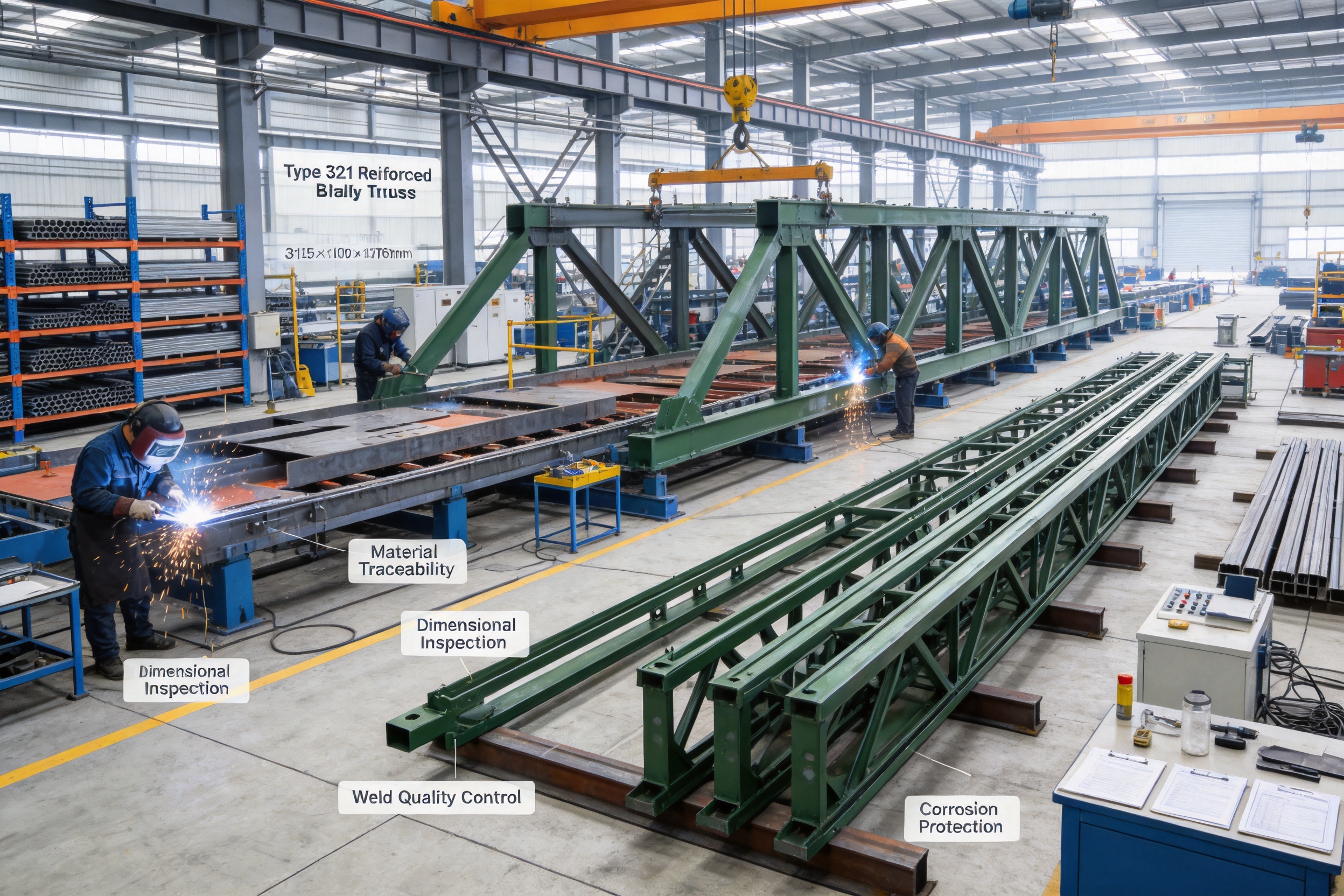
The performance of a reinforced truss depends heavily on manufacturing quality. A well-designed component can lose much of its value if material identification, dimensional control, welding, straightness, connection geometry, or corrosion protection is poorly managed. Advanced manufacturing therefore begins with process control rather than with the final visual appearance of the product.
5.1 Engineering review and production planning
Manufacturing begins with a review of the product drawings, material grade, dimensions, weld details, connection requirements, tolerances, and inspection criteria. Production planning should confirm how the component will be cut, formed, assembled, welded, inspected, finished, marked, stored, and packed.
For modular bridge components, production planning must also address repeatability. The objective is not merely to fabricate one acceptable piece. It is to produce a series of components with consistent dimensions and connection geometry so that each unit can be interchanged within the Type 321 system.
5.2 Material sourcing and traceability
Q355B steel should be purchased from controlled sources with appropriate material certification. Incoming materials can be checked for grade, thickness, surface condition, dimensions, and identification markings. Material traceability links the finished component to the original steel certificate and the relevant production batch.
Traceability is especially important for bridge structures because it supports quality documentation, future maintenance, investigation of defects, and project approval. Marking and records should be maintained throughout cutting, assembly, welding, inspection, and shipment.
5.3 Precision cutting and preparation
Steel plates and sections should be cut according to approved drawings and controlled production data. Precision cutting helps achieve consistent component dimensions and reduces excessive grinding or correction. Cut edges should be inspected for unacceptable notches, cracks, slag, excessive roughness, or other defects that could affect fit-up or fatigue performance.
Where welding is required, edge preparation must match the approved weld procedure. Clean, correctly prepared surfaces support proper fusion and reduce the risk of inclusions, lack of penetration, and incomplete fusion.
5.4 Fixture-based assembly
Assembly fixtures and jigs are valuable for modular bridge fabrication. They hold members in the correct position during tack welding and final welding, helping maintain the specified center distance, overall dimensions, straightness, and connection alignment.
Fixture-based assembly offers a major advantage over uncontrolled manual positioning. It reduces cumulative dimensional error and helps ensure that each reinforcement unit follows the same geometry. This repeatability is essential when the component must connect to standardized Type 321 panels in the field.
5.5 Controlled welding operations
Welding should be performed under approved procedures by qualified personnel. Important controls may include welding consumable selection, preheating where required, interpass temperature, welding sequence, heat input, joint cleanliness, and protection from adverse weather conditions.
Welding sequence is particularly important for slender or elongated steel components. Uneven heat input can cause distortion, residual stress, or misalignment. A planned sequence can reduce these effects and support accurate final geometry.
Factory welding also makes it easier to establish stable working conditions. Welding stations can be arranged for safe access, proper lighting, lifting assistance, and consistent inspection. This contributes to more reliable weld quality than uncontrolled field fabrication.
5.6 Dimensional inspection
After fabrication, the component should be inspected for length, width, depth, center distance, straightness, squareness, connection locations, weld size, and surface condition. Measuring tools may include calibrated steel rules, tapes, gauges, templates, levels, squares, and specialized dimensional equipment.
Dimensional inspection is not a cosmetic exercise. A component that is only slightly out of alignment may create problems when multiple panels are connected over a long span. Accurate inspection at the factory reduces installation difficulties and helps preserve the interchangeability of the modular system.
5.7 Weld inspection and non-destructive testing
Visual inspection is the first level of weld quality control. Inspectors look for cracks, undercut, overlap, porosity, arc strikes, incomplete profiles, excessive spatter, and other visible imperfections. Depending on the design and project requirements, additional non-destructive testing may include magnetic particle testing, ultrasonic testing, dye penetrant testing, or radiographic testing.
The appropriate inspection method depends on the weld type, thickness, accessibility, loading requirements, and governing standards. Inspection records should identify the component, weld location, test method, result, inspector, and date. Any repair should be controlled and re-inspected.
5.8 Surface treatment and corrosion protection
Steel bridge components may be exposed to rain, humidity, mud, deicing salts, industrial pollution, river spray, or coastal conditions. Surface preparation and coating are therefore important aspects of service performance.
Before coating, the steel surface should be cleaned to remove oil, rust, mill scale, moisture, welding residue, and other contaminants. The selected coating system may include a primer, intermediate coat, and finishing coat, depending on the intended exposure and project specification. Coating thickness, curing time, environmental conditions, and damaged areas should be controlled and recorded.
For temporary bridges, the coating system still matters because a component may be dismantled and reused several times. Good corrosion protection helps preserve section thickness, connection surfaces, and overall appearance during storage and repeated deployment.
5.9 Final marking, packing, and documentation
Finished components should be marked with product identification, batch or serial information where required, material traceability references, and handling indicators. Packing should prevent impact damage, excessive abrasion, standing water, and loss of small accessories.
Typical quality documentation may include material certificates, fabrication inspection records, weld inspection reports, dimensional inspection results, coating records, packing lists, and product instructions. Such documentation supports project acceptance and provides useful information for future maintenance.
6. Company Manufacturing and Engineering Strengths
The manufacturer is a China-based engineering enterprise specializing in Bailey bridges, bridge launching gantry systems, hanging baskets, pier formwork, bridge steel formwork, and related steel structures. Its activities cover design, manufacturing, erection, leasing, technical support, and system planning. This combination of fabrication and engineering experience is valuable because a reinforced truss must be understood as part of a complete bridge system.
A supplier that only sells individual steel members may not fully understand the practical requirements of bridge erection, load configuration, access, dismantling, or site logistics. By contrast, an enterprise involved in design and erection can connect product manufacturing with actual construction conditions. This can improve the selection of reinforcement arrangements, erection sequences, connection details, and maintenance recommendations.
6.1 Integrated design and fabrication capability
Integrated engineering allows the manufacturer to review the relationship among Type 321 truss panels, reinforced members, transoms, bracing, decks, ramps, bearings, and support conditions. This is important when a project requires more than standard components. Customized bridge widths, unusual approaches, nonstandard site constraints, or special load requirements may need coordinated design rather than isolated product supply.
The ability to support OEM and ODM requirements can also help contractors and engineering companies adapt a modular bridge solution to local specifications. Customization may involve dimensions, coating systems, marking, packaging, connection accessories, production quantities, or project-specific documentation. Any structural modification should be supported by engineering calculations and drawing approval.
6.2 Practical experience with multiple steel systems
The company’s product range includes Type 321 Bailey truss sections, HD200 or Type 200 Bailey truss sections, triangular and diamond hanging baskets, bridge steel formwork, and related engineered structures. Experience across these product categories can strengthen manufacturing knowledge in areas such as heavy steel assembly, welded connections, dimensional control, lifting points, corrosion protection, and construction-site coordination.
Different bridge products impose different requirements. Bailey trusses emphasize modular interchangeability and rapid erection. Hanging baskets require precise geometry and reliable load transfer during balanced cantilever construction. Steel formwork requires surface accuracy and dimensional stability. Working across these categories encourages a broader understanding of structural fabrication and site use.
6.3 Erection and leasing services
Erection capability can be especially useful for clients that need assistance beyond delivery. Site services may include component inspection, assembly planning, lifting sequence review, temporary support planning, bridge alignment, connection inspection, deck installation, and dismantling. Leasing services can also be appropriate when a bridge is needed for a defined construction period or emergency response rather than permanent ownership.
A leasing model may reduce initial capital expenditure and allow contractors to obtain standardized bridge components quickly. It also encourages systematic inspection, maintenance, refurbishment, and redeployment of equipment between projects.
6.4 Location and logistics
The manufacturing facility is located in Jiangsu Province, an area with developed industrial, transportation, and steel-processing networks. Access to transport infrastructure supports the movement of fabricated bridge components to domestic and international projects. Efficient logistics are important for modular bridge work because the delivery schedule often influences the entire erection program.
Export-oriented supply also requires attention to packing, lifting, corrosion protection, documentation, container loading, and communication with overseas contractors. Clear identification of components helps reduce confusion when multiple types of panels, bracing members, transoms, and reinforcement units arrive at a remote project site.
7. Applications of the Type 321 Reinforced Bailey Truss
7.1 Temporary highway bridges
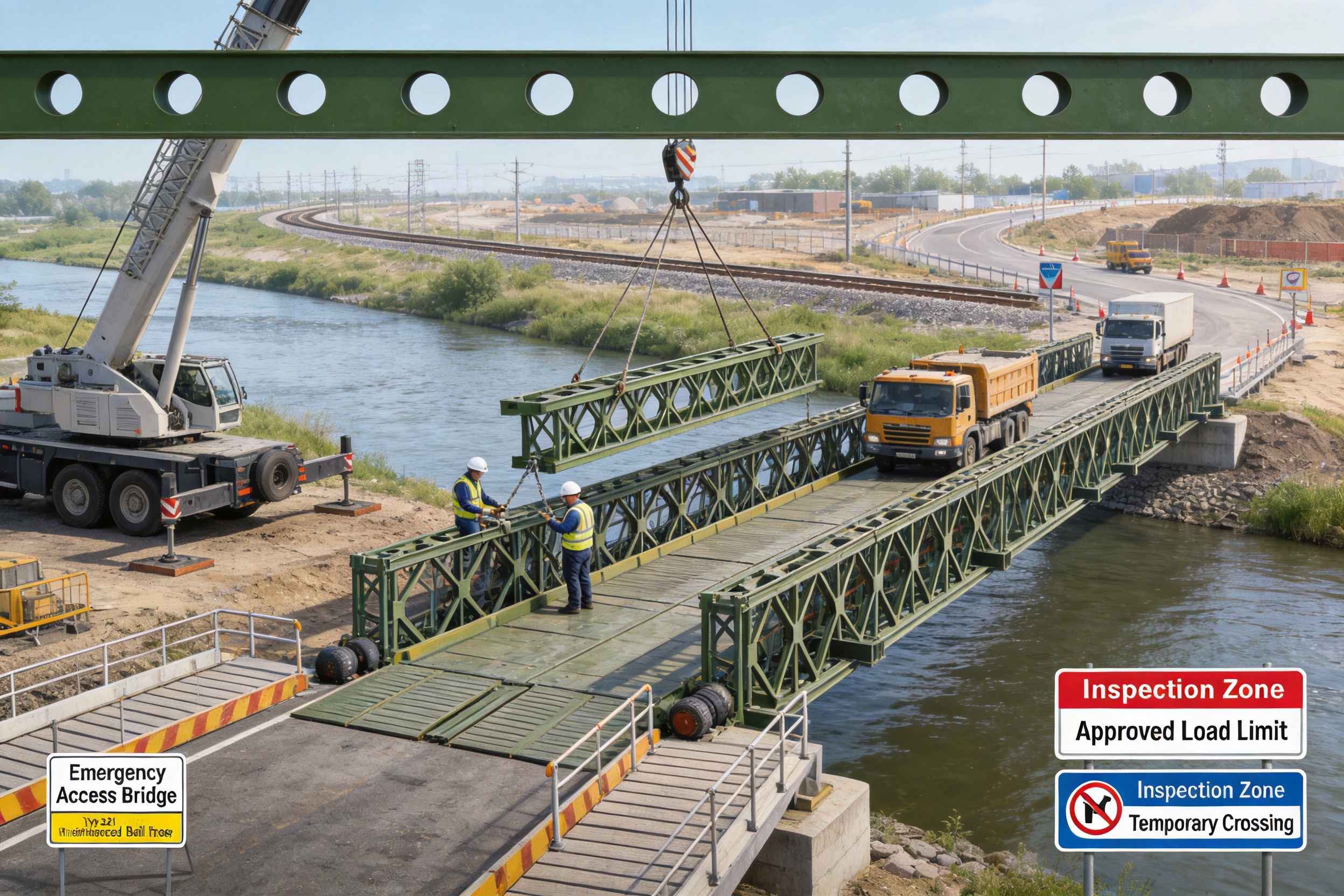
Temporary highway bridges are commonly required during road widening, bridge replacement, flood damage, landslide recovery, or major utility works. The reinforced Type 321 system can provide a rapid crossing while a permanent structure is designed or repaired.
Its modular nature allows the bridge to be designed for a particular span and traffic arrangement, then dismantled after the permanent route is restored. Reinforcement can help the temporary structure manage construction traffic and loaded vehicles while maintaining acceptable service performance.
7.2 Emergency and disaster-response crossings
Floods, earthquakes, storms, mining incidents, and other emergencies can interrupt road networks. Emergency bridges must often be transported to difficult locations and erected under time pressure. A standardized reinforced truss system can support faster mobilization than a fully site-built bridge.
In these circumstances, logistics and simplicity are as important as structural capacity. Components should be readily identifiable, handling requirements should be clear, and erection crews should be able to follow a repeatable installation method. The bridge must still be checked for foundation stability, water flow, scour, approach safety, and expected vehicle loading.
7.3 Construction access bridges
Large infrastructure projects frequently need temporary access across rivers, drainage channels, rail lines, excavations, or existing roads. A reinforced Bailey bridge can support delivery vehicles, cranes, concrete trucks, and construction equipment while minimizing disruption to the main project schedule.
Construction access bridges may experience frequent loading and difficult operating conditions. Mud, debris, impact, braking, and uneven traffic distribution can be significant. Reinforcement improves the structural reserve and stiffness of the modular span, while proper deck maintenance remains essential.
7.4 Municipal and water conservancy projects
Municipal engineering and water conservancy projects often require crossings that can be installed quickly without extensive permanent works. Reinforced Bailey bridges can be used for rural access, canal crossings, flood-control works, reservoir construction, and temporary detours.
Water-related projects require special attention to scour, hydraulic clearance, corrosion, debris impact, and seasonal water-level changes. The reinforced truss contributes to the superstructure, but the overall design must also address piers, abutments, bearings, approach embankments, and flood conditions.
7.5 Railway construction and maintenance support
Railway projects may use temporary road bridges to move equipment and materials near active or developing rail corridors. In such locations, bridge height, lateral clearance, construction sequencing, and interface with railway safety procedures must be carefully controlled.
The modular reinforced truss is useful when access requirements change as the railway project progresses. It can potentially be relocated or reconfigured, subject to inspection and engineering approval.
7.6 Semi-permanent bridge installations
Some projects require a bridge to remain in service for several years rather than a few weeks or months. In these cases, a reinforced Type 321 arrangement can offer a practical alternative where a conventional permanent bridge is not immediately available or economically justified.
Semi-permanent use requires a more comprehensive approach to fatigue, corrosion, inspection, drainage, deck replacement, traffic management, foundations, and user safety. A temporary classification does not mean that design discipline can be reduced. Long service periods require planned inspection and maintenance.
8. Installation Considerations
Successful installation begins before the components arrive. The project team should review approved drawings, site measurements, ground conditions, support elevations, span length, bridge width, loading requirements, crane capacity, transport access, and erection sequence.
All components should be checked on arrival. The inspection should look for transport damage, distortion, missing connection hardware, coating damage, incorrect identification, and contamination of connection surfaces. Damaged or questionable components should be isolated and evaluated before use.
During assembly, the Type 321 panels and reinforced trusses should be positioned according to the approved arrangement. Connection holes, pins, bolts, chord interfaces, and bracing points should not be forced into alignment through uncontrolled impact. If alignment is difficult, the cause should be investigated. Possible causes include incorrect component selection, foundation movement, manufacturing damage, or an erection-sequence error.
Lifting operations should use suitable equipment and approved lifting points. Workers must remain clear of suspended loads, and temporary stability must be maintained during each stage. The partially assembled bridge may behave differently from the completed structure, so temporary bracing and support arrangements are important.
Once the truss system is assembled, the deck, transoms, sway bracing, ramps, bearings, guardrails, and other accessories should be installed and inspected. The bridge should be checked for line, level, camber where applicable, support contact, connection security, deck continuity, and approach transitions.
Before opening to traffic, the project engineer should confirm that the structure meets the design requirements. Depending on the project, this may include a formal inspection, controlled test loading, deflection measurement, or independent approval. Operating restrictions such as speed limits, vehicle spacing, lane control, or maximum gross vehicle weight should be clearly posted.
9. Maintenance and Service-Life Management
Regular inspection is essential for any modular steel bridge. The frequency should reflect traffic volume, environmental exposure, service duration, previous defects, and the consequences of failure. Temporary bridges are sometimes exposed to harsher treatment than permanent structures because users may include construction equipment and vehicles with irregular axle loads.
Inspection should cover panel chords, reinforced trusses, diagonals, pins, bolts, transoms, deck units, welds, bracing, bearings, supports, ramps, and guardrails. Particular attention should be paid to areas where water, mud, debris, or deicing materials can accumulate.
Coating damage should be cleaned and repaired promptly. Surface rust may be manageable if addressed early, but advanced corrosion can reduce effective steel thickness and affect connection performance. Any repair coating should be compatible with the existing system and applied after suitable surface preparation.
Connections should be inspected for movement, wear, deformation, missing retainers, loose bolts, enlarged holes, and abnormal contact marks. Pins and connection holes are important load-transfer areas. Excessive wear can change the geometry of the bridge and should be assessed by a qualified engineer.
Deck surfaces should be kept clean and in good condition. A damaged or uneven deck can create impact loads, discomfort, and local stress concentration. Drainage paths should remain open so that water does not remain on or around structural members.
After dismantling, components should be cleaned, inspected, repaired where necessary, recoated, and stored on suitable supports. Reinforced trusses should not be placed directly in standing water or on unstable ground. Organized storage and clear marking make future redeployment faster and reduce the risk of installing damaged or mismatched components.
10. Why Factory-Made Reinforcement Is Preferable to Improvised Site Modification
Improvised strengthening may appear attractive because it can be arranged quickly with locally available steel. However, unplanned site modification creates several risks. The added members may not align with the original panel geometry, welds may be difficult to inspect, local stresses may be overlooked, and the modified bridge may no longer have predictable load paths.
A factory-made reinforced truss is produced according to defined dimensions, material requirements, fabrication procedures, and inspection criteria. It is designed to work with a known modular system and can be supplied with supporting documentation. This provides a stronger basis for structural calculations, project approval, installation planning, and future maintenance.
Factory production also improves consistency from one component to another. For contractors managing several bridge projects, consistent components simplify training, inventory, erection methods, inspection forms, and replacement planning.
11. Selection Guidance for Contractors and Bridge Owners
Before ordering Type 321 Reinforced Bailey Trusses, the purchaser should define the project conditions clearly. Important information includes required span, carriageway width, bridge arrangement, design vehicle, traffic frequency, expected service period, site environment, support type, access limitations, delivery location, and desired corrosion-protection system.
The purchaser should also confirm whether the project requires standard supply only or engineering support, shop drawings, erection assistance, leasing, customized markings, special packing, or a complete bridge package. Early communication reduces the risk of ordering individual components that do not match the intended system.
Quality documentation should be requested as part of the procurement process. This may include steel mill certificates, welding qualifications, inspection plans, dimensional reports, coating records, product identification, and packing lists. The exact documentation should correspond to the project specification and applicable regulations.
Price should not be the only comparison criterion. A lower initial purchase price may be offset by installation delays, dimensional problems, missing documentation, poor coating, difficult replacement, or premature maintenance. The more useful comparison is total project value, including structural reliability, delivery, erection time, service life, technical support, and reuse potential.
12. Competitive Advantages of the Product and Supplier
The Type 321 Reinforced Bailey Truss competes favorably with nonstandard strengthening solutions because it combines structural enhancement with modular compatibility. Its main competitive advantages include standardized dimensions, Q355B structural steel, improved bending resistance, increased truss stiffness, reduced deformation, easier transport, and practical integration with Type 321 bridge panels.
Another advantage is the ability to support multiple project categories. The same basic modular concept can be applied to temporary road crossings, emergency routes, construction access, water conservancy works, railway support, and semi-permanent installations. This versatility helps contractors maintain a broader equipment base and respond to changing project demands.
The supplier’s broader capabilities provide an additional advantage. Design, fabrication, erection, leasing, and technical support can be coordinated through one engineering organization. This reduces communication gaps between product selection and field application. It also allows the manufacturer to provide more complete solutions instead of treating the reinforced truss as an isolated commodity.
Experience with bridge steel formwork, launching gantry systems, hanging baskets, and other structural products supports a practical manufacturing culture. These products require accurate steel fabrication, reliable welding, controlled assembly, and awareness of construction-site requirements. Such experience is valuable when producing components that must perform in demanding temporary works environments.
For international customers, supplier responsiveness and documentation are also important competitive factors. Clear technical communication, export packing, component identification, quality records, and support during installation can have a direct effect on project success. A technically suitable product becomes significantly more valuable when it is delivered with reliable engineering coordination.
13. Engineering Limitations and Responsible Use
The reinforced truss should not be selected solely from a product name or nominal dimension. The bridge system must be verified for the actual project. Important checks include ultimate strength, serviceability, fatigue, lateral stability, wind effects, deck behavior, support reactions, foundation capacity, connection resistance, and construction-stage stability.
Load capacity depends on the complete arrangement. Two bridges using the same reinforced truss may have different capacities because of differences in span, width, panel configuration, bracing, deck weight, support conditions, or vehicle loading. The number and location of reinforced elements must follow an approved design.
Local regulations may also require special approval for bridges carrying public traffic, bridges over navigable waterways, railway-adjacent structures, or structures used in emergency conditions. The manufacturer can provide product information and technical support, but the responsible project engineer must confirm the final design and operating limitations.
14. Frequently Asked Questions
Q1: What is a Type 321 Reinforced Bailey Truss?
It is a structural strengthening component used with Type 321 prefabricated Bailey bridge panels. It is rigidly connected to the upper and lower chords of the panels to improve bending resistance, stiffness, and deformation control.
Q2: What are the main dimensions of this product?
The stated outer dimensions are 3115 × 100 × 176 millimeters, with a nominal center distance of 3000 millimeters. These dimensions support integration with the Type 321 modular bridge system.
Q3: What material is used?
The component is manufactured from Q355B structural steel. Material certificates and project-specific mechanical-property requirements should be confirmed during procurement.
Q4: Does reinforcement automatically increase the bridge load capacity?
Reinforcement is intended to improve the load-bearing performance of the truss system, but the final capacity depends on the complete bridge arrangement and site conditions. A qualified engineer must verify the span, panel configuration, connections, deck, supports, foundations, and design loads.
Q5: Where is the reinforcement most valuable?
It is particularly useful in bridge arrangements where bending, mid-span deflection, or truss deformation are controlling concerns. It may also be selected when a Type 321 bridge must accommodate higher traffic loads or longer service requirements than a basic arrangement.
Q6: Can the reinforced truss be used for emergency bridges?
Yes. Its modular format and compatibility with Type 321 panels make it suitable for emergency and temporary crossing systems, provided that the bridge is properly designed, erected, inspected, and operated within approved limits.
Q7: Can it be used in a semi-permanent bridge?
It can be considered for semi-permanent applications. Such use requires additional attention to corrosion protection, fatigue, inspection, drainage, deck maintenance, foundations, and long-term traffic conditions.
Q8: What are the advantages of factory fabrication?
Factory fabrication supports controlled material traceability, repeatable dimensions, fixture-based assembly, qualified welding, dimensional inspection, non-destructive testing where required, consistent coating, and complete production documentation. It also reduces the need for extensive structural modification at the construction site.
Q9: Can the product be customized?
Customization may be possible depending on the project requirements. Any change to dimensions, connection details, material, coating, or structural arrangement should be reviewed and approved by the manufacturer’s technical team and the responsible project engineer.
Q10: What services can the supplier provide?
The supplier’s capabilities include design support, manufacturing, bridge system planning, erection, leasing, customized fabrication, technical assistance, quality management, and the supply of related Bailey bridge and steel formwork products.
Q11: How should the truss be maintained?
It should be inspected regularly for corrosion, distortion, weld defects, connection wear, loose hardware, coating damage, deck problems, and support movement. Components should be cleaned, repaired, recoated, and stored properly after dismantling.
Q12: What information should be provided when requesting a quotation?
Useful information includes the required span, bridge width, design vehicle or load grade, traffic frequency, intended service period, site environment, support conditions, delivery location, quantity, coating requirements, and whether erection or technical assistance is needed.
15. Conclusion
The Type 321 Reinforced Bailey Truss is a practical and efficient strengthening solution for Type 321 prefabricated highway steel bridge systems. By connecting rigidly to the upper and lower chords of the original Bailey panels, it improves bending resistance, increases truss stiffness, limits deformation, and expands the potential application range of the modular bridge system.
Its standardized dimensions, Q355B steel construction, transportable format, and compatibility with established Type 321 components make it more predictable and versatile than improvised site reinforcement. It can support temporary highways, emergency response, construction access, municipal projects, water conservancy works, railway support, and semi-permanent crossings.
The product’s value is strengthened by the manufacturer’s integrated capabilities in design, fabrication, erection, leasing, technical support, and related steel structure production. Controlled material sourcing, fixture-based assembly, qualified welding, dimensional inspection, surface treatment, traceability, and project-oriented engineering support provide a strong foundation for dependable bridge construction.
At the same time, responsible use requires complete structural assessment. Reinforcement is one element of a bridge system, and its final performance depends on the panel arrangement, span, deck, connections, supports, foundations, loading, environment, and maintenance program. When these factors are properly coordinated, the Type 321 Reinforced Bailey Truss offers a durable, reusable, and construction-efficient way to improve the performance of modular steel bridges.
References
1. Bailey, D. C. The design principles and modular construction concepts associated with prefabricated military and emergency steel bridges.
2. Structural steel design standards covering material selection, welding, connection design, stability, fatigue, and serviceability assessment.
3. Bridge temporary works guidance concerning modular bridge erection, construction-stage stability, traffic loading, inspection, and maintenance.
4. Welding procedure specifications and quality-control practices for fabricated structural steel components.
5. Quality-management principles for material traceability, dimensional inspection, non-destructive testing, corrosion protection, and fabrication documentation.
6. Manufacturer’s product information for the Type 321 Reinforced Bailey Truss, including dimensions, center distance, material grade, and intended system application.


 Français
 Español
 عربى