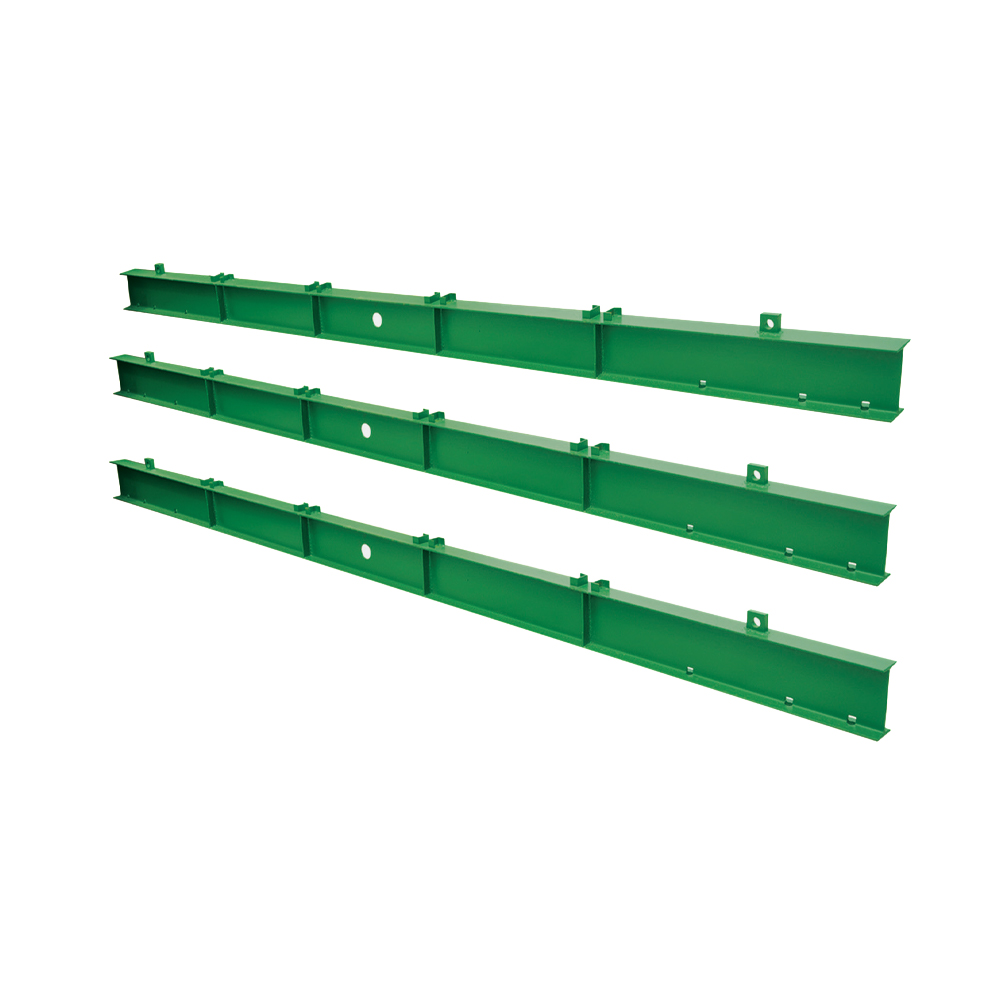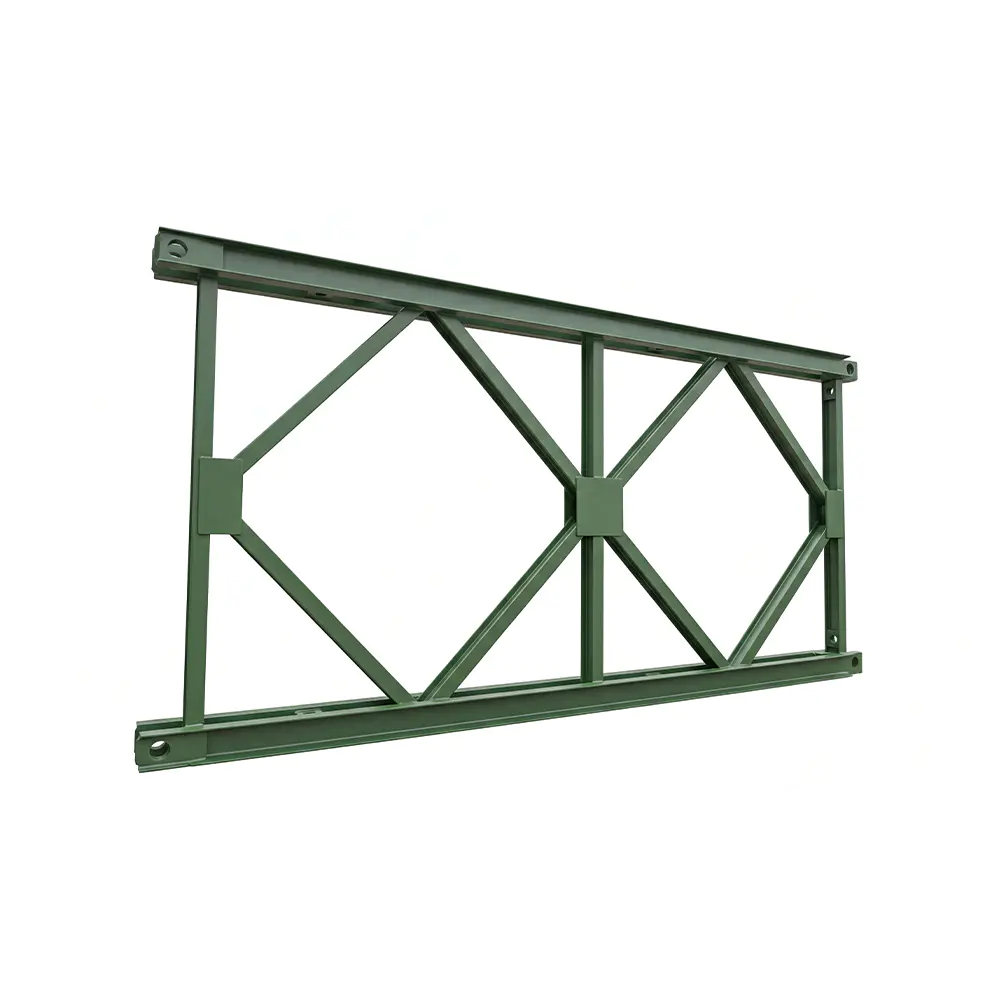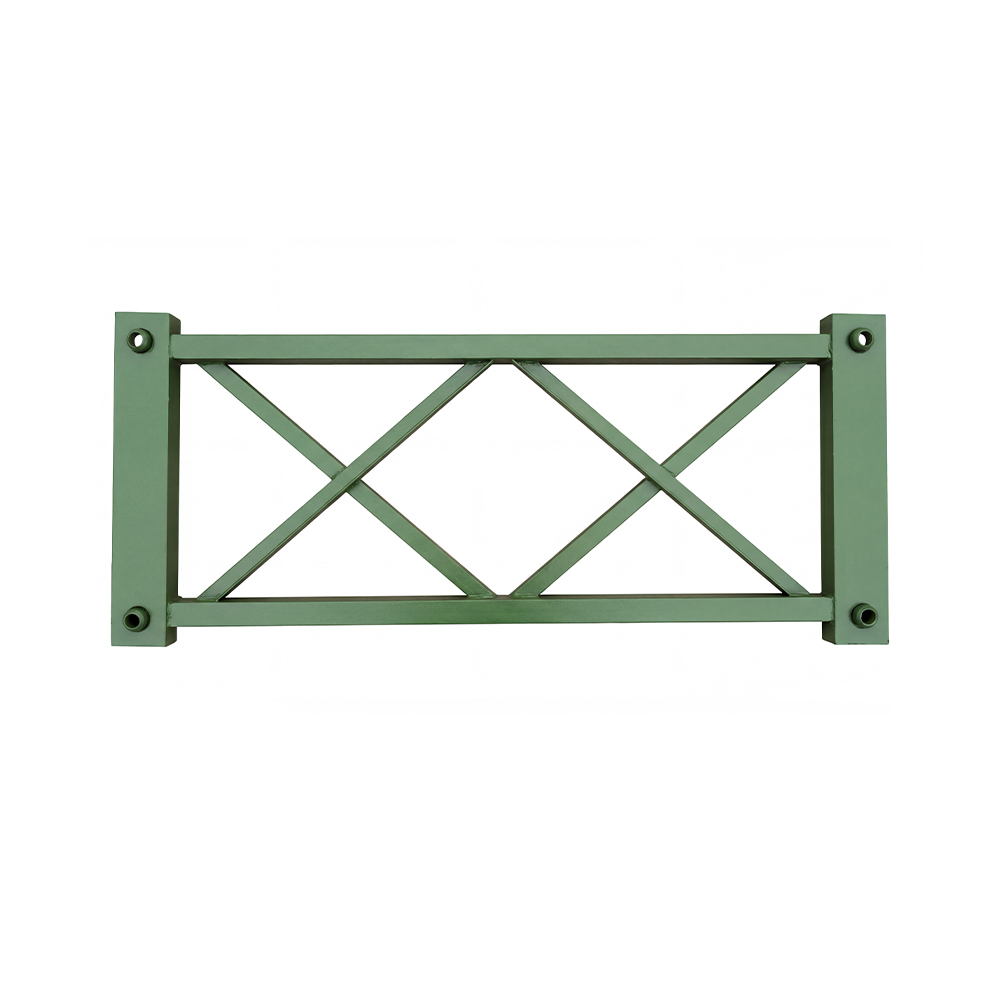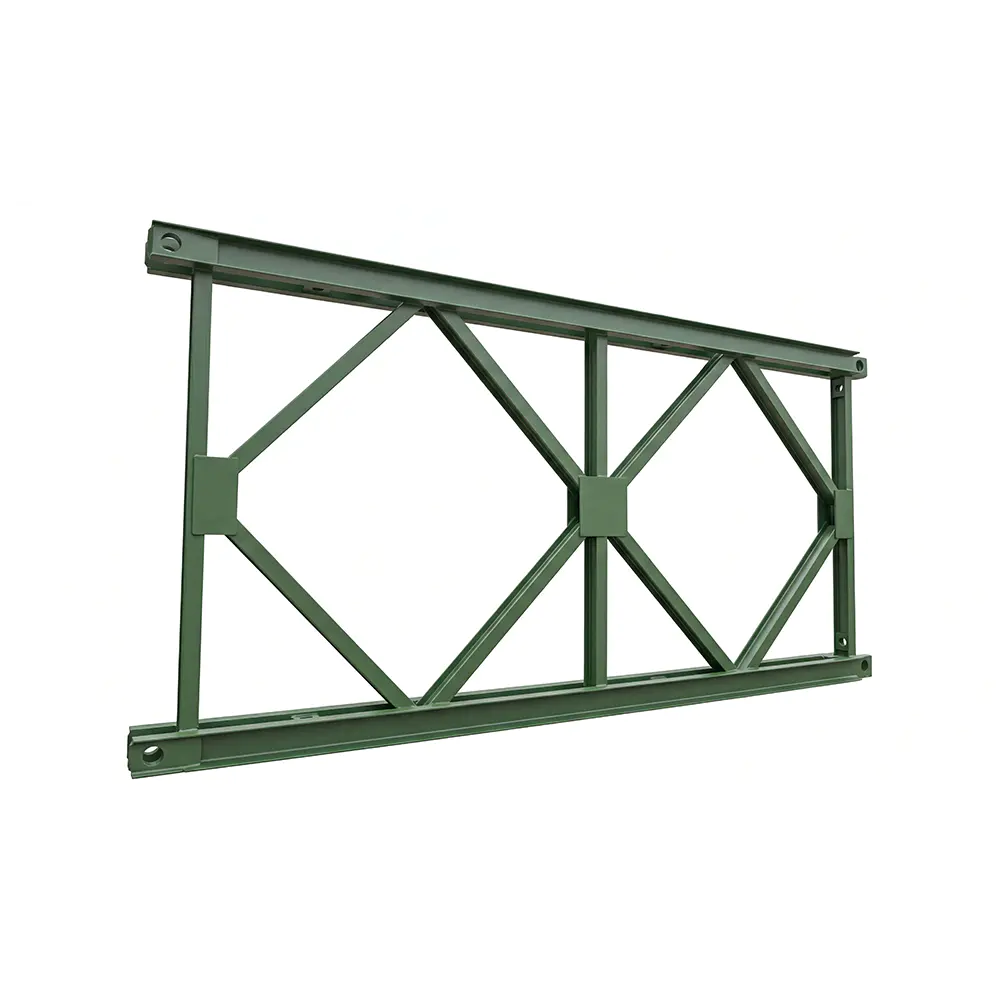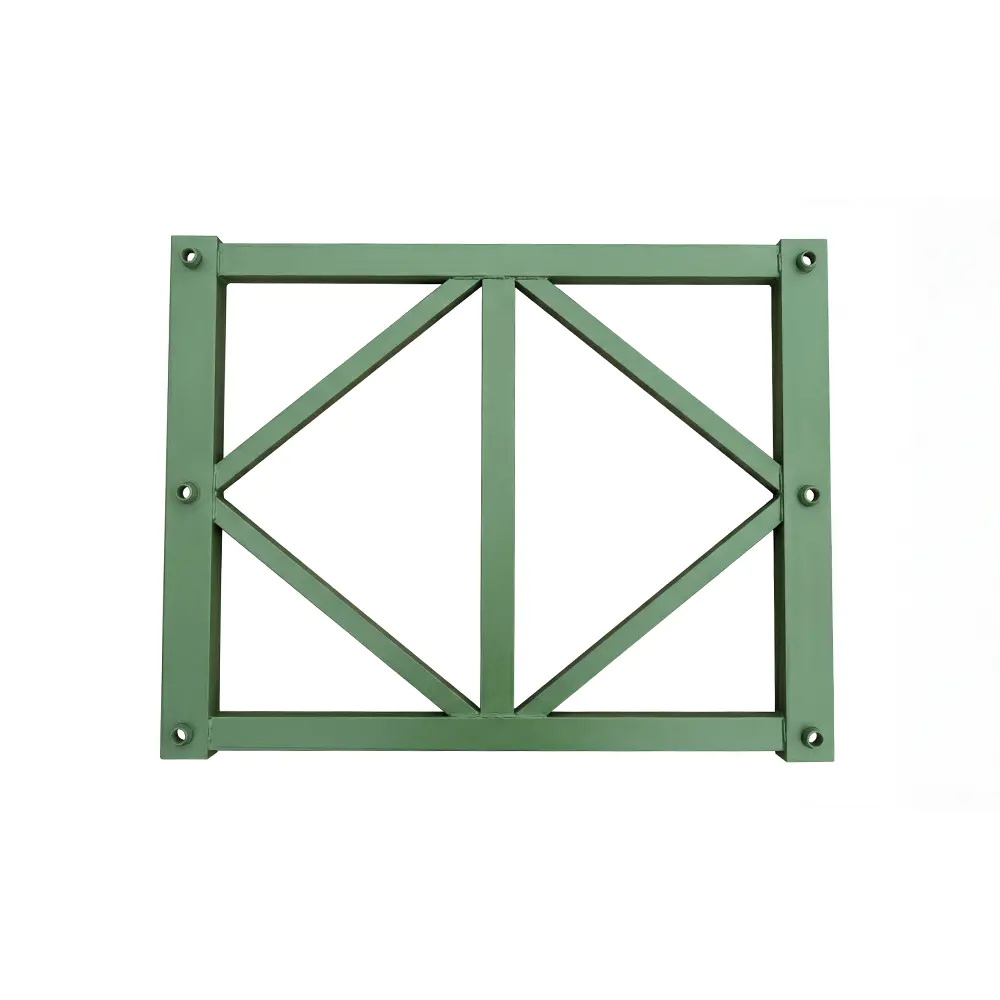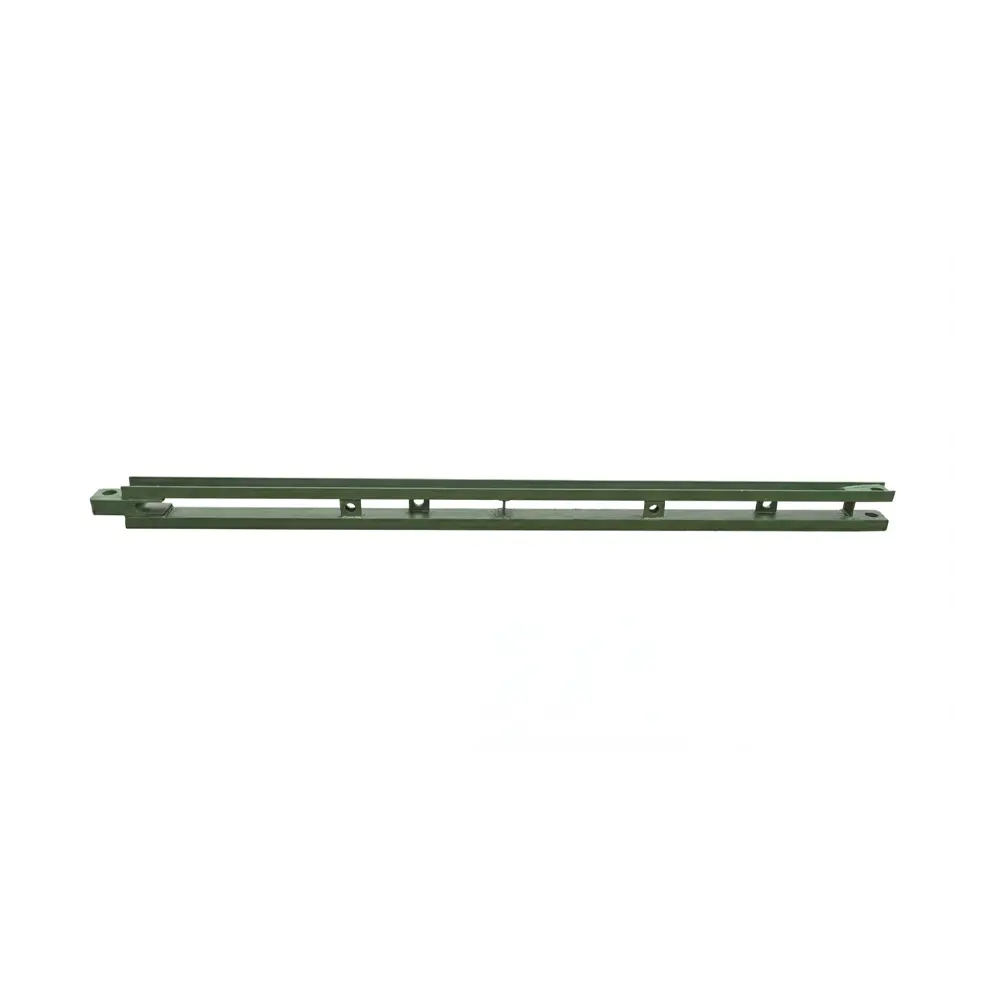
The Type 321 Reinforced Bailey Truss is a dedicated strengthening component for the Type 321 prefabricated highway steel bridge and its conventional span truss system. Designed to work with standardized Type 321 Bailey bridge panels, it improves the structural performance of the assembled truss by increasing bending stiffness, limiting deformation, and helping the bridge system accommodate higher service demands. As an important component in modular bridge construction, it supports the practical advantages of prefabricated steel systems while addressing one of their most important engineering requirements: sufficient strength and rigidity under changing load conditions.
Type 321 Bailey bridges are widely used where rapid installation, adaptable span arrangements, transportability, and reliable load-bearing performance are required. They are suitable for temporary bridges, emergency crossings, construction access bridges, semi-permanent transportation routes, military and civil defense applications, municipal projects, water conservancy works, and railway-related construction. However, every bridge configuration must be evaluated according to span, traffic loading, support conditions, wind effects, deck arrangement, and applicable design standards. The reinforced truss component provides an effective way to improve the capacity of a standard modular arrangement without abandoning the basic interchangeability and erection efficiency of the Type 321 system.
The Type 321 Reinforced Bailey Truss is manufactured and supplied by Zhenjiang Jinhao Road & Bridge Supporting Engineering Co., Ltd., a Chinese engineering enterprise specializing in Bailey bridges, bridge launching gantries, bridge formwork, hanging baskets, and other fabricated steel structures. The company offers design support, customized fabrication, system planning, technical assistance, erection services, leasing options, and quality management for bridge and construction projects.
1. Product Overview
A Bailey bridge is assembled from repeated steel truss panels and associated connection components. Instead of relying on a single large, permanently fabricated girder, the modular system uses standardized parts that can be transported, connected, adjusted, dismantled, and reused. This approach is particularly valuable when the construction site is remote, when access is restricted, or when a bridge must be completed in a short period.
The Type 321 Reinforced Bailey Truss forms part of this modular philosophy. It is intended to be rigidly connected to the upper and lower chords of Type 321 Bailey bridge panels. Once installed in the appropriate structural arrangement, it acts as a reinforcing member that helps the truss resist bending. Its role is especially important near the middle of a span, where bending moments and vertical deflection can become critical under concentrated or repeated loads.
The component has an outer dimension of 3115 × 100 × 176 millimeters and a stated center distance of 3000 millimeters. It is manufactured from Q355B steel. These dimensions allow the component to align with the geometry of the Type 321 panel system while maintaining the standardized modular characteristics required for efficient assembly. Compatibility should always be confirmed against the exact panel design, connection details, bridge layout, and engineering drawings before installation.
| Item |
Specification |
Engineering Significance |
| Product name |
Type 321 Reinforced Bailey Truss |
Strengthening member for Type 321 Bailey bridge panel systems |
| Application |
Type 321 prefabricated highway steel bridge and conventional span truss system |
Improves bending resistance and deformation control in suitable bridge arrangements |
| Outer dimensions |
3115 × 100 × 176 mm |
Supports alignment with standardized Type 321 modular geometry |
| Center distance |
3000 mm |
Provides a reference for structural layout and connection positioning |
| Material |
Q355B steel |
Provides a high-strength structural steel base for fabricated bridge components |
| Primary function |
Truss reinforcement |
Enhances bending stiffness, load capacity, and resistance to mid-span deformation |
2. Why Reinforcement Is Important in Modular Bridge Design
Modular bridges are designed for flexibility, but flexibility must be controlled. A bridge assembled from repeated panels may be very efficient in transport and erection, yet the structural system still needs to resist vertical traffic loads, dynamic effects, lateral forces, wind, braking forces, temperature effects, and construction-stage actions. As span length increases, bending moments and vertical deflections become increasingly important. A bridge that is adequate for a short crossing may require additional reinforcement when used over a longer span or under a greater design load.
Reinforcement is therefore not simply an optional accessory. It is a method of adapting a standardized bridge system to project-specific requirements. By connecting a reinforcing member to the upper and lower chords of the main truss panels, the effective stiffness of the assembled truss can be increased. This can reduce excessive movement under load and improve the structural efficiency of the bridge arrangement.
The Type 321 Reinforced Bailey Truss is particularly relevant in projects where the user wants to retain the standardized Type 321 system while improving performance. Instead of changing completely to a different bridge type, a reinforced configuration may provide a more practical path to meet the required span, traffic class, or service condition. The final design must be verified by qualified bridge engineers, but the product gives designers an additional structural option.
In a conventional beam or truss, the upper and lower chords participate in resisting bending through tension and compression. The greater the distance between the effective force paths and the more rigidly they are connected, the greater the bending resistance can be. A reinforcing truss component helps strengthen the load path and improves the ability of the overall system to distribute forces among connected panels. It also helps reduce localized deformation and may improve the behavior of the bridge under repeated traffic loading.
3. Main Structural Advantages
3.1 Increased Bending Capacity
The principal advantage of the Type 321 Reinforced Bailey Truss is its contribution to bending resistance. When a bridge spans an opening, the main truss must resist the bending moment generated by vertical loads. The reinforced arrangement adds structural material and improves the connection between the upper and lower chord regions. This enables the truss assembly to carry greater bending demand than an equivalent unreinforced arrangement, subject to the approved design configuration.
Improved bending capacity is valuable for highway bridges carrying construction vehicles, delivery trucks, emergency vehicles, and other heavy traffic. It is also useful when the bridge must support temporary equipment, construction materials, or machinery during a project. The reinforcement can help expand the range of load grades that may be considered for the Type 321 system, although the applicable load rating must be determined through engineering calculations rather than assumed solely from the presence of the component.
3.2 Greater Bending Stiffness
Strength and stiffness are related but different design considerations. A bridge may technically resist a specified load while still experiencing excessive deflection or vibration. Increased stiffness helps the bridge maintain its intended geometry and improves user comfort, operational reliability, and the protection of deck and connection components.
By rigidly connecting with the upper and lower chords of the Type 321 panels, the reinforced truss helps create a more effective structural section. The resulting system can resist bending deformation more efficiently than a basic panel arrangement. For longer spans and higher traffic demand, stiffness improvement may be as important as ultimate strength because excessive movement can affect riding quality, drainage, expansion details, approach transitions, and the long-term condition of the bridge.
3.3 Improved Mid-Span Deformation Control
For a simply supported bridge, the middle region of the span is often subject to significant vertical deflection. The Type 321 Reinforced Bailey Truss is intended to strengthen this critical area. By adding reinforcement in the truss system, the bridge can better resist deformation caused by concentrated wheel loads and distributed traffic loads.
Better deformation control can make bridge operations more predictable. It can also reduce the risk of secondary problems such as uneven deck movement, excessive vibration, loosening of connections, and accelerated wear of wearing surfaces. These benefits depend on correct installation, proper support conditions, suitable deck design, and regular inspection.
3.4 Compatibility with Standardized Bailey Components
One of the strongest advantages of the Type 321 Reinforced Bailey Truss is that it is developed for use with the Type 321 modular bridge family. Standardized components offer practical benefits that are difficult to obtain with a fully custom bridge fabricated as one piece. They can be manufactured in repeatable batches, transported using ordinary logistics arrangements, stored for future projects, and assembled with established erection procedures.
Compatibility with a known modular system also reduces the need to redesign every component for every site. Engineers can use familiar panel dimensions, connection principles, transom arrangements, deck accessories, and erection equipment. This may shorten planning time and simplify the supply of spare parts. For contractors who operate several Bailey bridge systems, reinforcement compatible with their existing Type 321 inventory can improve asset utilization.
3.5 Flexible Use in Temporary and Semi-Permanent Projects
The Type 321 system can be used in temporary, emergency, and semi-permanent applications. A reinforced arrangement is particularly useful when the bridge must remain in service for an extended period, carry frequent traffic, or support heavier vehicles than an ordinary temporary crossing. It may also be selected when the bridge will be dismantled and reused after a construction phase.
Temporary does not mean unimportant. A temporary bridge may serve as the only access route to a construction site, provide a detour during permanent bridge replacement, restore transportation after a disaster, or maintain connectivity in a flood-affected area. The reinforced truss can contribute to a stronger and more reliable temporary structure when the design demands exceed the capacity of an unreinforced layout.
4. Advantages Compared with Less Adaptable Alternatives
Traditional permanent bridges can provide high performance, but they often require extensive foundations, long fabrication periods, specialized transport, and complex site operations. A fully custom steel bridge may also involve large individual members that are difficult to move through narrow roads or onto remote sites. The Type 321 reinforced modular system offers a different balance between strength, speed, adaptability, and logistics.
Compared with a basic unreinforced Type 321 arrangement, the reinforced truss provides an additional method for improving bending performance without replacing the complete bridge concept. This is an important advantage for owners and contractors who already have Type 321 panels or who need to maintain standardized equipment across multiple projects.
Compared with improvised steel strengthening, a purpose-designed component offers better dimensional consistency and a more dependable connection concept. Improvised reinforcement may create uncertain load paths, poor fit-up, stress concentrations, or difficult inspection conditions. A manufactured reinforcing truss is produced for a defined modular system, allowing the design team to consider its dimensions and connection behavior during the engineering stage.
Compared with heavily specialized bridge equipment, the Type 321 reinforced system can be easier to transport, assemble, modify, and dismantle. Its modular format is well suited to contractors who must respond quickly to changing site conditions. The system can be configured for different spans and widths, with the reinforcement selected according to structural requirements.
Compared with low-grade or poorly controlled fabricated steel products, a Q355B structural steel component offers a more dependable material foundation. Material selection alone does not guarantee performance, but an appropriate structural steel grade, combined with controlled fabrication and inspection, supports consistent engineering quality.
5. Q355B Steel and Material Reliability
The Type 321 Reinforced Bailey Truss is specified as Q355B steel. Q355B is commonly used as a high-strength structural steel grade in fabricated steel structures. The “355” designation is associated with a nominal minimum yield strength level for relevant product thickness ranges under the applicable material standard. The “B” quality grade indicates a specified level of impact toughness and quality control requirements under that standard.
Material certification is important for bridge components because the design engineer needs to confirm that the supplied steel corresponds to the specified grade. A complete quality documentation package may include mill certificates, heat numbers, chemical composition data, mechanical test results, dimensional inspection records, and coating or surface treatment records when applicable.
Q355B steel can provide an effective balance of strength, weldability, availability, and fabrication suitability. The actual performance of the finished component also depends on plate quality, section geometry, weld design, welding procedure qualification, joint preparation, dimensional accuracy, residual stress control, and inspection. A reliable manufacturer must therefore manage the complete production process rather than depending only on the nominal steel grade.
6. Advanced Manufacturing Process
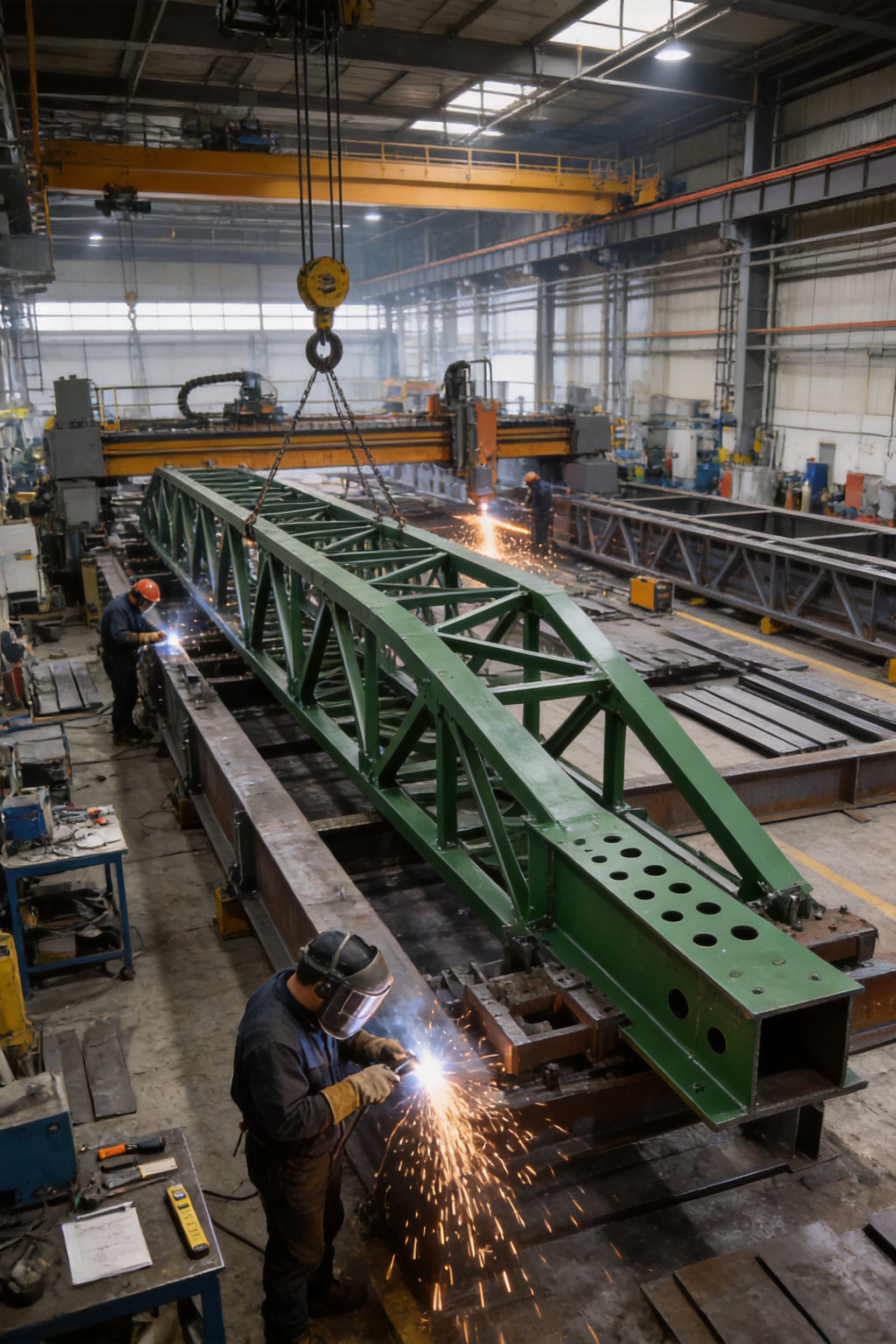
The production of a reinforced Bailey truss requires more than cutting steel and joining parts together. Bridge components must be accurately fabricated so that they fit the standardized panel system, transfer loads through intended paths, and remain stable during erection and service. Manufacturing quality directly affects installation efficiency, structural performance, and the ability to inspect and maintain the bridge.
6.1 Engineering Review and Production Planning
Manufacturing begins with a review of the approved drawings, product dimensions, connection details, material requirements, tolerances, welding specifications, and inspection criteria. The production team confirms how the component will interface with the Type 321 panels and identifies critical dimensions that must be controlled throughout fabrication.
Production planning can include material procurement, cutting schedules, welding sequences, fixture arrangements, inspection hold points, surface treatment requirements, marking procedures, and packing plans. This organized approach reduces avoidable variation between components and supports traceability from raw material to finished product.
6.2 Material Inspection and Traceability
When Q355B steel arrives at the factory, it should be checked against the purchase specification and supporting material documents. Thickness, dimensions, surface condition, heat number, and grade identification should be reviewed before the material enters production. Traceability marks can be transferred from the original plate or section to cut parts so that the material identity is not lost during fabrication.
Material traceability is especially valuable for bridge projects that require formal documentation. If a question arises about a component after delivery, the manufacturer can use production records to identify the material batch, fabrication date, inspection results, and relevant personnel or equipment.
6.3 CNC Cutting and Dimensional Control
Computer-controlled cutting equipment can be used to produce repeatable plate and section shapes. CNC plasma, flame, laser, or other suitable cutting methods may be selected according to thickness, geometry, production volume, and required edge quality. Accurate cutting reduces the need for excessive correction during assembly and helps maintain consistent connection locations.
After cutting, parts can be checked for dimensions, squareness, edge condition, distortion, and identification marks. Critical dimensions should be measured against approved drawings rather than relying only on visual inspection. Consistent control at this stage improves fit-up and reduces the possibility of cumulative dimensional errors in the completed truss.
6.4 Precision Fit-Up and Welding Fixtures
Fabrication fixtures help hold parts in the correct relationship during tack welding and final welding. For standardized bridge components, fixtures can improve repeatability and shorten setup time. Proper fit-up ensures that the intended load path is maintained and that welds are formed in the correct position with suitable joint gaps and alignment.
Fixture design should account for welding shrinkage and distortion. If this is ignored, a component may be dimensionally correct before welding but outside tolerance after cooling. Experienced production teams use planned welding sequences, balanced weld deposition, temporary restraints where appropriate, and controlled heat input to manage these effects.
6.5 Qualified Welding Procedures
Welding is one of the most important stages in the manufacture of a steel truss. Welding procedures should be selected according to steel grade, thickness, joint type, welding position, consumable classification, preheating requirements, interpass temperature, and post-weld inspection criteria. Welders should be appropriately qualified for the work they perform.
Typical quality controls may include visual inspection, dimensional inspection, weld profile checks, and nondestructive testing where required by the project specification. Depending on the design and applicable standards, ultrasonic testing, magnetic particle testing, dye penetrant testing, or radiographic testing may be used for selected welds.
Controlled welding helps prevent defects such as lack of fusion, incomplete penetration, undercut, porosity, cracking, excessive reinforcement, and distortion. These defects can reduce fatigue resistance or create local stress concentrations. A disciplined welding process therefore supports both immediate structural performance and long-term durability.
6.6 Straightening and Final Assembly Inspection
After welding, the component is checked for straightness, twist, overall dimensions, connection alignment, weld condition, and surface defects. If correction is necessary, it should be carried out using approved methods that do not damage the steel or compromise the component’s structural properties.
Final dimensional inspection is particularly important for a modular bridge component. A small deviation in one member can make field assembly difficult, especially when several panels and reinforcement pieces are connected over a full span. Quality control at the factory helps prevent delays, forced fit-up, or unsafe modifications at the construction site.
6.7 Surface Preparation, Coating, and Protection
Steel bridge components are exposed to moisture, dust, road salts, industrial pollutants, and changing temperatures. Appropriate surface preparation and protective coating can help reduce corrosion. The selected coating system should be compatible with the expected service environment, project duration, maintenance plan, and applicable specifications.
Surface preparation may include degreasing, abrasive blasting, mechanical cleaning, or other approved processes. Coating thickness, curing conditions, environmental conditions, and repair of damaged areas should be recorded. During transportation, lifting, and erection, care must be taken to avoid unnecessary impact damage to the protective coating.
6.8 Marking, Packing, and Delivery
Each component should be clearly marked with an identification code or other project reference. Proper marking assists unloading, inventory management, erection sequencing, inspection, and future reuse. Packing should protect connection areas and finished surfaces while allowing safe lifting and handling.
Because modular bridge components may be transported to remote or difficult sites, logistics planning is a major part of product value. The manufacturer’s experience with fabricated bridge structures helps ensure that components are arranged for efficient loading, secure transport, and straightforward site distribution.
7. Manufacturing Strengths of the Supplier
Zhenjiang Jinhao Road & Bridge Supporting Engineering Co., Ltd. was established in 2017 and is located in Shangdang Town Industrial Park, Dantu District, Zhenjiang City, Jiangsu Province, China. The company’s location provides access to regional transportation networks and industrial resources, supporting the production and shipment of fabricated steel bridge products.
The company has developed from a business focused on construction materials, industrial materials, and metal processing materials into a comprehensive enterprise engaged in the design, manufacture, erection, and leasing of bridge-related steel structures. This development provides an important combination of material knowledge, fabrication experience, and project-oriented service capability.
Its product range includes Bailey steel bridges, Type 321 Bailey truss sections, HD200 and Type 200 Bailey truss sections, triangular and diamond hanging baskets, bridge steel formwork, pier formwork, launching gantry systems, and related engineered steel structures. This broad product range enables the company to understand how individual components function within complete bridge and construction systems.
A supplier that manufactures both bridge trusses and related equipment can provide more coordinated technical support than a vendor that only sells isolated steel parts. For example, bridge owners may require assistance with panel arrangements, launching methods, deck support, temporary works, erection sequencing, or the integration of formwork and lifting systems. System-level knowledge can help reduce interface problems between separately sourced products.
The company also provides customized fabrication. While the Type 321 Reinforced Bailey Truss has defined dimensions and a specific system application, project requirements may vary in span, width, load grade, connection arrangement, corrosion protection, delivery schedule, and erection method. A manufacturer with design and fabrication capabilities can review these requirements and recommend a suitable configuration rather than treating every project as identical.
Technical support is another important strength. Bailey bridge systems are simple in concept but require careful planning. Incorrect panel orientation, inadequate bracing, insufficient bearing length, unsuitable deck details, or unapproved field modifications can affect safety. Technical communication between the supplier, contractor, and design engineer helps ensure that the product is used as intended.
8. Applications
8.1 Temporary Highway Bridges
Temporary highway bridges are used when a permanent bridge is being constructed, repaired, or replaced. They may also provide detours after an accident or structural failure. A reinforced Type 321 configuration can be considered when the temporary route must support regular traffic or heavier vehicles for an extended period.
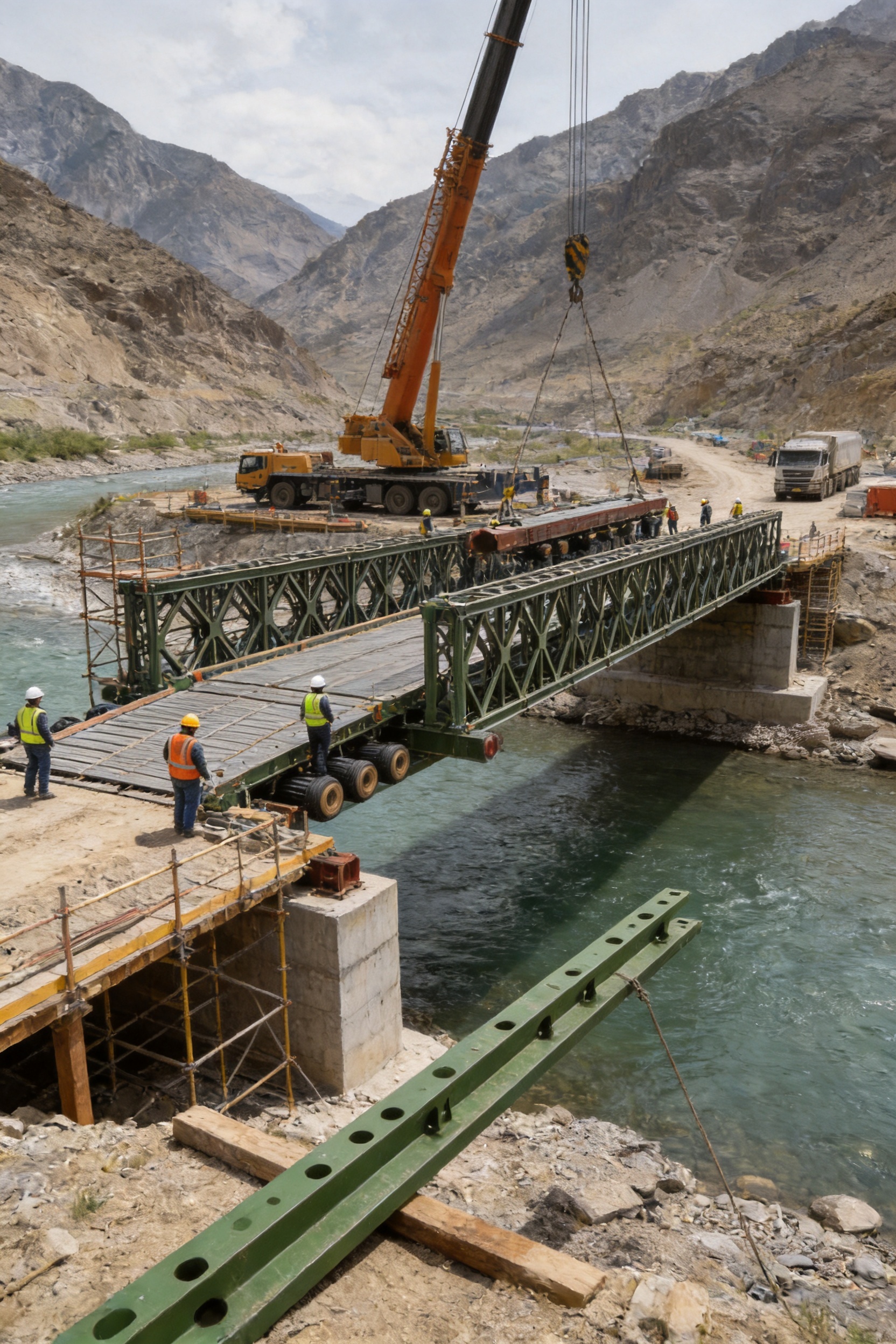
The modular structure can be delivered in sections, assembled near the approach, and installed using suitable cranes, launching equipment, or staged erection methods. After the permanent route is restored, the bridge may be dismantled, inspected, stored, and redeployed.
8.2 Emergency and Disaster-Response Crossings
Floods, earthquakes, landslides, and other emergencies can disrupt roads and isolate communities. A rapidly deployable bridge system can restore access for rescue vehicles, relief supplies, construction equipment, and local traffic. Reinforcement may be valuable when the crossing must carry demanding loads under difficult conditions.
Emergency deployment requires more than a strong product. Site investigation, foundation stability, water flow, debris impact, approach construction, traffic control, and inspection are all necessary. The reinforced truss provides a structural resource, while the complete emergency solution depends on competent planning and execution.
8.3 Construction Access Bridges
Large infrastructure projects often need temporary access over rivers, drainage channels, rail lines, excavations, or existing roads. Construction access bridges may carry dump trucks, cranes, concrete vehicles, steel deliveries, and other heavy equipment. The Type 321 Reinforced Bailey Truss can help create an adaptable access route that can be modified as construction progresses.
Because construction traffic can be intense and repetitive, engineers should consider dynamic effects, wheel loads, vehicle positioning, braking forces, deck wear, and inspection frequency. Reinforcement can improve structural performance, but the deck, transoms, bearings, bracing, and foundations must also be designed for the intended equipment.
8.4 Municipal and Water Conservancy Projects
Municipal projects may require crossings over canals, drainage channels, urban excavations, or temporary road diversions. Water conservancy projects may need access for maintenance vehicles, construction machinery, and material transport. The modular nature of the Type 321 system allows the bridge to be adapted to changing site requirements and project phases.
8.5 Railway and Industrial Engineering
Railway construction and industrial projects often involve temporary crossings and construction logistics routes. Components may be used in bridge structures, guide beams, temporary support systems, gantry arrangements, tower columns, or other engineered applications, provided the configuration is designed and approved for the intended use.
9. Installation and Project Planning
Before installation, the project team should confirm the span, bridge width, design load, panel arrangement, reinforcement arrangement, deck system, bearing configuration, approach geometry, foundation capacity, and erection method. The bridge should be designed by qualified professionals according to applicable national, regional, or project-specific standards.
Site access should be reviewed before delivery. Modular components are easier to transport than large permanent girders, but the route must still accommodate trucks, unloading equipment, lifting operations, and temporary storage. Ground conditions should be assessed to ensure that cranes, assembly areas, temporary supports, and approach embankments remain stable.
During assembly, all panels and reinforcement members should be checked for damage, distortion, missing parts, and identification. Pins, bolts, bracing members, chord connections, transoms, sway braces, deck components, and safety accessories should be installed in accordance with the approved method statement. Field cutting, drilling, welding, or unauthorized alteration should not be performed without engineering approval.
Launching operations require particular attention to balance, temporary support, nose arrangement, roller capacity, wind conditions, and the movement of the assembled bridge. The addition of reinforcement can affect the weight and center of gravity of the system. The launching equipment and temporary works must therefore be checked for the actual configuration rather than a standard unreinforced bridge.
After installation, the bridge should be inspected before opening to traffic. The inspection should cover panel connections, reinforcement connections, deck seating, bearing positions, bracing, approach transitions, guardrails, surface condition, and signs of distortion. Load testing or trial operation may be required by the project specification or responsible authority.
10. Maintenance and Inspection
Regular inspection helps maintain the performance of a reinforced modular bridge. Inspection frequency should reflect traffic volume, environmental exposure, bridge importance, service duration, and observed condition. Temporary bridges carrying heavy construction traffic may require more frequent inspection than lightly used access crossings.
Inspectors should look for loose or missing pins, bolts, damaged bracing, abnormal deformation, cracked welds, corrosion, coating failure, deck damage, bearing displacement, foundation settlement, and approach deterioration. Particular attention should be given to areas where water, mud, salt, or debris can collect.
Connections should be kept clean and properly secured. Damaged protective coatings should be repaired according to the approved coating system. If unusual vibration, noise, permanent deformation, or difficulty in closing a connection is observed, traffic should be controlled and the condition assessed by a qualified engineer.
Because modular bridges may be dismantled and reused, components should be inspected again after removal. Parts with permanent deformation, severe corrosion, damaged holes, cracked welds, or other defects should be repaired, tested, or removed from service according to engineering recommendations.
11. Quality Assurance and Documentation
Quality assurance should cover the full product lifecycle, from design review and material purchasing to fabrication, inspection, delivery, erection, and maintenance. Useful documentation may include approved drawings, material certificates, welding procedure records, welder qualifications, inspection reports, dimensional records, coating reports, packing lists, and installation instructions.
Traceability provides confidence that the delivered component corresponds to the specified product. It also supports future maintenance and replacement planning. For large bridge projects, documentation can be integrated into the owner’s asset management system so that each component’s history is available for later inspection.
Quality management is not limited to detecting defective products at the end of production. It also involves preventing defects through controlled processes, trained personnel, suitable equipment, clear work instructions, calibrated measuring tools, and defined inspection points. This process-oriented approach supports consistent quality across repeated modular components.
12. Customization and Technical Service
Although standardized dimensions are central to Bailey bridge efficiency, projects may require customized engineering support. The supplier can work with contractors and engineering companies to review the intended span, load grade, traffic type, bridge width, environmental conditions, delivery schedule, and erection method.
Customization may involve production quantity, marking, packing, coating, accessory selection, spare parts, technical drawings, installation guidance, and coordination with other bridge equipment. The goal is not to change the standardized system unnecessarily, but to adapt the supply package so that it fits the actual project plan.
For international customers, clear technical communication is essential. Drawings, specifications, inspection documents, packing lists, and installation instructions should be coordinated in advance. Differences in design standards and regulatory requirements should be identified at the beginning of the project. The supplier can provide technical information, while the project’s appointed engineer remains responsible for final design approval and compliance.
13. Sustainability and Reusability
Reusable modular bridge components can reduce waste compared with single-use temporary structures. After a bridge is dismantled, suitable components can be inspected and used again in another project. This supports a more efficient use of steel and may reduce the environmental impact associated with repeated fabrication.
Reusability depends on proper design, handling, maintenance, storage, and inspection. Components should not be dragged, dropped, overloaded, or modified without approval. Protective coatings and organized storage help preserve the serviceability of the steel. Accurate records of previous use can assist engineers in evaluating the condition of components before redeployment.
Efficient fabrication can also contribute to sustainability. Material nesting, controlled cutting, reduced rework, optimized transport packing, and repairable protective coating systems may lower production losses. A manufacturer that combines bridge engineering with metal processing experience is well positioned to improve these aspects over time.
14. Selecting the Right Reinforced Truss Solution
Customers should evaluate more than the purchase price when selecting a reinforced Bailey truss. Important considerations include material grade, dimensional accuracy, connection compatibility, welding quality, inspection documentation, corrosion protection, delivery reliability, technical support, spare-part availability, and the supplier’s experience with complete bridge systems.
The supplier should be able to explain the intended use of the component and identify the information required for engineering review. This may include span length, bridge width, traffic category, maximum vehicle weight, expected frequency of use, environmental exposure, support arrangement, deck type, and target service period.
A reliable product comparison should distinguish between nominal strength and verified system performance. Two components may appear similar but differ in steel grade, plate thickness, weld quality, fit-up accuracy, or inspection control. A well-manufactured component that fits the existing Type 321 system can provide greater practical value than a cheaper product requiring field correction or creating uncertainty during assembly.
15. Role in a Complete Bridge Solution
The Type 321 Reinforced Bailey Truss is an important component, but it is not an independent bridge by itself. Its performance depends on the complete structural system, including main panels, chord connections, transoms, stringers, deck units, sway bracing, lateral bracing, bearings, foundations, approaches, and traffic safety equipment.
Bridge design must consider load distribution between parallel trusses. It must also evaluate local panel forces, connection capacities, shear, lateral stability, buckling, fatigue, bearing reactions, and construction-stage effects. The reinforced truss should be included in the structural model or calculation method used by the responsible engineer.
This system-level perspective is one of the strengths of working with a supplier that manufactures multiple categories of bridge equipment. Jinhao’s experience with Bailey bridges, launching gantries, hanging baskets, pier formwork, and steel formwork allows it to support projects that involve several temporary works systems rather than a single isolated product.
16. Frequently Asked Questions
What is a Type 321 Reinforced Bailey Truss?
It is a structural strengthening component designed for Type 321 Bailey bridge panel systems. It connects with the upper and lower chords of the panels and helps improve bending capacity, bending stiffness, and resistance to mid-span deformation.
What are the dimensions of the product?
The stated outer dimensions are 3115 × 100 × 176 millimeters, with a center distance of 3000 millimeters. The dimensions should be checked against the project drawings and the exact Type 321 panel arrangement before ordering or installation.
What material is used?
The product is specified as Q355B steel. Material certificates and project-specific documentation should be requested when required by the design, contract, or inspection authority.
Does reinforcement automatically increase the bridge load rating?
No. Reinforcement can improve the structural capacity of a suitable Type 321 arrangement, but the final load rating must be calculated and approved by a qualified engineer. Span, panel configuration, bridge width, deck system, connections, bearings, foundations, and traffic conditions all affect the final result.
Where is this product normally used?
It may be used in temporary highway bridges, emergency crossings, construction access bridges, municipal works, water conservancy projects, railway construction, industrial projects, and semi-permanent bridge applications where a Type 321 system requires improved bending performance.
Can the component be used with existing Type 321 Bailey bridge panels?
It is designed for the Type 321 system, but compatibility must be confirmed. Existing panels should be checked for dimensions, connection condition, deformation, corrosion, and design configuration before reinforcement is added.
Can the product be customized?
Project-specific support may be available for fabrication quantities, coatings, markings, packing, accessories, drawings, and technical documentation. Any change to the standard structural geometry or connection arrangement requires engineering review and approval.
What manufacturing controls are important?
Important controls include material verification, traceability, CNC cutting, fixture-based fit-up, qualified welding procedures, dimensional inspection, weld inspection, surface preparation, coating control, final marking, and protective packing.
Is the reinforced truss suitable for permanent bridges?
It is primarily associated with modular temporary, emergency, and semi-permanent bridge systems. Whether it can be used for a particular permanent or long-term application depends on the applicable design standard, project approval, durability requirements, inspection plan, and engineering calculations.
How should the product be maintained?
Regular inspections should check connections, welds, bracing, corrosion, coating condition, deformation, deck behavior, bearings, foundations, and approaches. Any abnormal movement, damage, or permanent deformation should be evaluated by a qualified engineer.
What services does the manufacturer provide?
Zhenjiang Jinhao Road & Bridge Supporting Engineering Co., Ltd. provides bridge product manufacturing, design and system planning support, customized fabrication, technical assistance, erection-related services, and leasing options for selected bridge and construction equipment.
How can overseas customers evaluate a supplier?
They should review the supplier’s product range, engineering capability, material documentation, welding and inspection processes, quality records, delivery experience, technical communication, and ability to support the complete bridge system. Clear project specifications should be exchanged before commercial confirmation.
17. Conclusion
The Type 321 Reinforced Bailey Truss provides a practical way to strengthen a standardized modular bridge system. By rigidly connecting to the upper and lower chords of Type 321 Bailey bridge panels, it improves bending stiffness, supports greater load-bearing capability, and helps control deformation in critical span regions. These characteristics make it valuable for temporary, emergency, construction, municipal, water conservancy, railway, and semi-permanent bridge projects.
Its advantages are based on more than its dimensions or material grade. The product combines modular compatibility, transportability, reusability, adaptable bridge planning, and a strengthening function that can be integrated into established Type 321 erection methods. Compared with improvised reinforcement or less adaptable bridge alternatives, it offers a more systematic and controllable approach to improving a modular steel bridge configuration.
Manufacturing quality remains essential. Q355B steel, controlled cutting, precise fit-up, qualified welding, inspection, surface protection, traceability, and careful packing all contribute to dependable performance. The supplier’s broader experience in Bailey bridges, launching gantries, hanging baskets, bridge formwork, pier formwork, and related engineered steel structures supports a system-oriented approach to customer service.
For every project, the reinforced truss should be selected and installed according to approved engineering calculations and applicable standards. When properly designed, manufactured, erected, inspected, and maintained, the Type 321 Reinforced Bailey Truss can help contractors, governments, and engineering companies build stronger and more adaptable modular bridge solutions with efficient construction logistics and long-term reuse potential.
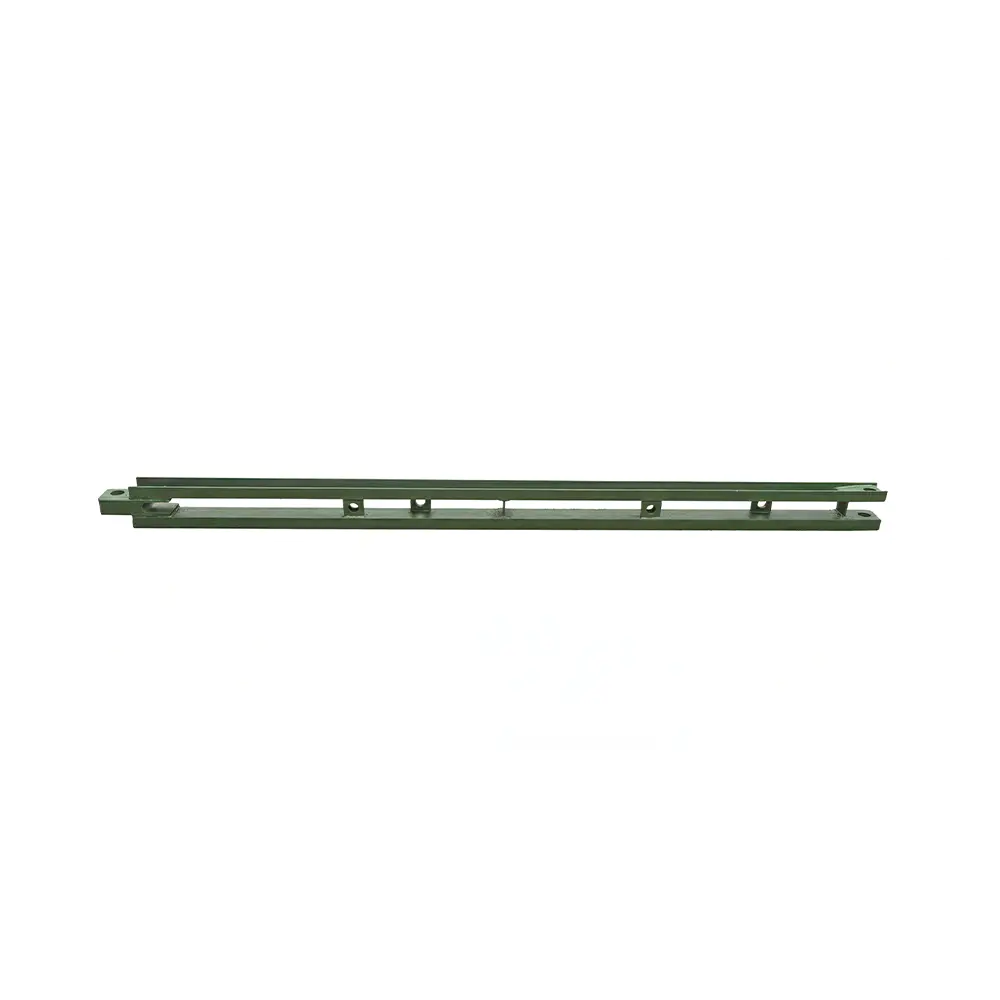
Type 321 - Reinforced Bailey Truss
Technical Reference Notes
The following references are provided as general technical sources for modular steel bridge planning, structural steel fabrication, welding quality, inspection, and bridge maintenance. Project teams should use the editions and standards required by the authority having jurisdiction.
1. General principles of modular prefabricated steel bridge design and temporary works engineering.
2. Structural steel material standards covering chemical composition, mechanical properties, delivery conditions, and impact toughness requirements.
3. Bridge welding standards covering welding procedure qualification, welder qualification, joint preparation, inspection, and acceptance criteria.
4. Standards and manuals for Bailey bridge panel systems, modular truss erection, bridge launching, and temporary bridge load assessment.
5. Technical guidance for nondestructive testing of welded steel structures.
6. Bridge inspection and maintenance manuals addressing corrosion, connection condition, deformation, deck systems, bearings, and foundations.
7. Temporary works design guidance for construction access bridges, emergency crossings, lifting operations, launching equipment, and site safety management.
8. Manufacturer’s product information for Type 321 Bailey bridge components and Type 321 Reinforced Bailey Truss systems.
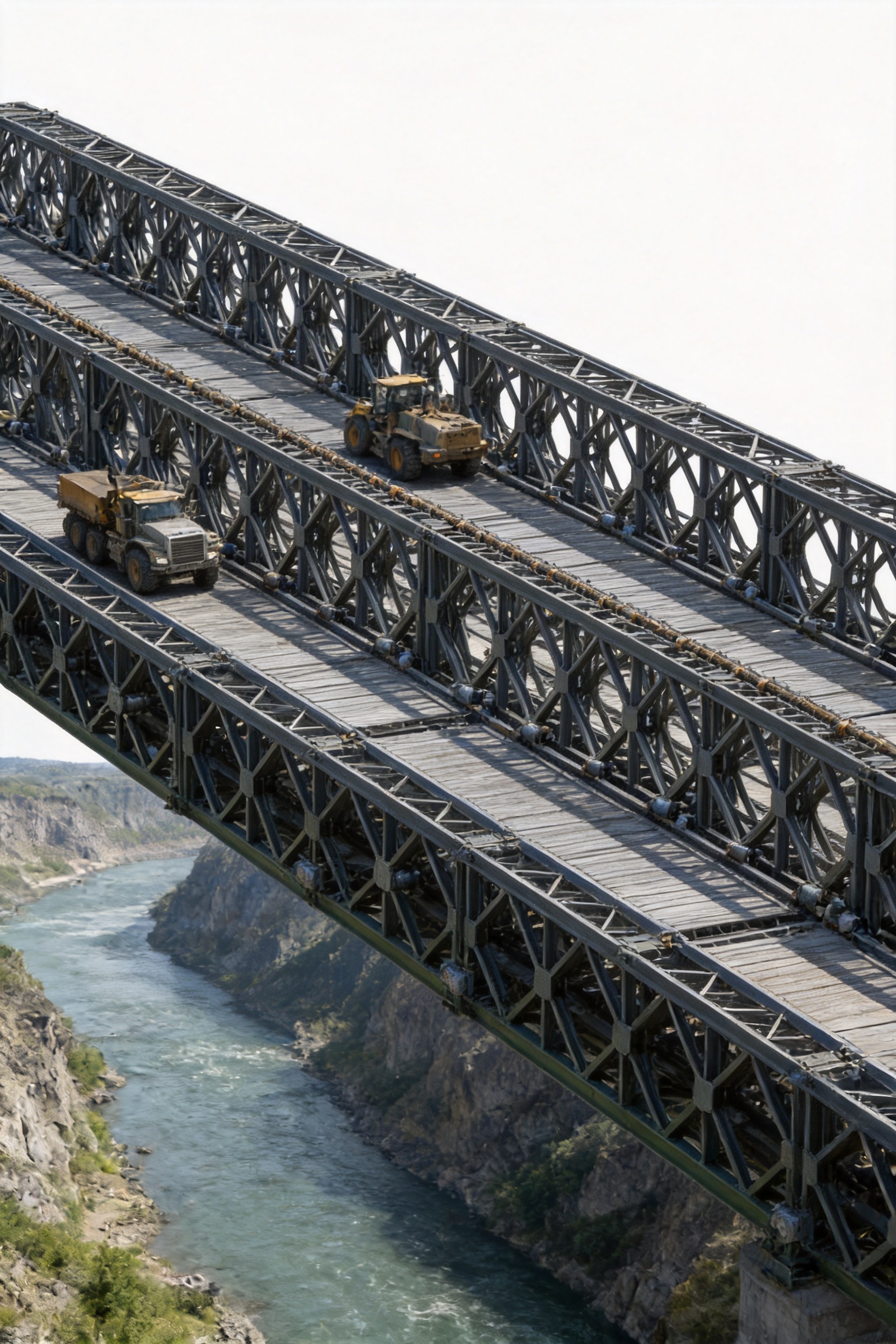
For product selection, engineering review, fabrication coordination, and project support, customers may contact the manufacturer through its sales and technical service channels.


 Français
 Español
 عربى