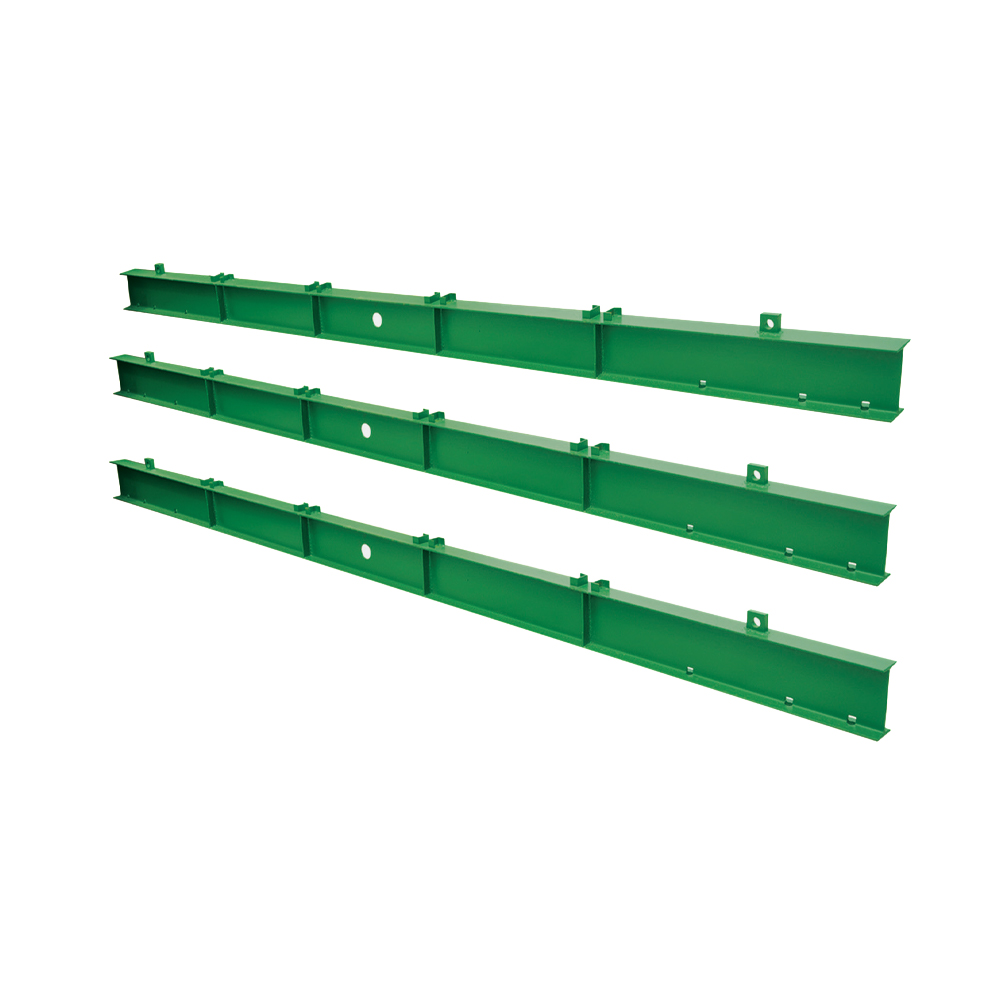
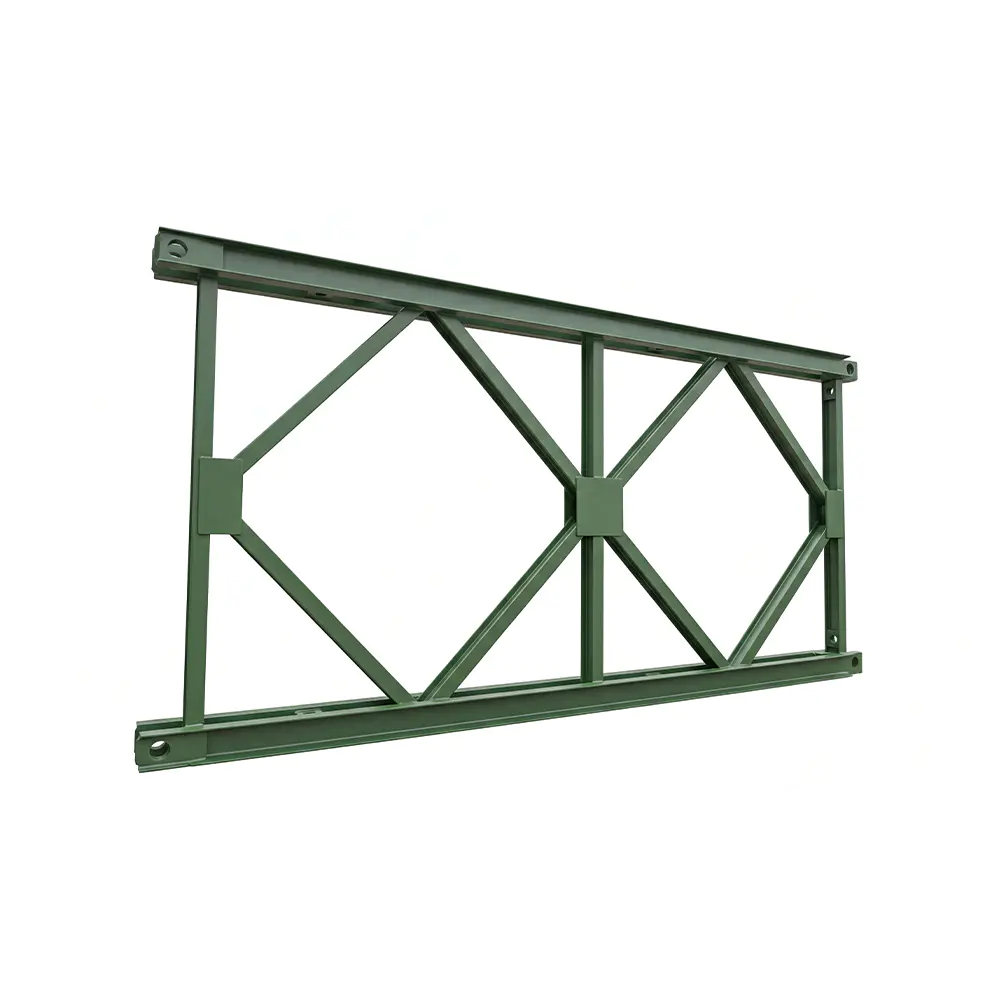
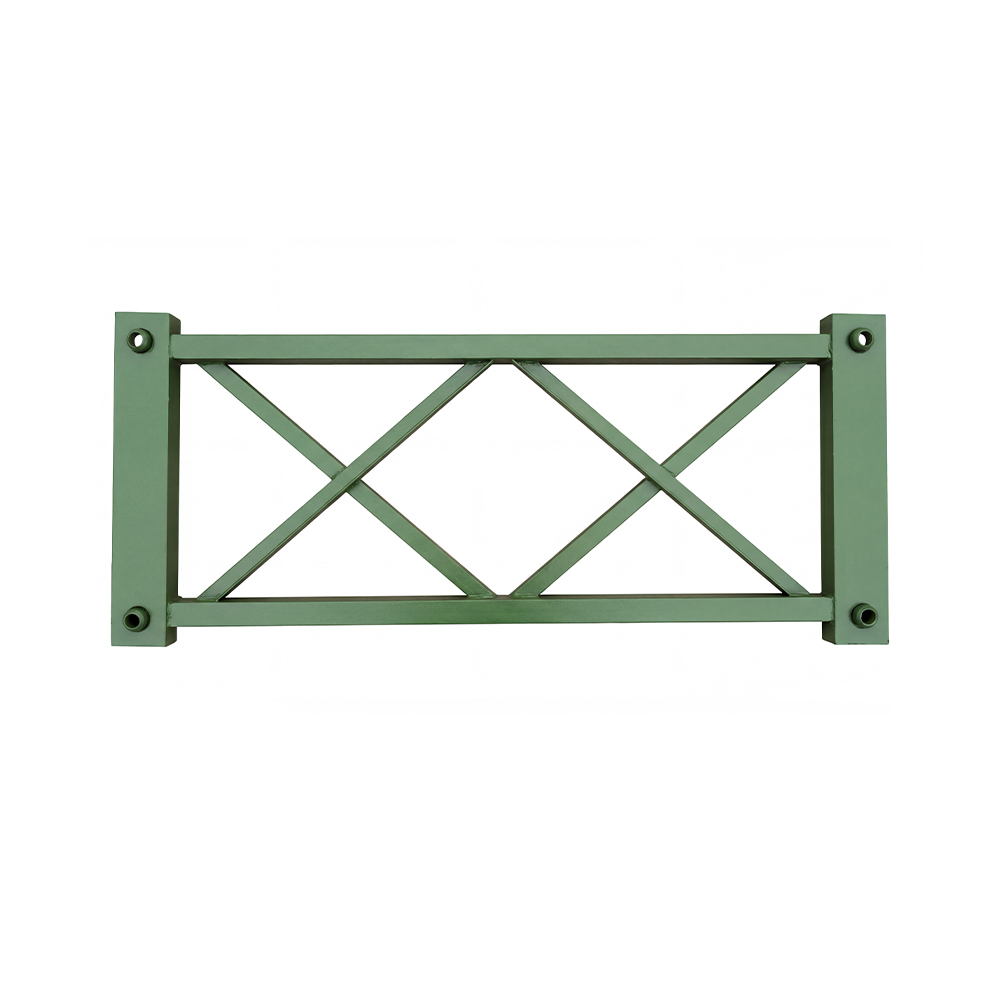
Pier and cap beam formwork is one of the most important temporary or reusable systems used in bridge substructure construction. Although formwork is removed after concrete reaches the required strength, its influence remains visible in the accuracy, durability, appearance, and overall efficiency of the completed bridge. A well-designed formwork system controls the geometry of pier columns and cap beams, withstands the pressure of fresh concrete, maintains alignment during pouring, and creates a smooth surface that minimizes subsequent repair and finishing work.
Modern highway and railway projects increasingly require formwork that can support rapid construction while maintaining strict dimensional and appearance standards. Conventional timber formwork may be inexpensive for small or irregular jobs, but it often requires extensive site fabrication, repeated adjustment, and additional surface treatment after demolding. Lightweight modular panels may be convenient, yet they can lack the rigidity needed for high-strength concrete, large pier sections, or repeated mass production. Pier and cap beam formwork manufactured from engineered steel provides a more dependable alternative by combining high structural stiffness, accurate fabrication, strong joint sealing, and controlled positioning.
The pier and cap beam formwork supplied by Zhenjiang Jinhao Road & Bridge Supporting Engineering Co., Ltd. is designed for bridge substructure applications involving pier columns and cap beams with circular, square, rectangular, and irregular cross-sections. Its core advantages include sufficient rigidity, excellent joint sealing, dedicated positioning clips, precise verticality control, and reliable flatness control for cap beams. After demolding, the concrete surface can be smooth and uniform, often eliminating the need for extensive finishing.
This article examines the system’s construction value, manufacturing strengths, application methods, technical advantages, and role in efficient bridge building. It also explains why properly engineered steel formwork can outperform improvised or low-rigidity alternatives in demanding highway, railway, municipal, and water-related infrastructure projects.
1. The Role of Formwork in Bridge Substructure Construction
Bridge substructures transfer loads from the superstructure to the foundations and surrounding ground. Pier columns support vertical and horizontal forces, while cap beams distribute loads from girders, deck systems, bearings, or other superstructure components into the pier arrangement. Because these elements must meet strict geometric and structural requirements, their construction cannot depend only on concrete quality. The formwork must also provide accurate support during the entire pouring and curing process.
Fresh concrete exerts considerable lateral pressure on formwork. The pressure is affected by the height of the pour, concrete consistency, placement speed, vibration intensity, temperature, and setting time. If formwork panels deform, joints open, or supporting components shift, the finished pier may develop bulging, honeycombing, leakage marks, dimensional errors, or visible surface defects. Even when the concrete itself satisfies the required mix design, poor formwork can reduce the quality of the completed component.
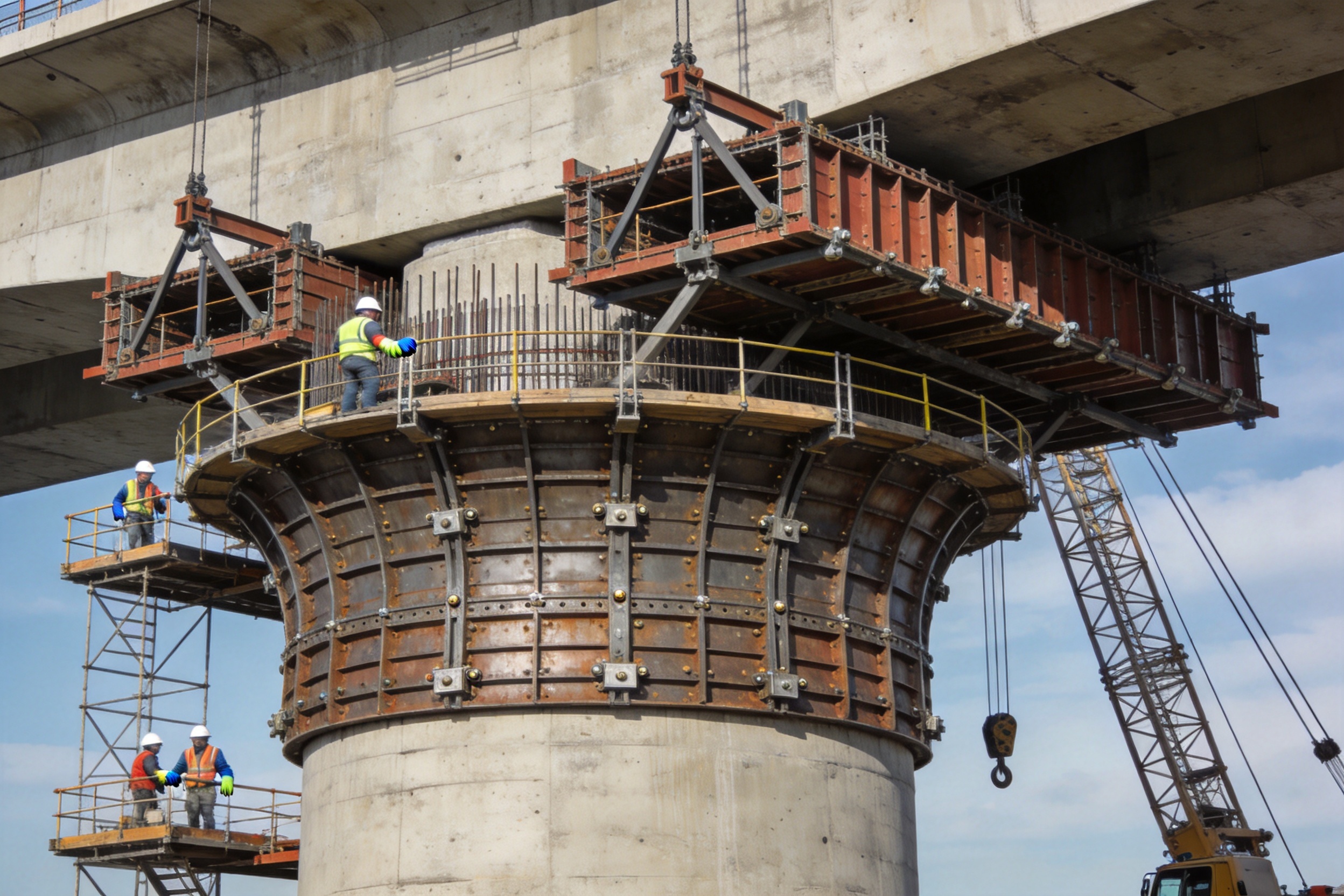
Pier formwork is responsible for defining the vertical or inclined faces of the pier column. It must remain stable while reinforcement is enclosed and concrete is placed. Cap beam formwork has an additional challenge because cap beams are often wider, deeper, and more complex than the pier shaft below. Their geometry may include bearing seats, stepped sections, cantilevered ends, chamfers, openings, or connection details. The formwork must therefore support both large loads and precise local features.
For mass bridge construction, the formwork must also support repetition. A contractor may need to construct dozens or hundreds of piers with similar dimensions. A system that requires extensive manual alteration for every pour creates delays and increases the likelihood of inconsistent quality. Reusable steel formwork, when properly designed, enables standardized assembly, fast adjustment, and consistent results from one pier to the next.
2. Product Overview
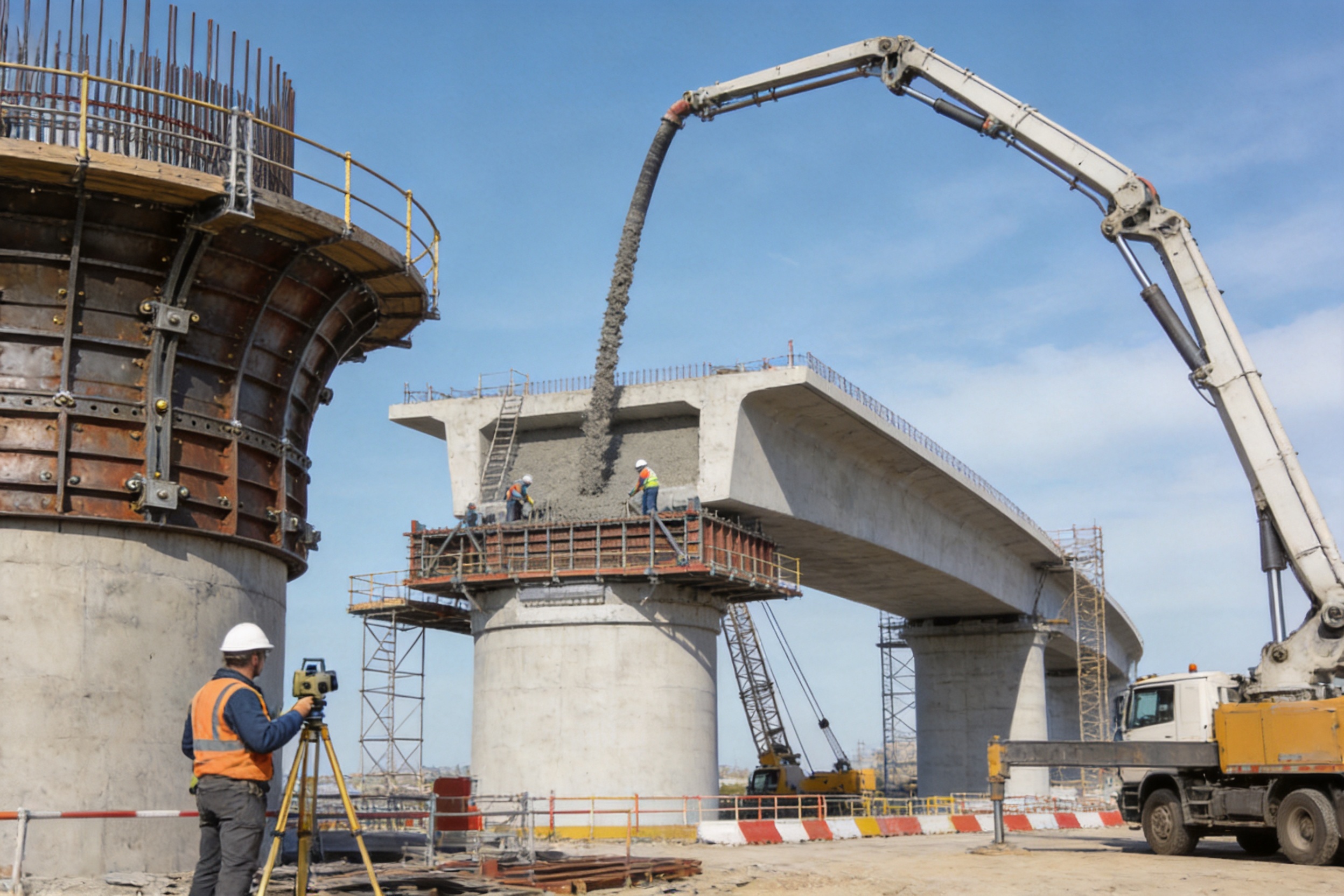
Pier and cap beam formwork is an engineered steel forming system used to shape and support concrete during the construction of bridge columns and cap beams. The system normally consists of fabricated steel panels, stiffening ribs, connection components, positioning clips, supporting frames, working platforms, access arrangements, and adjustment hardware selected according to the project design.
The system can be configured for a range of pier shapes. Circular pier columns may use curved steel panels manufactured to a specified radius. Square or rectangular piers may use flat modular panels joined at accurately fabricated corners. Irregular sections can be produced through customized panel combinations and specially shaped inserts. Cap beam formwork can be configured as a complete system or integrated with pier column formwork to create a continuous and accurately positioned assembly.
A major feature of this type of formwork is the use of dedicated positioning clips and connection details. These components help hold panels in their designed relationship during assembly, reinforcement installation, concrete placement, and vibration. Rather than relying solely on manual measurement and temporary bracing, the formwork provides defined positioning points that improve repeatability and reduce adjustment time.
The system is suitable for projects where concrete appearance and dimensional accuracy are important. It is particularly appropriate for highway and railway bridges, urban viaducts, municipal structures, water conservancy works, industrial bridge facilities, and other projects involving repeated pier construction or high-strength concrete placement.
| Application Requirement | Formwork Response | Construction Benefit |
|---|
| High lateral pressure from fresh concrete | Rigid fabricated steel panels and reinforced support components | Reduced deformation and more reliable geometry |
| Accurate pier verticality | Positioning clips, adjustable connections, and controlled assembly | Improved alignment and easier inspection |
| Cap beam flatness and level control | Engineered panel layout and stable support arrangement | More accurate bearing and superstructure interfaces |
| Repeated construction | Modular and reusable components | Lower setup time and more consistent results |
| High appearance standards | Well-sealed joints and smooth steel forming surfaces | Reduced honeycombing, leakage marks, and finishing work |
| Different pier geometries | Customized circular, square, rectangular, and irregular configurations | Greater suitability for varied bridge designs |
3. Core Advantages of the Steel Formwork System
3.1 Sufficient Rigidity Under Concrete Pressure
Rigidity is a primary performance requirement for pier and cap beam formwork. When concrete is poured, the pressure acts against the panels and attempts to push them outward. A formwork system with inadequate stiffness may deflect between supports or develop permanent distortion after repeated use. Even minor movement can affect pier dimensions, cap beam level, edge straightness, and the location of embedded components.
Engineered steel formwork provides a rigid forming surface supported by reinforcement ribs, frames, and connection components. The arrangement is designed to distribute pressure across the panel rather than allowing the load to concentrate at isolated points. This is particularly important for deep cap beams and tall pier columns, where concrete pressure can remain significant over a large area.
Compared with improvised timber panels, steel panels are less vulnerable to moisture-related swelling, repeated wetting and drying, and loss of shape during handling. Compared with thin or lightly reinforced panels, properly designed steel formwork offers greater resistance to local buckling and repeated loading. The result is more reliable dimensional control throughout the pouring process.
3.2 Excellent Joint Sealing
Open or poorly aligned joints are a common cause of concrete leakage. Cement paste escaping through panel joints can create fins, stains, voids, and rough lines on the finished surface. Leakage may also reduce the quality of the concrete near the joint if the cement-rich material is lost during placement.
The pier and cap beam formwork system is designed with close-fitting panel connections and joint sealing arrangements. Accurate fabrication reduces unwanted gaps, while properly selected seals or joint treatment methods help prevent the escape of cement paste. Good joint sealing is especially valuable when the concrete surface will remain exposed and when the project requires a uniform architectural appearance.
Effective sealing also reduces the need for labor-intensive repair. Instead of chipping away hardened fins, filling leakage channels, or applying surface coatings, the construction team can achieve a better finish directly from the formwork. This can shorten the finishing stage and improve the visual consistency of multiple bridge piers.
3.3 Precise Verticality Control
Pier verticality affects the position of the cap beam, bearings, girders, deck alignment, and load transfer path. If a pier column is not correctly aligned, the error may become more difficult and expensive to correct as construction progresses upward. Accurate formwork positioning is therefore a critical part of substructure quality management.
Dedicated positioning clips and adjustable connection points help establish the correct relationship between the formwork panels. Before pouring, the contractor can verify the assembly through surveying and make controlled adjustments. During placement, the stable formwork arrangement helps prevent movement caused by vibration, worker access, or concrete flow.
Positioning clips also support repeatability. Once the correct configuration has been established for a particular pier type, the same reference points can be used on subsequent units. This reduces dependence on trial-and-error assembly and makes it easier for site teams to follow a standardized installation procedure.
3.4 Accurate Cap Beam Flatness
Cap beams often receive bearings or support other precast and cast-in-place components. Their top surface and bearing areas must therefore satisfy strict level and flatness requirements. Unevenness may affect bearing installation, produce uneven load distribution, or require corrective work before the superstructure can be placed.
Stable cap beam formwork helps maintain the designed elevation and surface geometry. The system can be arranged to account for the cap beam’s width, depth, overhang, chamfer, and bearing seat details. Proper support beneath the formwork limits deflection, while accurate side panels control the external dimensions.
Good flatness is not achieved only through the formwork itself. It also depends on reinforcement placement, concrete workability, vibration, leveling, and curing. However, a rigid and accurately fabricated formwork system creates the necessary foundation for these activities to produce a consistent result.
3.5 Smooth and Flawless Concrete Surfaces
The forming surface directly influences the appearance of exposed concrete. Steel panels manufactured with appropriate surface treatment can produce smooth faces with consistent texture. When joints are correctly sealed and panels are cleaned and treated before use, the likelihood of visible defects is reduced.
A smooth surface provides more than aesthetic value. It reduces the need for patching, grinding, rendering, or painting. This can lower labor consumption and shorten the period between demolding and the next construction activity. On projects with many piers, the accumulated savings can be significant.
Uniform surfaces also simplify inspection. When the concrete finish is consistent, construction teams can identify genuine defects more easily rather than spending time distinguishing normal panel marks from issues requiring correction. This supports better quality records and more efficient acceptance procedures.
4. Advantages Over Conventional and Competing Formwork Solutions
4.1 Comparison with Timber Formwork
Timber formwork remains useful for small projects, temporary modifications, and highly irregular details. However, it often requires considerable cutting, drilling, bracing, and on-site adjustment. Moisture can change the dimensions of timber, and repeated use may lead to worn edges, damaged surfaces, or reduced joint tightness.
Steel formwork provides greater dimensional stability and is better suited to repeated bridge construction. Its panels can be manufactured according to engineering drawings rather than assembled entirely at the jobsite. This supports more reliable geometry and reduces the amount of disposable material.
Timber systems may also require more post-pour finishing because panel joints can leave marks or allow leakage. The close-fitting joints of engineered steel formwork help produce a cleaner surface. Although the initial investment in steel may be higher, the reusable nature of the system can improve total project economics when multiple pours are planned.
4.2 Comparison with Low-Rigidity Modular Panels
Some lightweight modular systems are easy to transport and handle, but their performance may be limited when used for tall piers, deep cap beams, high-strength concrete, or fast placement cycles. Excessive deflection can cause dimensional errors, especially if support spacing is not carefully controlled.
Rigid steel formwork is more appropriate when the project prioritizes geometry, surface quality, and repeated performance. Its structure can be engineered around the concrete pressure and the specific dimensions of the pier or cap beam. This does not mean that every project requires the heaviest possible system; rather, the formwork should be proportioned according to actual construction conditions.
4.3 Comparison with Non-Customized Standard Forms
Standardized formwork components are valuable because they encourage interchangeability and simplify logistics. However, bridge designs often include different pier diameters, cap beam widths, varying heights, sloped faces, bearing seats, and special reinforcement arrangements. A system that cannot be adapted may force contractors to use fillers, improvised brackets, or additional site fabrication.
Customized steel formwork combines the advantages of standard manufacturing with project-specific adaptation. Common components can be produced through repeatable fabrication methods, while the panel shape, dimensions, connection points, and accessories can be adjusted for the required bridge design. This approach improves compatibility without sacrificing manufacturing control.
4.4 Comparison with Poorly Integrated Systems
Another important advantage is system integration. Formwork performance is affected not only by panels but also by clips, braces, working platforms, lifting points, access arrangements, and adjustment hardware. If these items are purchased separately without a coordinated design, installation can become slow and unsafe, and the panels may not remain in the intended position.
An integrated supply approach allows the formwork configuration to be considered as a complete construction system. The panel arrangement, supporting structure, connection method, and adjustment procedure can be coordinated before delivery. This reduces the risk of incompatible components and supports a clearer installation sequence for the contractor.
5. Manufacturing Strengths and Quality Control
The performance of pier and cap beam formwork begins with manufacturing accuracy. A formwork system can only control concrete geometry effectively when its own components are produced according to reliable drawings, controlled dimensions, and suitable fabrication procedures. Zhenjiang Jinhao Road & Bridge Supporting Engineering Co., Ltd. combines design, manufacturing, erection, and technical support capabilities for bridge-related steel structures and formwork products.
5.1 Engineering Design and Configuration
Manufacturing begins with an understanding of the bridge design and construction sequence. Relevant information includes pier cross-section, pier height, cap beam dimensions, reinforcement arrangement, concrete placement method, expected pour rate, access requirements, crane capacity, and the number of planned reuses.
Based on these conditions, the formwork can be divided into practical modules. The engineering team considers panel dimensions, lifting weight, connection locations, reinforcement ribs, support points, working platforms, and adjustment areas. For irregular pier shapes, the geometry must be translated into accurately fabricated panel segments that can be assembled without unwanted discontinuities.
Design coordination is also important when the same formwork is expected to serve several pier types. A modular arrangement may allow selected panels or accessories to be reused for different dimensions. This can reduce the number of special components required while preserving the ability to adapt the system to the project.
5.2 Steel Plate Preparation and Panel Fabrication
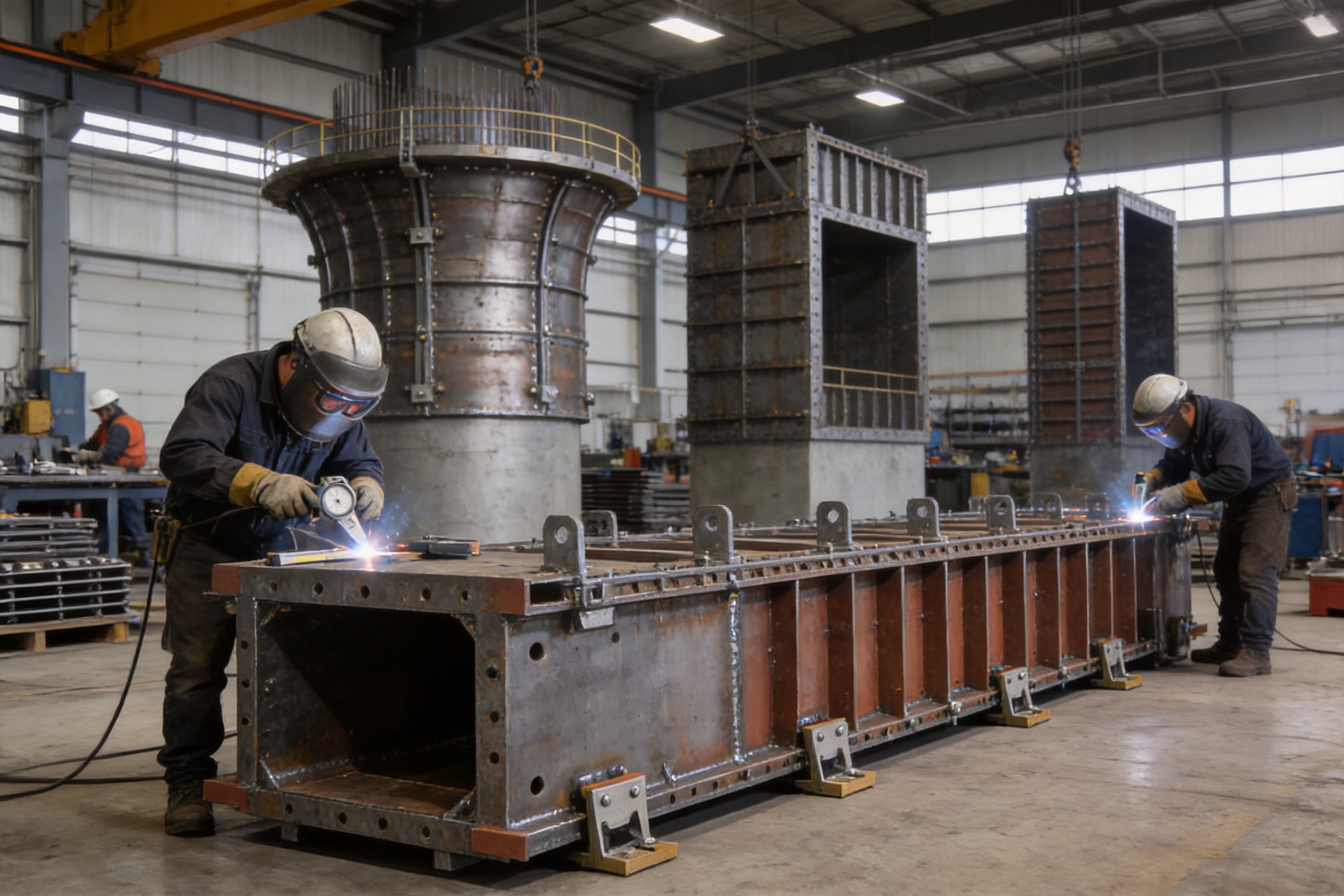
Steel plate preparation normally involves material inspection, cutting, edge preparation, forming where required, and assembly with stiffeners or frames. Curved panels for circular piers require controlled forming so that the finished radius matches the design. Flat panels require accurate cutting and edge alignment to ensure that adjacent sections close properly.
Fabrication quality affects both structural performance and concrete appearance. Uneven edges can create gaps at joints, while poorly aligned stiffeners may cause local distortion. Controlled workshop production is therefore preferable to extensive field modification. Factory fabrication allows measurements to be repeated under stable conditions and makes it easier to identify deviations before shipment.
5.3 Welding and Structural Assembly
Welding connects panel plates, ribs, frames, brackets, lifting points, and other steel components. The welding procedure must be appropriate for the material thickness and the structural function of each connection. Welded assemblies should be checked for alignment, distortion, visible defects, and proper attachment of load-bearing components.
Where welding heat may affect panel flatness, fabrication sequencing and temporary restraint can help limit distortion. After welding, critical dimensions should be verified against the approved drawings. This is particularly important for panel edges, curved surfaces, clip locations, and connection holes, because errors in these areas can affect the entire formwork assembly.
5.4 Dimensional Inspection
Dimensional inspection may include checking panel length, width, height, diagonal measurements, hole positions, curvature, edge straightness, connection alignment, and overall assembly fit. Inspection at the component stage is valuable because corrections are easier before the formwork is delivered to the construction site.
Trial assembly can be used for complex or customized systems. By assembling representative components in the workshop, the manufacturer can verify that panels meet correctly, clips engage properly, and adjustment components provide the intended range. Trial assembly also helps prepare installation instructions and identify any potential interference with reinforcement or access equipment.
5.5 Surface Treatment and Protection
The forming surface should be prepared to provide a consistent concrete finish and protect the steel from premature deterioration. Surface preparation may include cleaning, removal of welding residue, treatment of sharp edges, and application of a suitable protective coating to non-contact surfaces. The selected treatment depends on the expected service environment, transport conditions, and project requirements.
Before concrete placement, the forming surface should be cleaned and treated with an appropriate release agent. The release agent must be applied evenly and should not accumulate in corners or run onto reinforcement. Correct maintenance between pours preserves the surface quality and helps extend the useful life of the panels.
5.6 Quality Documentation and Delivery
For infrastructure projects, quality management includes more than physical manufacturing. Drawings, component lists, inspection records, assembly instructions, and maintenance recommendations help the contractor use the equipment correctly. Clear identification of panels and accessories can simplify transportation, storage, and repeated installation.
Proper packing and delivery planning are also important. Components should be protected from impact and deformation during handling. Lifting points, stacking arrangements, and component markings should be considered so that the formwork reaches the site ready for controlled assembly rather than requiring extensive sorting or repair.
6. Installation and Construction Workflow
6.1 Preparation Before Assembly
Before installing pier and cap beam formwork, the construction team should review the approved drawings, survey control points, reinforcement layout, concrete placement plan, lifting arrangements, and safety requirements. The foundation or previously cast concrete surface should be checked for elevation, cleanliness, and suitability for the planned support arrangement.
All panels and accessories should be inspected after delivery. Damaged edges, bent brackets, missing clips, contaminated forming surfaces, or damaged threads should be identified before assembly. The components should be arranged in the installation sequence to reduce unnecessary handling and avoid confusion between similar panels.
6.2 Positioning the Pier Formwork
The first stage is to establish the reference position of the pier column. Depending on the design, the formwork may be installed around reinforcement that has already been fixed, or it may be positioned in coordination with reinforcement installation. The construction team should ensure that the formwork does not displace reinforcement or reduce the required concrete cover.
Panels are connected using the specified clips, bolts, pins, or other components. The positioning system helps define the panel relationship, while braces and adjustment devices establish verticality and stability. Surveying should be performed before the pour to confirm centerline, dimensions, top elevation, and vertical alignment.
6.3 Installing Cap Beam Formwork
Cap beam formwork is installed after the pier arrangement and support conditions have been verified. Depending on the construction method, the cap beam may use brackets, temporary supports, a supported platform, or another engineered arrangement. The support system must be capable of carrying the formwork, reinforcement, workers, fresh concrete, and construction equipment without excessive movement.
The side panels and soffit panels should be aligned to the design dimensions. Particular attention should be given to bearing seats, end faces, chamfers, drainage details, and embedded items. The top surface should be checked for elevation and level before concrete placement.
6.4 Pre-Pour Inspection
A pre-pour inspection should confirm that all connections are tight, joints are sealed, braces are secure, supports are properly seated, and access platforms are safe. The formwork should be clean, and the release agent should be applied evenly. Reinforcement cover, embedded items, construction joints, and openings should also be checked.
Survey results should be recorded so that any adjustment can be made before concrete is introduced. It is much more efficient to correct a small alignment issue during the inspection stage than to repair an incorrectly positioned cap beam after the concrete has hardened.
6.5 Concrete Placement and Monitoring
Concrete should be placed according to the approved method and at a rate suitable for the formwork system. Excessively rapid placement can increase lateral pressure and may cause avoidable stress on panels and connections. Concrete should be distributed evenly to prevent unbalanced loading.
Vibration should be sufficient to consolidate the concrete but controlled so that it does not strike or displace the formwork. During the pour, workers should monitor joints, braces, panel alignment, and signs of movement. If abnormal leakage, deformation, or displacement is observed, placement should be managed safely and corrective action taken according to the site procedure.
6.6 Curing and Demolding
After placement, the concrete must remain undisturbed while it gains sufficient strength. The demolding time depends on the concrete design, temperature, curing conditions, structural requirements, and project specifications. Premature removal can damage edges or surfaces, while unnecessary delays can slow the construction cycle.
When the formwork is removed, panels should be separated carefully to avoid damaging concrete corners and to protect the panel edges. Steel wedges, clips, and adjustment components should be handled according to the manufacturer’s instructions rather than forced with uncontrolled impact.
6.7 Cleaning and Reuse
Immediately after demolding, residual concrete should be removed from the forming surfaces and joints using methods that do not damage the steel. Panels should be checked for deformation, damaged seals, missing hardware, or blocked connection holes. Any required repair should be completed before the next installation.
Consistent cleaning and inspection are essential for maintaining a smooth concrete finish. A panel that is not properly cleaned may transfer hardened material or irregularities to the next pier. Preventive maintenance also extends the service life of the formwork and improves the reliability of repeated construction cycles.
7. Applications in Highway and Railway Bridge Projects
Highway bridge projects often require many piers constructed in a relatively short period. Standardized steel formwork supports this demand by enabling repeated assembly, controlled surveying, and predictable concrete finishes. The system is suitable for interchanges, elevated roads, river crossings, viaducts, and approach structures.
Railway bridges typically impose strict requirements on alignment, settlement control, component geometry, and long-term durability. Pier and cap beam formwork helps contractors maintain consistent dimensions and accurate bearing interfaces. This is especially important where the superstructure involves precast beams, segmental construction, or other systems that depend on precise support locations.
Urban bridge and viaduct projects may place greater emphasis on appearance because the piers remain visible in public spaces. Smooth concrete surfaces, uniform joint patterns, and clean edges can improve the visual quality of the completed structure. Steel formwork also helps reduce construction debris and repeated on-site cutting associated with less durable forming materials.
Water conservancy and industrial bridge projects may involve unusual pier shapes, difficult access, or repeated exposure to demanding environmental conditions. A customized steel system can be adapted to the geometry and construction sequence while providing a durable forming solution for repeated use.
8. Suitability for Different Pier Geometries
8.1 Circular Pier Columns
Circular piers require curved forming surfaces with a consistent radius. Segmented steel panels can be designed to create the required circumference while allowing lifting, assembly, and demolding. Accurate curvature helps avoid visible steps or flat spots on the concrete surface.
8.2 Square and Rectangular Piers
Square and rectangular piers are generally assembled from flat panels connected at corners. Corner details must be rigid and tightly sealed to maintain sharp or chamfered edges. Modular flat panels can be reused efficiently when several piers have the same dimensions.
8.3 Irregular and Special Sections
Some bridge designs use tapered, flared, multi-sided, or otherwise irregular piers. These shapes require closer coordination between design and fabrication. Customized panels, inserts, and connection arrangements can reproduce the required profile while retaining the stability and joint control of a steel system.
8.4 Complex Cap Beams
Cap beams may include overhanging ends, multiple bearing locations, stepped soffits, inclined faces, recesses, and embedded components. The formwork can be divided into panels that reflect these details, provided that the supporting arrangement is designed to resist the relevant loads and maintain the required tolerances.
9. Economic and Project Management Benefits
The economic value of steel formwork should be assessed over its full construction life rather than only by its purchase price. A reusable system can be used for multiple pours, reducing the need for repeated procurement and disposal. Faster installation and demolding can improve the utilization of cranes, labor teams, reinforcement crews, and concrete equipment.
Reduced finishing work is another important benefit. If the concrete surface is smooth and joint lines are controlled, fewer workers are needed for patching and grinding. This can reduce material consumption and avoid delays between structural completion and the next stage of construction.
Standardized formwork also supports better planning. Contractors can establish a repeatable cycle for installation, inspection, pouring, demolding, cleaning, and relocation. Predictable cycles make it easier to coordinate concrete deliveries and allocate site resources.
Improved quality can prevent indirect costs. Correcting a misaligned pier or defective cap beam may involve additional surveying, concrete repair, reinforcement modification, bearing adjustment, or schedule disruption. By controlling geometry from the beginning, engineered formwork reduces the likelihood of such problems.
10. Safety and Operational Considerations
Formwork safety depends on correct design, assembly, inspection, and use. Workers should not modify load-bearing members without approval, remove braces while concrete is fresh, or place equipment on platforms beyond their rated capacity. Lifting operations must use suitable equipment and established communication procedures.
Working platforms, ladders, guardrails, and access points should be arranged to allow workers to inspect and operate the formwork without climbing on unstable surfaces. The formwork should be secured against movement before workers enter the area or concrete placement begins.
Weather conditions can affect operations. Wind may influence large panels during lifting, while rain can affect working surfaces, release agent application, and concrete placement. The site team should establish procedures for securing components and suspending work when conditions exceed safe limits.
Safety and quality are closely connected. A formwork system that is easy to assemble, adjust, inspect, and clean helps reduce hurried work and unsafe improvisation. Clear component identification and installation guidance further support consistent site practice.
11. Company Capabilities and Service Strengths
Zhenjiang Jinhao Road & Bridge Supporting Engineering Co., Ltd. was established in 2017 and is located in an industrial area of Zhenjiang, Jiangsu Province, China. The company has developed from an enterprise involved in construction, industrial, and metal processing materials into a comprehensive provider of bridge-related steel products and engineering support.
Its product and service scope includes Bailey steel bridges, Type 321 Bailey truss sections, HD200 or Type 200 Bailey truss sections, bridge launching gantry systems, hanging baskets, pier formwork, bridge steel formwork, and related engineered steel structures. This broader background is valuable because bridge formwork is part of a wider construction system rather than an isolated product.
The company provides design, manufacturing, erection, leasing, customized fabrication, system planning, technical support, and quality management services. For contractors and engineering companies, this means that formwork requirements can be discussed together with transport, lifting, installation, reuse, and project scheduling considerations.
Experience with bridge steel structures also supports a practical understanding of field conditions. Bridge projects may involve restricted access, staged construction, changing pier dimensions, limited lifting capacity, and demanding schedules. A supplier familiar with these conditions can help develop a system that is not only structurally suitable but also practical to install and reuse.
The company serves contractors, government-related projects, and engineering organizations in different markets. Its stated operating principles emphasize customer-focused service, integrity, practical operation, innovation, cooperation, and quality. These principles are relevant to formwork supply because successful results depend on coordination among design, production, delivery, and site execution.
12. How to Select the Right Pier and Cap Beam Formwork
Selection should begin with the bridge geometry. The contractor or designer should identify the pier shape, dimensions, height, taper, cap beam arrangement, bearing details, and any special recesses or openings. These factors determine the panel layout and the need for customized components.
The construction method must also be considered. The available crane capacity, lifting points, access restrictions, reinforcement sequence, concrete placement rate, and planned number of reuses all affect the most suitable configuration. A panel system that is appropriate for a large open site may require modification for a congested urban project.
Quality requirements should be defined clearly. If the concrete will remain exposed, the project should specify acceptable surface appearance, joint patterns, corner treatment, and finishing standards. If the formwork will be reused many times, the design should consider cleaning, storage, adjustment, and repair procedures.
Finally, the supplier’s technical support and manufacturing capability should be evaluated. Important questions include whether the supplier can produce customized geometry, provide assembly drawings, complete dimensional inspection, coordinate delivery, support site erection, and supply replacement or maintenance components when needed.
13. Recommended Maintenance Practices
After each use, steel panels should be cleaned before concrete residue hardens. Cleaning tools should be selected to avoid gouging or scratching the forming surface. Particular attention should be paid to panel edges, bolt holes, clip locations, and corner areas.
Connection hardware should be inspected for thread damage, deformation, corrosion, and loss. Positioning clips should engage fully and should not be used if they are bent or cracked. Braces and adjustment devices should be checked for straightness and proper operation.
Panels should be stored on stable supports that prevent twisting and keep the forming surface away from standing water or contamination. Similar components should be labeled and protected from accidental impact. Before a new project or a long period of storage, a complete inspection can identify issues that might otherwise appear during installation.
Regular maintenance improves concrete quality and prolongs the useful life of the system. It also supports accurate cost estimation because the contractor can plan repairs and replacement of consumable items rather than responding to unexpected failures.
14. Frequently Asked Questions
Q1: What types of bridge elements can this formwork construct?
The system is intended for pier columns and cap beams used in highway, railway, municipal, water conservancy, and related bridge projects. It can be configured for circular, square, rectangular, and irregular cross-sections according to the project design.
Q2: Why is steel formwork preferable for repeated bridge construction?
Steel formwork offers high rigidity, dimensional stability, reusable panels, accurate fabrication, and reliable joint control. These characteristics make it suitable for repeated pours where consistent geometry and surface quality are required.
Q3: Can the system be customized for non-standard pier shapes?
Yes. The panel arrangement, curvature, dimensions, connection points, and special inserts can be designed according to the required pier and cap beam geometry. Customized fabrication is particularly useful for tapered, flared, multi-sided, or otherwise irregular sections.
Q4: How does the system help control pier verticality?
Dedicated positioning clips, adjustable connections, stable bracing, and pre-pour surveying work together to control the position of the panels. The formwork provides defined reference relationships that reduce reliance on improvised site adjustment.
Q5: How is cap beam flatness maintained?
Cap beam flatness depends on accurate panel fabrication, adequate support, correct elevation adjustment, stable connections, and proper concrete placement. The formwork provides a rigid and controlled platform for these construction activities.
Q6: Can the finished concrete surface be left exposed?
When the panels are properly fabricated, cleaned, sealed, and treated with suitable release agent, the system can produce a smooth and uniform concrete surface. Final appearance also depends on concrete quality, reinforcement arrangement, vibration, curing, and site workmanship.
Q7: Is the formwork suitable for high-strength concrete?
It can be suitable for high-strength concrete when the system is designed for the relevant concrete pressure, placement rate, vibration method, and support conditions. These project-specific factors should be reviewed during engineering and planning.
Q8: Can one formwork system be used for multiple pier sizes?
A modular system may be configured for reuse across multiple pier types, depending on the dimensional range and project requirements. Additional panels, inserts, or adjustable components may be needed when dimensions vary substantially.
Q9: What information is needed for a quotation or technical proposal?
Useful information includes pier and cap beam drawings, cross-section dimensions, heights, concrete grade, construction sequence, number of planned pours, reuse requirements, site lifting capacity, delivery location, and required surface finish. Complete information allows the system to be designed more accurately.
Q10: What services can the manufacturer provide?
Services may include customized design, fabrication, system planning, technical support, erection assistance, quality management, and leasing or supply arrangements depending on the project. The exact service scope should be confirmed during technical discussions.
15. Conclusion
Pier and cap beam formwork has a direct influence on the safety, appearance, accuracy, and efficiency of bridge substructure construction. A system with sufficient rigidity resists the pressure of fresh concrete and preserves the intended dimensions. Well-sealed joints reduce leakage and surface defects. Dedicated positioning clips and controlled connections improve pier verticality and cap beam flatness. Smooth forming surfaces reduce finishing work and support a cleaner final appearance.
Compared with improvised timber systems, low-rigidity panels, and non-customized solutions, engineered steel formwork offers stronger repeatability, better dimensional stability, and greater suitability for standardized mass construction. Its value increases on projects involving numerous piers, high-strength concrete, strict appearance requirements, or demanding construction schedules.
The manufacturing process is equally important. Accurate design, controlled plate preparation, reliable welding, dimensional inspection, surface treatment, trial assembly, and careful delivery preparation all contribute to the performance of the final system. A supplier with capabilities in design, fabrication, erection, leasing, and technical support can help contractors manage formwork as an integrated construction solution.
With its focus on bridge steel structures and customized engineering services, Zhenjiang Jinhao Road & Bridge Supporting Engineering Co., Ltd. provides pier and cap beam formwork for contractors and engineering organizations seeking dependable performance in highway, railway, municipal, and related infrastructure projects. When correctly selected, installed, inspected, and maintained, the system can improve construction quality while reducing repeated labor, corrective work, material waste, and schedule uncertainty.
References
American Concrete Institute. Guide to Formwork for Concrete.
American Concrete Institute. Specifications for Structural Concrete and Concrete Construction.
European Committee for Standardization. Execution of Concrete Structures: Formwork and Temporary Works Principles.
International Organization for Standardization. Quality Management Systems: Requirements.
International Federation for Structural Concrete. Good Practice for Concrete Construction and Surface Quality.
Bridge construction quality control manuals for highway and railway infrastructure projects.
Technical information supplied for pier and cap beam formwork, bridge steel formwork, and related engineered steel structures.


 Français
 Español
 عربى