Modern bridge construction increasingly depends on equipment that can combine structural strength, precise movement, adaptable geometry, and dependable jobsite safety. These requirements become especially demanding when contractors build large-span, high-load, and continuously cast-in-place box girder bridges. In such projects, a form traveler must support formwork, working platforms, construction loads, and fresh concrete while advancing from one completed segment to the next. It must also operate accurately without imposing excessive additional stress on the bridge structure.
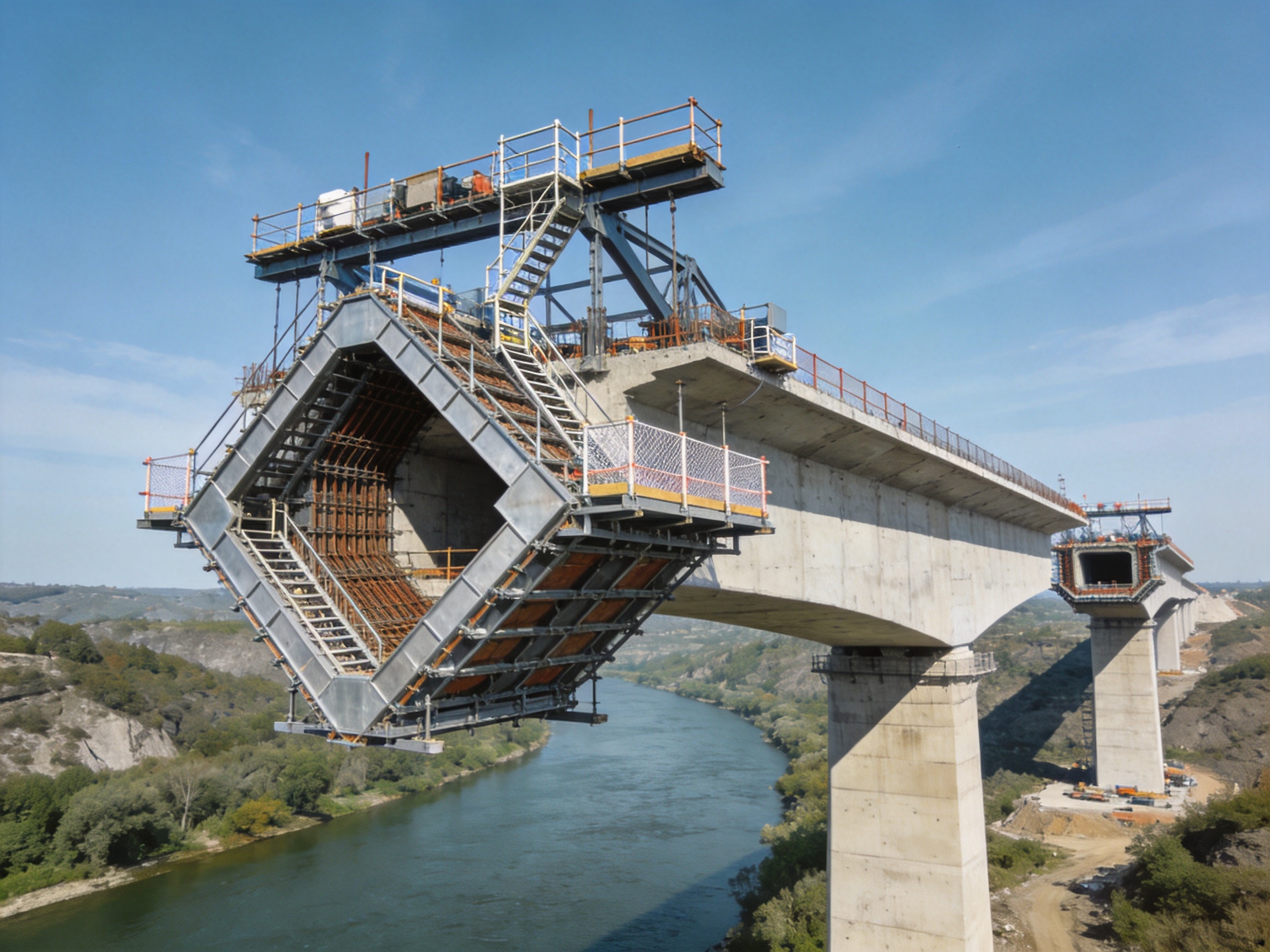
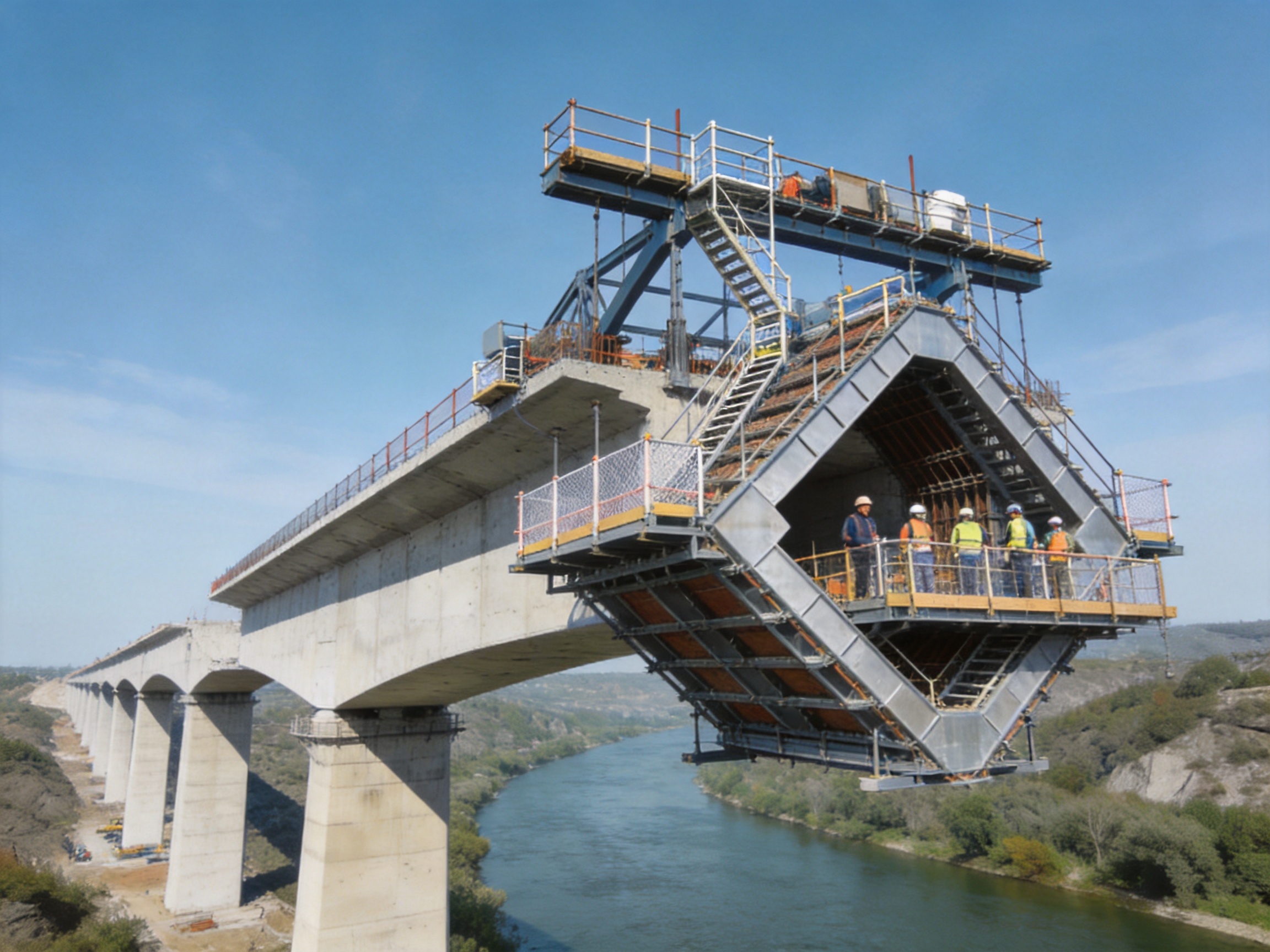
The Diamond Form Traveler is designed to address these challenges through a rhombus-shaped load-bearing frame. Its diamond configuration provides a favorable balance between rigidity, weight, and adaptability. The system is suitable for balanced cantilever construction, particularly where bridge geometry, loading conditions, or site restrictions make conventional equipment less effective. Its structural concept allows the traveler to maintain high overall stiffness while limiting unnecessary self-weight and reducing the additional load transferred to the main bridge beam.
Manufactured and engineered by Zhenjiang Jinhao Road & Bridge Supporting Engineering Co., Ltd., the Diamond Form Traveler reflects the company’s broader expertise in bridge construction equipment, steel formwork, Bailey bridges, launching gantries, hanging baskets, and related steel structures. The company combines design capability, steel fabrication, system planning, technical support, erection assistance, and leasing services to provide equipment solutions for demanding infrastructure projects.
This article explains the working concept, principal advantages, manufacturing strengths, application value, and selection considerations of the Diamond Form Traveler. It also compares the system with more conventional traveler arrangements and answers common questions from contractors, bridge engineers, and project owners.
1. Understanding the Diamond Form Traveler
A form traveler is a temporary construction machine used to support formwork and construction operations during the segmental casting of bridge decks. In balanced cantilever construction, bridge segments are cast successively outward from a pier. After one segment reaches the required strength, the traveler moves forward and is positioned to support the next segment. This process continues until adjacent cantilevers meet or the bridge reaches a closure segment.
The Diamond Form Traveler receives its name from the rhombus-shaped arrangement of its primary load-bearing members. Rather than relying only on a simple horizontal frame, the diamond configuration creates a spatial structural system in which loads can be distributed through inclined and vertical components. The resulting geometry provides a stable working platform for the formwork system while maintaining a relatively low structural mass.
The main frame normally works together with front and rear support arrangements, adjustable formwork, anchoring devices, movement mechanisms, access platforms, working platforms, and safety protection components. These elements create one coordinated construction system. The frame carries the formwork and construction loads, the anchoring components transfer forces to the completed bridge segment, and the movement equipment allows the traveler to advance in a controlled sequence.
Because the equipment is used repeatedly along the bridge alignment, its performance depends not only on its ultimate load capacity but also on its movement accuracy, adjustment range, connection reliability, and ability to accommodate changing cross-sections. The Diamond Form Traveler is therefore designed as a complete system rather than as an isolated steel frame.
2. Why the Rhombus Structure Matters
The geometry of a load-bearing frame strongly affects its stiffness, stability, weight, and behavior under changing loads. A rhombus-shaped system forms a triangulated or partially triangulated load path that can resist vertical, longitudinal, and transverse effects more effectively than a lightly braced rectangular frame. Inclined members help transfer forces toward the anchoring and support points, while the upper members provide a stable base for the formwork and construction platforms.
High rigidity is one of the most important characteristics of a traveler. Fresh concrete produces substantial temporary loads, and the formwork must remain stable during pouring, vibration, and curing. Excessive deflection can affect the geometry of the segment, create difficulty during formwork adjustment, and introduce unwanted stress into both the traveler and the bridge. A rigid frame helps maintain dimensional accuracy and supports consistent construction quality.
The rhombus arrangement also contributes to efficient material use. A system that achieves stiffness through geometry can reduce the need for oversized members in every direction. Lower self-weight is beneficial because the traveler is supported by the bridge structure during construction. Every additional tonne of equipment increases the temporary load on the cantilever, the anchoring system, and the completed segment. A lighter traveler can therefore help reduce additional stress on the main beam while preserving the required working capacity.
Low self-weight does not mean reduced reliability. The objective is to achieve a rational strength-to-weight ratio through suitable member sizing, effective bracing, accurate connections, and appropriate load distribution. This balance is particularly valuable for long-span bridges, where each cantilever segment must be carefully controlled and where temporary construction loads can influence the overall structural behavior.
3. Core Advantages of the Diamond Form Traveler
3.1 High Overall Stiffness
The primary advantage of the Diamond Form Traveler is its high overall stiffness. Its main frame creates a stable load-bearing skeleton that resists deformation during concrete placement and other construction activities. High stiffness improves the behavior of the formwork, helps preserve the intended segment profile, and reduces the risk of unwanted movement while concrete is being cast.
For bridge contractors, stiffness also improves the repeatability of construction operations. When the traveler responds predictably under similar loads, engineers and site teams can establish reliable adjustment procedures for each segment. This supports better control of elevation, width, alignment, and camber.
3.2 Reduced Additional Stress on the Main Beam
A traveler is a temporary load, but its effect on the permanent bridge structure must be considered throughout construction. The Diamond Form Traveler is developed with a relatively low self-weight so that the construction equipment does not impose unnecessary stress on the main beam. This is particularly important for slender box girders, long cantilevers, and projects with strict temporary-load limitations.
Reducing the equipment’s own mass can improve the margin available for fresh concrete, reinforcement, workers, tools, and other construction materials. It may also simplify temporary load calculations and reduce the demand on anchoring and support components. The actual allowable load must always be confirmed through project-specific structural analysis, but the low-weight design concept provides a useful foundation for efficient construction planning.
3.3 Adaptability to Irregular Cross-Sections
Bridge segments do not always have a uniform cross-section. Variations may occur in deck width, web inclination, bottom slab shape, edge geometry, haunches, diaphragms, and longitudinal alignment. A rigid but inflexible traveler may require extensive modification when used on a bridge with changing or irregular geometry.
The Diamond Form Traveler is designed to accommodate a broad range of working conditions through adjustable and coordinated components. Its formwork and support arrangements can be configured to suit project-specific box girder dimensions. This adaptability is valuable for bridges with variable-depth girders, changing widths, curved alignments, or complex transition zones.
3.4 Precise Synchronous Forward Movement
Forward movement is a critical stage in every traveler cycle. The traveler must be released, shifted, aligned, and secured without uncontrolled displacement or uneven loading. The Diamond Form Traveler uses a coordinated movement approach so that its principal support points advance in a synchronous manner.
Precise synchronous movement helps prevent twisting, skewing, and uneven transfer of loads. It also makes it easier to place the traveler accurately for the next segment. Controlled movement can reduce adjustment time, improve operator confidence, and help protect the completed concrete and anchoring components.
Synchronization may be achieved through suitable mechanical, hydraulic, or guided movement arrangements selected according to the project design. The specific operating method should be established in the equipment drawings, method statement, and site safety plan. Regardless of the chosen mechanism, the objective is the same: maintain stable geometry and coordinated movement during every relocation cycle.
3.5 Comprehensive Safety Protection
Bridge construction equipment must provide more than load-bearing capacity. Workers need safe access to the formwork, reinforcement, inspection points, and concrete placement areas. The Diamond Form Traveler can be combined with working platforms, guardrails, access ladders, toe boards, protective screens, anti-fall measures, and other safety components required by the project.
A comprehensive protection system helps separate personnel movement from moving or suspended components. It can also reduce the risk of falling objects and provide more secure working conditions at height. Safety equipment must be correctly installed, regularly inspected, and used in accordance with the approved construction method. The traveler’s design provides the structural basis, but safe performance depends on proper assembly, operation, maintenance, and supervision.
4. Comparison with Conventional Traveler Solutions
Many form travelers use a basic truss, frame, or hanging arrangement. These systems can be effective when the bridge geometry is regular and the working conditions are straightforward. However, a conventional arrangement may become less efficient when the project involves irregular cross-sections, high segment loads, restricted access, or strict limits on temporary weight.
The Diamond Form Traveler offers several practical advantages over a basic rectangular or heavily reinforced frame. Its rhombus-shaped load-bearing structure can provide high stiffness without requiring every member to be oversized. This can produce a more favorable relationship between structural capacity and equipment weight. The system is also intended to support accurate synchronized movement and flexible adaptation to different beam shapes.
| Performance consideration |
Basic conventional arrangement |
Diamond Form Traveler |
| Load-bearing geometry |
Often based on rectangular frames or simple trusses |
Rhombus-shaped primary load-bearing structure |
| Overall stiffness |
Depends heavily on member size and additional bracing |
Enhanced through efficient geometric load distribution |
| Equipment self-weight |
May increase when additional reinforcement is required |
Designed to achieve high rigidity with controlled self-weight |
| Adaptability |
May require more modification for irregular sections |
Suitable for varied and irregular box girder geometries |
| Forward movement |
Can be more sensitive to uneven release or support conditions |
Configured for precise, coordinated forward movement |
| Application range |
Well suited to standard, repetitive conditions |
Suitable for large-span, high-load, and complex-stress projects |
| Safety integration |
May require separate planning for platforms and protection |
Can be integrated with comprehensive safety protection systems |
This comparison does not mean that every conventional traveler is unsuitable or that the Diamond Form Traveler eliminates the need for engineering review. Equipment selection must be based on the bridge design, segment length, concrete volume, construction sequence, allowable temporary loads, site conditions, and local regulations. The principal advantage of the diamond system is its ability to provide a balanced and adaptable solution where ordinary arrangements may require substantial reinforcement or repeated modification.
5. Applications in Large-Span Box Girder Construction
The Diamond Form Traveler is particularly suitable for cast-in-place segmental box girder bridges constructed by the balanced cantilever method. This method is widely used where ground-based falsework is difficult, expensive, or disruptive. It is useful over rivers, roads, railways, deep valleys, built-up areas, and environmentally sensitive zones.
In a balanced cantilever project, construction proceeds outward from a pier in approximately balanced stages. A traveler supports the formwork on one side, while a corresponding operation takes place on the opposite side or an appropriate temporary balancing system is used. The equipment must maintain stable support while the new segment is cast and while the bridge’s temporary loading changes during each cycle.
The Diamond Form Traveler is also valuable where the bridge includes variable-depth girders or non-standard cross-sections. Such structures can provide structural efficiency and architectural value, but they place greater demands on formwork adjustment and equipment versatility. A traveler that can be configured for changing geometry helps reduce the need for improvised site modifications.
Potential applications include highway viaducts, railway bridges, urban elevated structures, river crossings, long-span approach bridges, and other reinforced concrete or prestressed concrete box girder systems. The final application must be confirmed through detailed engineering analysis and compatibility review.
6. Engineering and Design Process
A reliable traveler begins with a clear understanding of the bridge and the construction method. Before fabrication, the engineering team reviews the general arrangement drawings, box girder dimensions, segment length, concrete volume, reinforcement arrangement, casting sequence, anchoring conditions, access requirements, and movement procedure.
The design process normally establishes the main load cases. These may include the self-weight of the traveler, formwork, fresh concrete, reinforcement, workers, tools, construction equipment, wind effects, impact or accidental effects, movement conditions, and temporary unbalanced loading. The design must also consider support reactions, connection forces, local stresses, deflection limits, stability, and the transfer of loads into the completed bridge segment.
Geometry is then developed around the required working envelope. The traveler must provide enough space for reinforcement installation, inspection, concrete placement, vibration, curing, formwork stripping, and segment removal. At the same time, its members must remain clear of permanent reinforcement, ducts, embedded components, and access routes.
Adjustability is incorporated into areas where the bridge profile changes. Connection points, brackets, formwork supports, and working platforms may be designed to allow controlled adjustment. This is more effective than relying on unplanned field cutting or welding, which can affect quality and delay the construction cycle.
Where required, the design may be prepared as a customized arrangement for a specific bridge. A project-specific system can optimize the traveler’s dimensions, support positions, formwork interface, movement path, and safety features. Custom engineering is especially useful for large spans, unusual pier arrangements, restricted construction envelopes, or complex cross-sections.
7. Advanced Manufacturing Capabilities
The performance of a form traveler depends heavily on manufacturing quality. Even a sound structural concept can underperform if members are inaccurately cut, welded with distortion, assembled without dimensional control, or delivered without proper inspection records. Jinhao’s experience in metal processing and bridge steel structures supports a manufacturing approach centered on controlled fabrication and system-level quality.
7.1 Material Preparation
Manufacturing begins with the selection and preparation of suitable steel materials according to the approved design and applicable project requirements. Plates, sections, tubes, connection components, fasteners, pins, and other items are identified and organized before fabrication. Proper material tracking helps reduce errors and makes it easier to confirm that each component corresponds to the design documentation.
Steel surfaces are prepared for cutting, forming, welding, and protective treatment. Material preparation should account for thickness, dimensions, weld details, connection requirements, and expected service conditions. Components exposed to outdoor construction environments require suitable corrosion protection and careful handling during storage and transport.
7.2 Precision Cutting and Component Processing
Main frame members and connection plates must be manufactured to accurate dimensions. Controlled cutting and drilling improve the fit-up of the traveler during assembly and reduce the need for field correction. Accurate holes are particularly important for pinned or bolted connections because misalignment can create installation difficulty and unwanted local stress.
Processing accuracy also helps maintain the intended geometry of the rhombus frame. Small dimensional deviations can accumulate when multiple members are connected together. A disciplined fabrication process reduces this risk by controlling individual components before they are incorporated into the larger assembly.
7.3 Welding and Structural Assembly
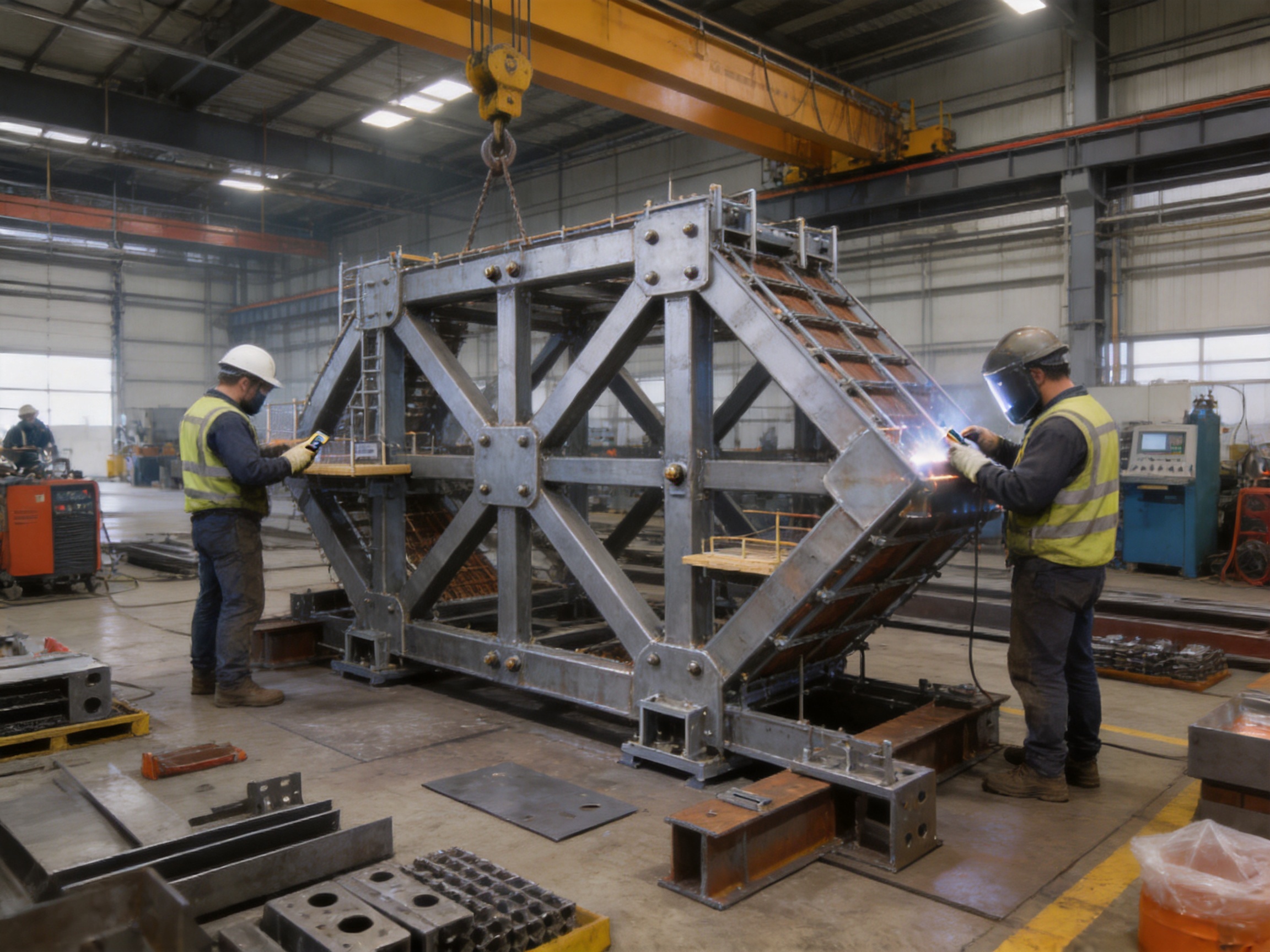
Welding is a central part of steel traveler fabrication. Main members, stiffeners, gusset plates, brackets, platforms, and support components must be assembled in accordance with approved drawings and welding procedures. Proper fit-up, joint preparation, welding sequence, and distortion control help preserve structural alignment.
Large welded assemblies may require temporary fixtures or controlled positioning during fabrication. The purpose is to maintain the designed geometry and ensure that connection points remain within acceptable tolerances. After welding, visual inspection and other appropriate quality checks can be performed according to the project’s inspection plan.
Factory assembly provides an opportunity to identify interference between components before the equipment reaches the bridge site. It can also verify the operation of adjustable parts, access platforms, formwork interfaces, pins, locking devices, and movement components. This reduces the likelihood of discovering major fit-up problems during critical construction stages.
7.4 Trial Assembly and Dimensional Verification
Trial assembly is particularly valuable for complex traveler systems. Components can be assembled in a controlled factory environment to confirm overall dimensions, connection compatibility, movement clearance, and the relationship between the primary frame and auxiliary systems.
Dimensional verification may include checking the distance between support points, the alignment of pin holes, the position of adjustment brackets, platform levels, formwork interfaces, and the assembled frame geometry. Findings from trial assembly can be addressed before shipment, when corrections are generally faster and safer than modifications at height on a bridge.
7.5 Surface Treatment and Protection
Steel equipment used outdoors is exposed to rain, humidity, dust, concrete residue, and repeated handling. Surface preparation and protective coating help extend service life and maintain the condition of the components. The coating system should be selected according to the project environment, storage duration, transport requirements, and maintenance plan.
Special attention should be given to welds, edges, connection zones, drainage points, and areas where coating may be damaged during assembly. Proper touch-up procedures should be established for field repairs. For equipment intended for repeated leasing or use on multiple projects, maintainable surface protection can help preserve appearance and reduce long-term maintenance costs.
8. Quality Management and Factory Strengths
Jinhao’s development from a company involved in construction materials, industrial materials, and metal processing into a comprehensive bridge equipment enterprise provides a practical foundation for the Diamond Form Traveler. Its product range includes Bailey steel bridges, Type 321 Bailey truss sections, HD200 or Type 200 Bailey truss sections, triangular and diamond hanging baskets, bridge steel formwork, launching gantries, pier formwork, and related engineered steel structures.
This product breadth is important because bridge construction equipment is rarely used in isolation. A contractor may require a combination of temporary bridges, access structures, formwork, launching equipment, lifting arrangements, and support systems. Experience across several product categories helps the manufacturer understand how different steel systems interact on a construction site.
Quality management should cover the complete product lifecycle, including design review, material preparation, fabrication, welding, assembly, inspection, surface treatment, packing, delivery, installation, operation, and maintenance. A system-level approach is more effective than inspecting only the finished steel frame because traveler performance depends on the fit and function of all associated components.
Factory production also supports repeatability. Standardized fabrication methods, reusable jigs, organized component identification, and documented inspection procedures can improve consistency from one project to another. At the same time, the manufacturer can adapt the basic diamond concept to project-specific requirements instead of treating every application as a fixed standard product.
Another strength is the ability to support customers beyond fabrication. Jinhao provides design and system planning, customized manufacturing, technical support, quality management, erection assistance, and equipment leasing. These services can help contractors select the appropriate configuration, plan the movement cycle, organize site assembly, and manage the equipment during construction.
9. Installation and Commissioning on Site
Site installation should be carried out according to approved drawings, method statements, lifting plans, and safety procedures. Before assembly begins, the contractor should verify the condition and dimensions of the completed bridge segment, anchoring points, embedded items, access routes, lifting equipment, and temporary support arrangements.
Components should be identified and placed in an orderly sequence. The main frame is typically assembled with the assistance of cranes or other lifting equipment, after which pins, bolts, support devices, platforms, formwork, safety systems, and movement components are installed. Temporary supports may be required during assembly until the traveler reaches its stable working configuration.
Commissioning should include checks of connection tightness, pin installation, locking devices, hydraulic or mechanical movement equipment, formwork adjustment, platform stability, guardrails, access routes, and load transfer points. The system should be moved or adjusted in a controlled trial before concrete is placed. Any abnormal noise, binding, uneven movement, excessive deflection, or misalignment should be investigated immediately.
Site teams should also confirm communication procedures. Synchronous movement requires coordinated instructions among operators, supervisors, lifting personnel, and safety staff. A clear command structure reduces the risk of one support point moving before the others or of personnel entering restricted zones during relocation.
10. Operating Cycle During Segment Construction
A typical traveler cycle begins after the previously cast segment has achieved the required strength and the relevant construction approvals have been obtained. The formwork is released or adjusted in accordance with the method statement. Anchoring and support conditions are checked before the traveler is prepared for movement.
The traveler is then advanced using its coordinated movement system. During this stage, operators monitor the position of the frame, support reactions, clearances, alignment, and the condition of the bridge segment. Movement should proceed at a controlled rate, with no personnel exposed to unnecessary hazards.
Once the traveler reaches the next casting position, it is aligned and secured. The formwork is adjusted to the required cross-section, elevation, longitudinal grade, and camber. Reinforcement, ducts, inserts, and embedded items are installed. Inspection is completed before concrete placement.
During casting, the concrete placement sequence should follow the approved method to avoid sudden unbalanced loading. The traveler’s behavior should be observed for unexpected movement, vibration, or deformation. After casting, the segment is cured and monitored until it reaches the required strength. The cycle then repeats.
Efficient operation depends on coordination between the traveler, formwork, reinforcement, concrete supply, surveying, prestressing, inspection, and safety teams. A high-quality traveler can support a shorter and more predictable cycle, but good project management remains essential.
11. Safety and Maintenance Considerations
Safety begins with a project-specific risk assessment. The construction team should identify hazards related to work at height, suspended loads, moving equipment, fresh concrete, hydraulic systems, temporary anchoring, wind, restricted access, falling objects, and communication failures.
All platforms, guardrails, ladders, toe boards, protective screens, and access points should be inspected before each use. Damaged or missing components must be repaired or replaced. Workers should use appropriate personal protective equipment and follow designated access routes.
Anchoring and support devices require particular attention because they transfer construction loads into the completed bridge. Pins, bolts, locking plates, brackets, and bearing surfaces should be checked for correct installation, wear, deformation, and contamination. The traveler should never be moved unless the release and movement conditions have been verified.
Routine maintenance includes cleaning concrete residue, lubricating moving parts, checking hydraulic or mechanical equipment, inspecting welds and connection plates, repairing damaged coatings, and recording defects. Equipment used on multiple projects should undergo a more comprehensive inspection between deployments.
Weather conditions must also be considered. Strong wind, heavy rain, lightning, poor visibility, or other severe conditions may affect lifting, movement, concrete placement, and work at height. The project’s safety management system should establish clear stop-work criteria.
12. Economic and Project Benefits
The value of the Diamond Form Traveler extends beyond its structural performance. A well-designed traveler can reduce the amount of temporary material required, improve construction repeatability, and limit the need for extensive field modification. These benefits may contribute to lower labor requirements, improved schedule control, and reduced disruption to the surrounding area.
Its relatively low self-weight can also support more efficient lifting and assembly. Smaller or more manageable components may simplify transportation and site handling, although the final logistics plan depends on the selected configuration and project conditions.
Adaptability provides another economic benefit. If one traveler can accommodate several related cross-sections or segment conditions, the contractor may avoid purchasing or fabricating entirely different systems for each bridge zone. Adjustable equipment can be particularly valuable on projects with variable-depth girders, changing deck widths, or complex geometry.
Jinhao’s leasing service may provide an alternative to direct equipment purchase. Leasing can help contractors manage capital expenditure, especially when a traveler is needed for a single project or a limited construction period. The commercial decision should consider transport, assembly, technical support, maintenance, modification, and return requirements.
13. How to Select the Right Configuration
Before ordering or leasing a Diamond Form Traveler, the project team should provide complete technical information. Important data includes the box girder cross-section, maximum and minimum dimensions, segment length, concrete volume, reinforcement arrangement, casting sequence, bridge curvature, longitudinal grade, pier geometry, anchoring locations, and site access limitations.
Temporary load requirements should be reviewed carefully. The total design load includes not only fresh concrete but also reinforcement, formwork, workers, tools, equipment, construction materials, wind effects, and possible unbalanced conditions. The design team should confirm the required capacity and deflection limits through appropriate calculations.
The movement route must also be examined. The traveler needs sufficient clearance from the bridge, adjacent structures, temporary works, power lines, traffic, and other obstructions. The sequence for releasing, advancing, positioning, and anchoring must be compatible with the available equipment and site safety arrangements.
Finally, the contractor should evaluate service support. Design coordination, factory trial assembly, delivery packaging, site erection, operator training, commissioning, technical assistance, spare parts, and maintenance support can all influence project performance. A supplier that can provide both equipment and engineering assistance may reduce coordination risks.
14. Company Manufacturing and Service Strengths
Zhenjiang Jinhao Road & Bridge Supporting Engineering Co., Ltd. operates from an industrial location in Dantu District, Zhenjiang, Jiangsu Province, China. Established in 2017, the company has expanded from its earlier focus on construction and industrial materials into a comprehensive enterprise serving bridge construction and temporary works.
The company’s capabilities cover the design, manufacturing, erection, and leasing of bridge-related steel systems. Its experience includes Bailey bridges, launching gantries, hanging baskets, pier formwork, bridge steel formwork, and other engineered structures. This combination of products and services allows the company to support different phases of bridge construction rather than supplying only individual steel components.
For the Diamond Form Traveler, this broader capability supports integrated thinking. The equipment must work with the bridge’s formwork, anchoring points, construction sequence, and site logistics. Knowledge of steel structures, temporary bridges, formwork, and erection systems helps the manufacturer develop practical solutions that can be assembled, adjusted, moved, and maintained in real construction environments.
The company also emphasizes customized fabrication and system planning. Customization may involve adapting the frame dimensions, formwork interface, platform arrangement, movement system, support details, or safety protection to the requirements of a particular bridge. This is important because complex box girder projects often cannot be served effectively by a one-size-fits-all product.
Technical support and quality management complete the manufacturing offer. Contractors can benefit from assistance during design coordination, production, delivery, installation, and operation. The company’s customer-first and cooperation-oriented approach is intended to support long-term relationships with contractors, governments, and engineering companies in international markets.
15. Frequently Asked Questions
What is a Diamond Form Traveler?
A Diamond Form Traveler is a bridge construction system used to support formwork and construction operations during cast-in-place segmental box girder construction. Its primary load-bearing frame has a rhombus or diamond-shaped configuration designed to provide high rigidity, controlled self-weight, and adaptability to different working conditions.
What type of bridge construction is it used for?
It is mainly used for balanced cantilever construction of reinforced concrete or prestressed concrete box girder bridges. It can be considered for large-span viaducts, highway bridges, railway bridges, urban elevated structures, river crossings, and other projects where ground-based falsework is impractical or undesirable.
What is the main advantage of the diamond-shaped frame?
The diamond-shaped frame provides an efficient structural load path. It can achieve high overall stiffness while controlling equipment self-weight. This helps the traveler resist deformation, maintain formwork accuracy, and reduce unnecessary additional stress on the bridge’s main beam.
Can it accommodate irregular box girder sections?
Yes. The system is intended to adapt to various working conditions and irregular beam cross-sections through adjustable components and project-specific configuration. The exact adjustment range depends on the design, formwork arrangement, and bridge geometry provided for the project.
How does the traveler move forward?
The traveler advances through a coordinated movement system that may use suitable mechanical, hydraulic, or guided arrangements. Its support points are moved in a controlled and synchronous manner to reduce twisting, skewing, and uneven load transfer. The approved operating procedure must define the exact movement sequence.
Does a low self-weight reduce load capacity?
Not necessarily. Low self-weight is a design objective intended to improve the ratio between structural capacity and equipment mass. The traveler must still be designed for the required fresh concrete, formwork, reinforcement, worker, equipment, and temporary loading conditions. Capacity must be verified for each project.
What safety systems can be included?
The traveler can be integrated with guardrails, working platforms, access ladders, toe boards, protective screens, anti-fall measures, locking devices, and other safety components. The final safety arrangement should comply with the project’s method statement, risk assessment, and applicable regulations.
Can the equipment be customized?
Yes. Customized fabrication can address different box girder dimensions, segment lengths, support positions, formwork interfaces, bridge alignments, access conditions, movement requirements, and safety arrangements. A technical review is required before the final configuration is determined.
What manufacturing services are available?
The supplier can provide design and system planning, steel fabrication, trial assembly, quality management, customized manufacturing, technical support, erection assistance, and leasing services. The exact scope should be agreed according to the project schedule and contract requirements.
What information should a contractor provide when requesting a quotation?
The contractor should provide bridge drawings, box girder dimensions, segment length, concrete volume, reinforcement details, casting sequence, bridge alignment, pier dimensions, anchoring conditions, site restrictions, required delivery date, and any applicable technical or safety standards. Complete information improves design accuracy and quotation efficiency.
How should the traveler be maintained?
Maintenance includes regular inspection of steel members, welds, bolts, pins, locking devices, movement equipment, hydraulic or mechanical components, platforms, guardrails, and protective coatings. Concrete residue should be removed, moving parts should be lubricated, and damaged components should be repaired before the next construction cycle.
16. Conclusion
The Diamond Form Traveler provides a specialized solution for complex box girder construction. Its rhombus-shaped load-bearing structure combines high rigidity, controlled self-weight, geometric adaptability, precise synchronous movement, and integrated safety potential. These characteristics make it suitable for large-span, high-load, and complex-stress bridge projects where construction accuracy and temporary load management are especially important.
Compared with simpler traveler arrangements, the diamond configuration can offer a more efficient balance between stiffness and weight. Its ability to adapt to irregular cross-sections can reduce field modification, while coordinated movement supports safer and more repeatable construction cycles. The system is not a substitute for project-specific engineering, but it provides a strong platform for solving demanding temporary works challenges.
Manufacturing quality is equally important. Through design coordination, controlled steel processing, accurate cutting, disciplined welding, trial assembly, dimensional verification, surface protection, and system-level inspection, Jinhao supports the reliable production of bridge construction equipment. Its experience with Bailey bridges, launching gantries, hanging baskets, bridge formwork, pier formwork, and other steel systems strengthens its ability to understand the practical requirements of infrastructure projects.
For contractors and bridge owners evaluating equipment for balanced cantilever construction, the Diamond Form Traveler should be assessed not only as a steel frame but as a complete engineering and service solution. Proper selection, customization, factory verification, site installation, operator training, maintenance, and technical support all contribute to successful performance. When these elements are coordinated, the traveler can help improve construction safety, dimensional control, productivity, and overall project efficiency.
References
1. AASHTO. LRFD Bridge Construction Specifications. American Association of State Highway and Transportation Officials.
2. AASHTO. LRFD Bridge Design Specifications. American Association of State Highway and Transportation Officials.
3. fib. Model Code for Concrete Structures. International Federation for Structural Concrete.
4. International Organization for Standardization. Quality Management Systems—Requirements.
5. International Organization for Standardization. General Principles for Design—Risk Assessment and Risk Reduction.
6. American Institute of Steel Construction. Specification for Structural Steel Buildings.
7. European Committee for Standardization. Execution of Steel Structures and Aluminium Structures.
8. Zhenjiang Jinhao Road & Bridge Supporting Engineering Co., Ltd. Product and company information for bridge construction equipment, steel formwork, launching systems, and temporary bridge structures.


 Français
 Español
 عربى